OVERVIEW
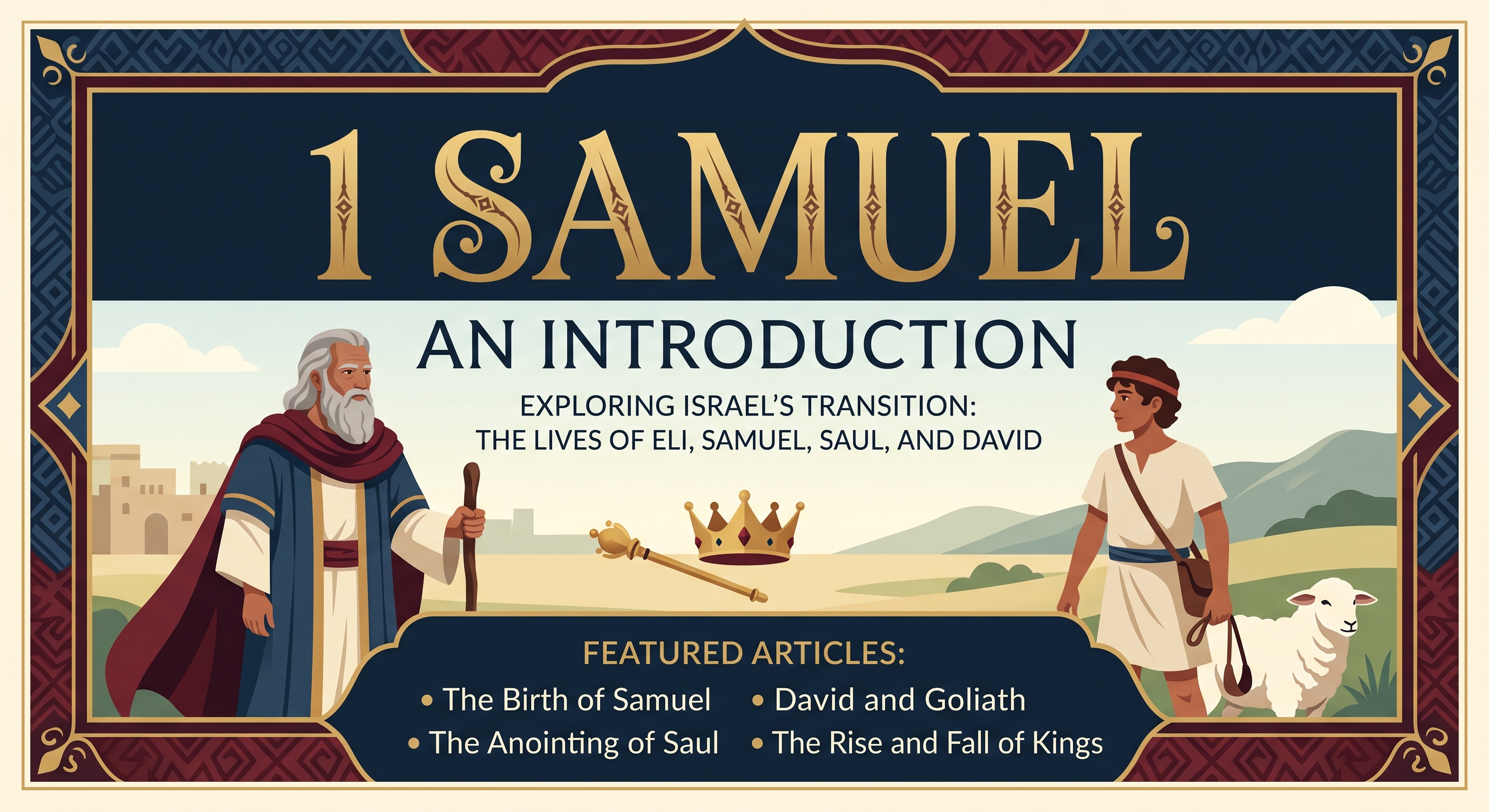
The book of 1 Samuel marks one of the great turning points in Israel’s history. It narrates the transition from the era of the judges, a period marked by tribal disunity and cyclical apostasy, to the establishment of the monarchy under Saul and the rise of David, the man after God’s own heart. The book takes its name from Samuel, the last of the judges and the first in the line of Israel’s prophets, whose life and ministry bridge two very different forms of national leadership.
In the Hebrew Bible, 1 and 2 Samuel originally formed a single scroll. The division into two books came later, first in the Greek translation known as the Septuagint, where the material was grouped together with 1 and 2 Kings under the title “Books of the Kingdoms.” The Hebrew tradition eventually adopted the twofold division as well, and it is the form in which the book has come down to readers today. Because of this shared origin, 1 Samuel cannot be read in isolation from 2 Samuel. The story that begins with Hannah’s prayer in the opening chapter reaches its fullest resolution only in the account of David’s reign that follows.
The book falls naturally into three movements. The first (1 Samuel 1–7) concerns Samuel’s birth, call, and ministry, set against the corruption of the priesthood at Shiloh and the loss and return of the ark of the covenant. The second (1 Samuel 8–15) narrates Israel’s request for a king, Saul’s anointing and early reign, and the gradual unraveling of his fitness to rule. The third (1 Samuel 16–31) follows the rise of David, from his private anointing by Samuel through his years as a fugitive from Saul’s jealousy, culminating in Saul’s death on Mount Gilboa.
MAIN ISSUES IN THE STUDY OF 1 SAMUEL
The Origin and Legitimacy of the Monarchy
Perhaps no theme runs deeper through 1 Samuel than the question of kingship. The book preserves what many scholars regard as two distinct evaluations of Israel’s request for a king: one that treats the request as a rejection of the Lord’s own kingship and therefore as sin, and another that treats the monarchy as a legitimate, even divinely sanctioned, response to Israel’s need for centralized leadership and military deliverance. The tension between these perspectives, most visible in the contrast between 1 Samuel 8 and 1 Samuel 9–11, has generated extensive discussion about the text’s sources and the theological point of view of its final editors.
The Composition History of the Book
Since the rise of historical criticism, scholars have debated how 1 Samuel reached its present form. Many have identified underlying sources, including a so-called “Ark Narrative” in chapters 4–6, a “History of David’s Rise” beginning around chapter 16, and various traditions about Saul that do not always fit together easily. The book is also widely regarded as part of the larger Deuteronomistic History, the extended narrative running from Joshua through 2 Kings that evaluates Israel’s history according to the theological standards of the book of Deuteronomy. Understanding 1 Samuel well requires some engagement with these compositional questions, even as readers continue to interpret the book in its finished, canonical shape.
The Character and Rejection of Saul
Saul is one of the Old Testament’s most tragic figures. Chosen by the Lord and initially endowed with the Spirit for the task of leadership, he nonetheless loses the kingdom through a series of failures, including his unauthorized offering at Gilgal and his incomplete obedience in the war against the Amalekites. Interpreters continue to wrestle with how to read Saul: as a man doomed almost from the outset by the narrative’s hostility toward him, or as a genuinely tragic figure whose failures, while real, are also framed by forces and expectations beyond his full control.
The Rise of David and the Question of Legitimation
The long central section of the book devoted to David’s flight from Saul has often been read as an apologetic composition, a narrative crafted to defend David against the charge that he seized the throne through treachery or rebellion. Attention to this apologetic dimension raises important questions about how ancient Israelite readers were meant to evaluate David’s repeated opportunities to kill Saul, his time among the Philistines, and the deaths of Saul’s rivals to the throne, several of which benefit David without ever implicating him directly.
Samuel as Prophet, Priest, and Judge
Samuel occupies an unusual place in Israel’s institutional history, functioning at different points as judge, priest, and prophet. His role in anointing both Saul and David, his intercession for the people, and his sharp confrontations with Saul over obedience have made him a central figure for discussions of the prophetic office and its relationship to kingship in ancient Israel.
The Ark Narrative and the Presence of God
The account of the ark’s capture by the Philistines, its disruptive presence among them, and its eventual return to Israelite territory (1 Samuel 4–6) raises important theological questions about divine presence, holiness, and sovereignty. The narrative insists that the LORD is not bound to the ark as a mere talisman of military success, a lesson Israel learned painfully at the battle of Aphek.
Historical and Archaeological Questions
1 Samuel is set during the transition from the Iron Age I to Iron Age II periods in the southern Levant, and its narratives intersect with ongoing archaeological and historical debates about the emergence of the Israelite state, the extent of Saul’s and David’s territorial control, and the reliability of the biblical portrait of an early, unified monarchy. These questions continue to generate vigorous scholarly discussion.
THEOLOGICAL THEMES
Beyond these historical and literary issues, 1 Samuel develops several enduring theological themes: the reversal of human expectation, expressed memorably in Hannah’s song (1 Samuel 2:1–10); the Lord’s freedom to choose the humble and unlikely over the strong and prominent; the danger of confusing outward appearance with divine favor, as in the contrast between Saul’s stature and David’s heart; and the seriousness with which the text treats obedience to the divine word, particularly in the narratives concerning Saul’s disobedience.
CONCLUSION
The posts collected here explore these and other issues as they arise across the narrative of 1 Samuel, moving from Hannah’s barrenness and prayer at Shiloh to Saul’s death on Mount Gilboa. Read individually, each post addresses a specific text or question. Read together, they trace the larger movement of the book: the passing of leadership from judges to kings, the rise and fall of Israel’s first king, and the Lord’s preparation of David, the king after His own heart, for the throne of Israel.
Did you find this study helpful?
If so, consider subscribing to Dr. Claude Mariottini’s Blog. Subscribers receive new posts on the Old Testament, biblical archaeology, and current issues in biblical studies delivered directly, so you never miss a study like this one.
I write for a global readership — currently spanning readers in 235 countries and territories — and your subscription helps this ministry of teaching continue to grow and reach even further.
If today’s post was meaningful to you, please share it with others on Facebook, X, or your platform of choice. A single share can introduce someone new to the study of God’s word.
Thank you for reading, and I look forward to sharing more with you soon.
STUDIES ON 1 SAMUEL
The Ark of the Covenant
The Ark of the Covenant and the Fall of Dagon
Hannah
Samuel: Lessons From a Remarkable Child – Broken Dreams
Samuel: Lessons From a Remarkable Child – Dedication
The Barren Has Borne Seven: A Mother’s Day Meditation
Samuel
Samuel: Lessons From a Remarkable Child – Broken Dreams
Samuel: Lessons From a Remarkable Child – Dedication
Samuel: Lessons From a Remarkable Child – Living Upstream
Samuel: Lessons From a Remarkable Child – Hearing God
Saul
How Long Did Saul Reign in Israel?
What Did Saul Think About Himself?
Translating the Bible: The Problem of Omitted Words
King Saul: Little in His Own Eyes
King Saul: Little in His Own Eyes
“I Have Rejected Saul” – Part 1
“I Have Rejected Saul” – Part 2
1 Samuel 28: The Medium of Endor – Part 1
1 Samuel 28: The Medium of Endor – Part 2
David
The Lord’s Anointed: Growing a Heart that Loves God
Goliath
Ancient Structures Found at Gath, the City of Goliath
The City of Gath, Goliath’s Residence
The City Where David Killed Goliath
David and Goliath as Metaphors
OTHER TOPICS
“Him that Pisseth against the Wall”
Him that Pisseth against the Wall – Part 2
The Election of a President: An Old Testament Perspective
Claude Mariottini
Emeritus Professor of Old Testament
Northern Baptist Seminary
If you enjoyed reading this post, you will enjoy reading my books.
VISIT MY AMAZON AUTHOR’S PAGE
BUY MY BOOKS ON AMAZON (Click here).
NOTE: Did you like this post? Do you think other people would like to read this post? Be sure to share this post on Facebook and share a link on X so that others may enjoy reading it too!
If you are looking for other series of studies on the Old Testament, visit the Archive section and you will find many studies that deal with a variety of Old Testament topics.