
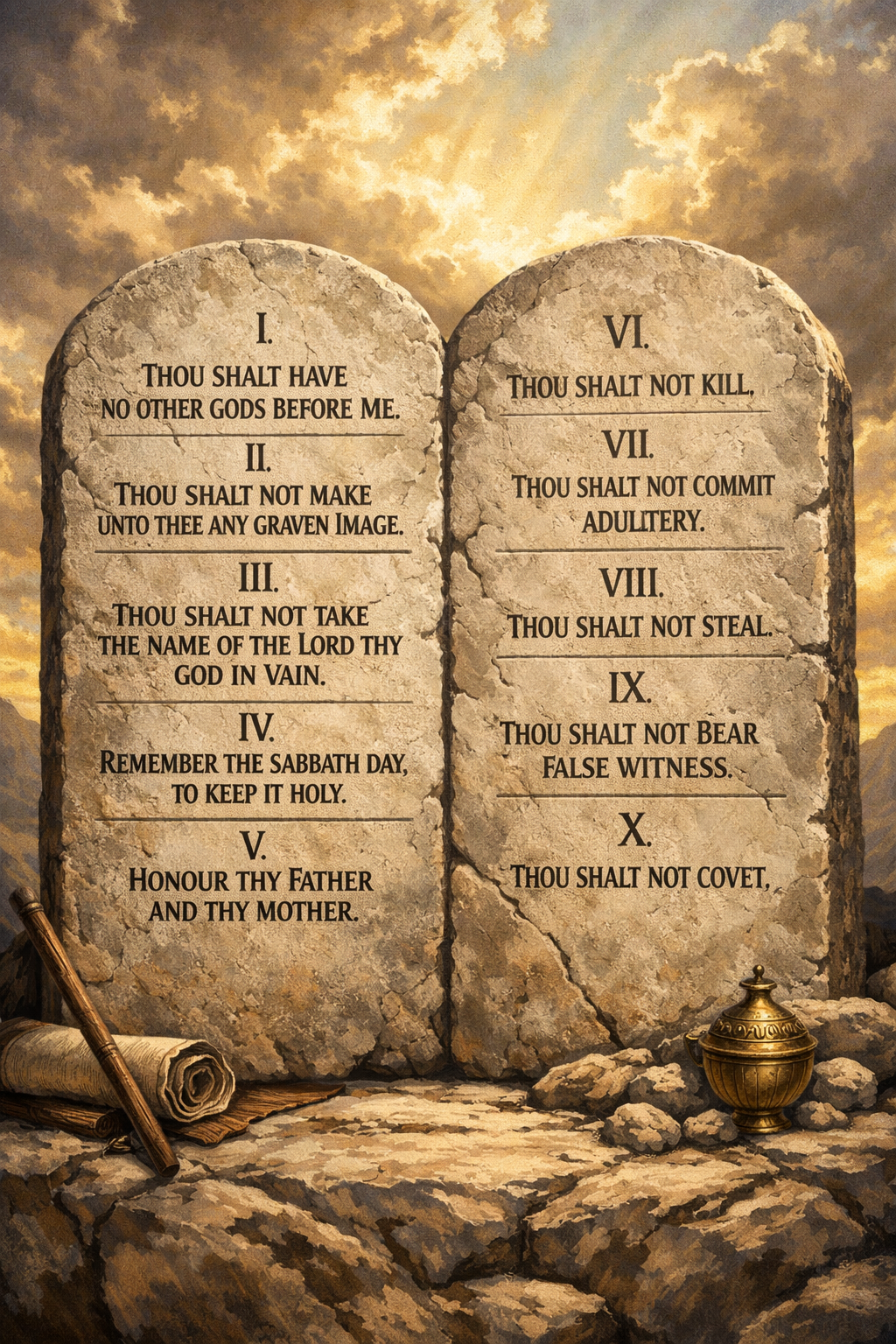
The Ten Commandments represent a fundamental set of divine laws that God gave to Israel through Moses on Mount Sinai. Known in Hebrew as the “Ten Words” and in Greek as the “Decalogue,” these commandments held such significance that in their original Hebrew form, each was expressed as a single word. According to the Old Testament, these laws were inscribed on two stone tablets by the finger of God himself, as recorded in both Exodus and Deuteronomy (Exod 31:18; Deut 9:10). When Moses broke the first tablets in response to Israel’s idolatry (Exod 32:19), God commanded him to prepare two new tablets, upon which the Lord rewrote the same commandments (Exod 34:1).
The Decalogue has been aptly called the Magna Carta of the social order, serving as the legal framework that regulated God’s covenant relationship with Israel. As Moses spent forty days and nights on Mount Sinai without food or water (Exod 34:28), God established these words as the foundation of His covenant with the nation. The influence of these ten laws has extended far beyond ancient Israel, shaping the religious, cultural, and legal traditions of countless nations throughout history. The Covenant served as Israel’s Constitution, with the Decalogue functioning as its Bill of Rights.
The First Commandment: Exclusive Devotion to God
“You shall have no other gods before me” (Exod 20:3) stands as the foundational commandment upon which all others rest. This prohibition against worshiping any deity except Yahweh established the fundamental principle of monotheistic devotion for Israel. The commandment meant that no other god could be worshiped in any place dedicated to Yahweh’s worship, and no other deity could make any claim upon an Israelite’s life or loyalty.
This exclusive relationship between God and His people was so important that Exodus 22:20 declared that anyone who sacrificed to any god other than the LORD must be destroyed. The First Commandment essentially demanded that Israel’s religious allegiance be undivided and absolute, rejecting the polytheistic practices common among surrounding nations and establishing the theological foundation for Israel’s unique identity as God’s chosen people.
The Second Commandment: No Graven Images
The Second Commandment, “You shall not make for yourself an idol” (Exod 20:4), prohibited the making of any idol or image, whether representing things in heaven above, on earth beneath, or in the waters below. This commandment went beyond simply forbidding the worship of other gods—it prohibited the creation of any physical representation of Yahweh himself. The invisible, transcendent God of Israel could not be reduced to a material form or confined to human artistic expression.
Additionally, this commandment extended to forbid the making of images to represent any other gods, as stated in Exodus 20:23: “Do not make any gods to be alongside me; do not make for yourselves gods of silver or gods of gold.” This prohibition distinguished Israel’s worship from the idol-centered religions of neighboring peoples and emphasized that God’s nature transcends physical representation. It protected the people from the temptation to worship the creation rather than the Creator and maintained the spiritual purity of their worship practices.
The Third Commandment: Reverence for God’s Name
“You shall not make wrongful use of the name of the LORD your God” (Exod 20:7) established the principle of treating God’s name with utmost reverence and respect. This commandment warned that the LORD would not hold guiltless anyone who misused His name, indicating the seriousness of this offense. The prohibition meant that God’s name could not be invoked frivolously, superfluously, or dishonestly in oaths and vows.
Beyond careless speech, this commandment also forbade using God’s name in magical practices, in curses intended to harm others, or in attempts to summon evil spirits. The name of God represented His character, authority, and presence among His people. To misuse His name was to show contempt for God himself. This commandment taught Israel that their relationship with God required reverent speech and that His holy name must be honored in every context where it was invoked.
The Fourth Commandment: Sabbath Rest
The Fourth Commandment called Israel to “Remember the Sabbath day by keeping it holy” (Exod 20:8) establishing a weekly rhythm of work and rest. For six days, labor was expected and appropriate, but the seventh day was consecrated as a Sabbath to the Lord. On this day, all work was prohibited—not just for the head of household, but for sons and daughters, servants, animals, and even foreigners living among them.
The rationale for this commandment differed slightly between Exodus and Deuteronomy. Exodus grounded the Sabbath in creation, noting that God made the heavens and earth in six days and rested on the seventh, blessing and making it holy (Exod 20:9–11). Deuteronomy, however, connected the Sabbath to Israel’s redemption from slavery in Egypt, reminding them that they were once enslaved with no rest, but God brought them out with a mighty hand and outstretched arm (Deut 5:13–15). Both versions emphasized rest as a divine gift and established a pattern that honored both creation and redemption, providing humanitarian protection for the vulnerable and regular time for spiritual renewal.
The Fifth Commandment: Honor for Parents
“Honor your father and your mother” (Exod 20:12) established the foundational principle for family relationships and social stability. This commandment came with a promise: that by honoring parents, children would live long in the land God was giving them. The prohibition extended beyond simple respect to forbid the cursing of one’s parents, which in ancient Israel was considered a capital offense.
The scope of this commandment encompassed two distinct applications. First, it required young people to show proper respect and obedience to parents who still held authority over them. Second, it obligated mature adults to honor and care for their aging parents, ensuring they were not abandoned or neglected in their old age. This commandment thus protected the integrity of the family unit across generations and established that the parent-child relationship carried lifelong obligations. By honoring this vertical family relationship, Israel would maintain social cohesion and ensure that wisdom and tradition passed faithfully from generation to generation.
The Sixth Commandment: The Sanctity of Life
“You shall not murder” (Exod 20:13) established the fundamental protection of human life within the covenant community. This commandment prohibited homicide committed with malice, recognizing that human life, created in God’s image, held sacred value that no individual could violate. The Hebrew word used here specifically referred to unlawful killing, distinguishing murder from other forms of taking life.
Importantly, this commandment also implied that even those who committed capital crimes could not be executed without proper legal procedures. This meant that personal vengeance, vigilante justice, or mob violence had no place in Israel’s society. Justice for serious crimes had to be administered through established legal channels, with appropriate investigation, witnesses, and judicial oversight. The Sixth Commandment thus protected not only innocent life but also established that even the guilty deserved due process, laying the groundwork for a justice system based on law rather than passion or personal retribution.
The Seventh Commandment: Sexual Purity
The Seventh Commandment, “You shall not commit adultery” (Exod 20:14), protected the sanctity of marriage and family relationships. Specifically, this law prohibited sexual union with a married or betrothed woman, recognizing that such acts violated the covenant of marriage and damaged the family structure that undergirded Israelite society.
Adultery was viewed as a serious offense because it represented betrayal of solemn vows, violated the rights of the wronged spouse, threatened the certainty of lineage and inheritance, and undermined the trust essential to stable family life. By protecting marriage from sexual infidelity, this commandment safeguarded the family unit as the basic building block of society. It emphasized that sexual intimacy was not merely a private matter but had profound social implications, and that the marriage covenant required faithfulness and exclusivity. This protection of marital fidelity helped ensure that children would be raised in stable homes and that property would pass to legitimate heirs.
The Eighth Commandment: Protection of Property
“You shall not steal” (Exod 20:15) established the inviolability of personal property and protected individuals from theft. This straightforward commandment recognized the right to private ownership and prohibited taking what belonged to another. The law covered all forms of theft, from small items to significant property, making clear that taking what was not rightfully one’s own violated both the victim and the community’s trust.
Beyond material property, the commandment likely also addressed the kidnapping of persons, which Exodus 21:16 specified as a capital offense. In the ancient world, kidnapping was the primary source of the slave trade, and stealing a person represented the ultimate form of theft—robbing someone of their freedom and very identity. By protecting both property and personhood, the Eighth Commandment established economic security and personal liberty as fundamental rights within the covenant community. It recognized that societal stability required respect for what belonged to others, whether possessions or freedom itself.
The Ninth Commandment: Truth in Justice
The Ninth Commandment, “You shall not bear false witness against your neighbor” (Exod 20:16), prohibited giving false testimony against one’s neighbor, directly addressing the integrity of the judicial system. In ancient Israel, where legal proceedings relied heavily on witness testimony, false witnesses could destroy innocent lives through their lies. This commandment protected individuals from malicious accusations, whether from a plaintiff bringing a fraudulent suit or from a witness providing perjured testimony.
Truth-telling in legal contexts was essential for justice to function properly. Without truthful testimony, the innocent could be punished while the guilty went free, property could be stolen through false claims, and the entire legal system would collapse into chaos. By prohibiting false witness, this commandment established that justice required honesty and that the community had a collective responsibility to ensure that legal proceedings reflected truth. It made clear that bearing false witness was not merely a lie but an attack on justice itself, potentially destroying reputations, taking property, or even costing lives through false accusations.
The Tenth Commandment: Guarding the Heart
The Tenth Commandment stands unique among the Decalogue in that it addresses internal desires rather than external actions: “You shall not covet your neighbor’s house… wife… or anything that belongs to your neighbor” (Exod 20:17). While the previous commandments could be enforced through observable behavior, this final commandment reached into the human heart, prohibiting the lustful desire to possess what belonged to another.
Coveting represented more than mere admiration or wishful thinking—it involved an intense desire that could lead to scheming to seize another person’s property or household members. This commandment recognized that external crimes like theft, adultery, and murder often began with internal covetousness. By condemning the inner desire and greed to take what belonged to another, this commandment addressed the root cause of many violations of the preceding laws. It established that God’s law governed not only actions but also attitudes, not only behavior but also the intentions of the heart. In doing so, the Tenth Commandment revealed that true righteousness required more than external compliance—it demanded internal transformation and contentment with what God had provided.
Conclusion
The Ten Commandments provided Israel with a comprehensive moral and legal framework that governed their relationship with God and with one another. The first four commandments established proper worship and reverence for God, while the final six regulated relationships within the community. Together, they formed a covenant constitution that shaped Israel’s identity as God’s people and influenced legal and moral systems throughout human history. These ancient laws continue to resonate today, reflecting timeless principles about divine authority, human dignity, justice, family, and the importance of both right actions and right attitudes. The Decalogue remains a testament to the enduring wisdom of divine law and its power to shape human society toward justice, compassion, and holiness.
Note: This study on the Ten Commandments was presented to the members of “Growing in Grace,” the senior Bible study group of The Compass Church in Naperville, Illinois, on December 21, 2025.
Claude Mariottini
Emeritus Professor of Old Testament
Northern Baptist Seminary
If you enjoyed reading this post, you will enjoy reading my books.
VISIT MY AMAZON AUTHOR’S PAGE
BUY MY BOOKS ON AMAZON (Click here).
NOTE: Did you like this post? Do you think other people would like to read this post? Be sure to share this post on Facebook and share a link on X so that others may enjoy reading it too!
If you are looking for other series of studies on the Old Testament, visit the Archive section and you will find many studies that deal with a variety of Old Testament topics.













 Dr. Claude Mariottini - Professor of Old Testament