With this post, I begin the study of Ezekiel 22. As I explained in the introduction to this series, the chapter contains three oracles, each introduced by the words “The word of the LORD came to me” (22:1, 17, 23). Part One of the series examines the first oracle, the indictment of Jerusalem in 22:1–16, together with the image of the smelting furnace in 22:17–22.
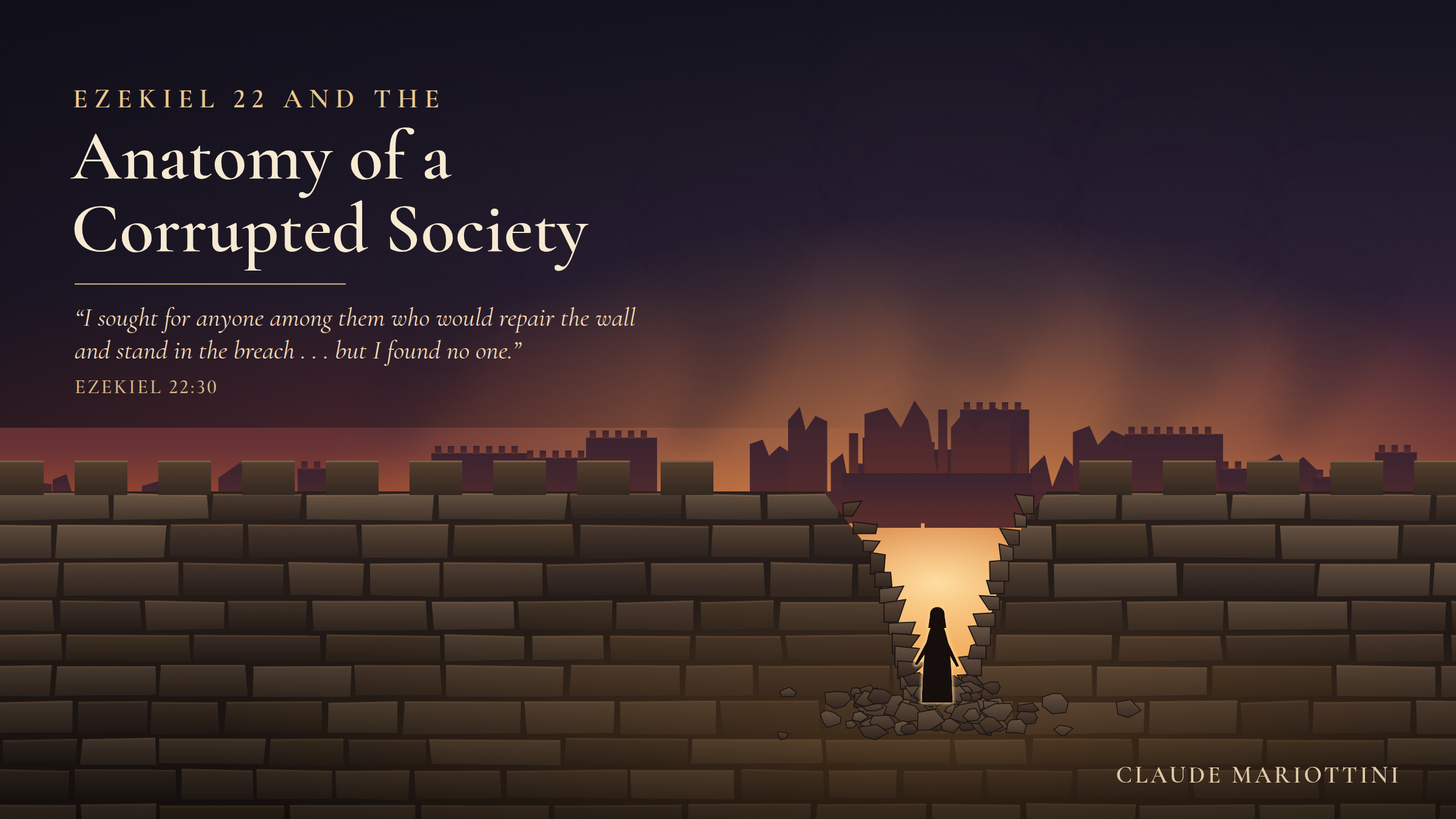
In this post, I examine the first five verses of the chapter. They are brief, but they set the terms for everything that follows. Before the prophet lists a single crime, God gives Jerusalem a new and shocking name: “the bloody city.” He also places Ezekiel in a courtroom, commanding him to “judge” the city and to declare to it “all its abominable deeds.” To understand these verses, we must ask what this name meant, where it came from, and why an exile living in Babylon was commanded to speak it over the city he loved. We must also ask how a chapter like this one should be read today. That question, as I will argue at the end of this post, must be settled at the very beginning.
The Text
¹The word of the LORD came to me: ²You, mortal, will you judge, will you judge the bloody city? Then declare to it all its abominable deeds. ³You shall say, Thus says the Lord GOD: A city! Shedding blood within itself; its time has come; making its idols, defiling itself. ⁴You have become guilty by the blood that you have shed, and defiled by the idols that you have made; you have brought your day near, the appointed time of your years has come. Therefore I have made you a disgrace before the nations, and a mockery to all the countries. ⁵Those who are near to you and those who are far from you will mock you, you infamous one, full of tumult. (Ezekiel 22:1–5, NRSV)
A Shocking Name for the Holy City
The oracle opens with a question that is really a command: “You, mortal, will you judge, will you judge the bloody city?” (22:2). Before Ezekiel names a single crime, God gives Jerusalem a new name. The Hebrew expression, ʿîr haddāmîm, means literally “city of bloods.” Daniel Block explains that the plural reflects “the dispersed stains/pools of blood, hence murder.”[1]
To feel the shock of this name, we must remember what Jerusalem meant to the people of Judah. Jerusalem was the city of David and the site of the temple. Israel’s worship celebrated Zion as “the city of our God,” “the joy of all the earth” (Ps. 48:1–2). The psalmist declared, “God is in the midst of the city; it shall not be moved” (Ps. 46:5). Pilgrims prayed for the peace of Jerusalem (Ps. 122:6–7). Now the prophet calls this city by a name that belongs to a murderer.
Commentators have noticed the force of this reversal. Peter Craigie writes: “The city that is still thought of today as the ‘Holy City’ is here described as the ‘bloody city’ (verse 2); the bloodthirsty deeds of its citizens had transformed the character of the city.”[2] Block puts it this way: “She who had been designated the holy city, the place of Yahweh’s residence and his temple, has become the locus of bloodguilt and idolatry.”[3]
Ezekiel was not the first prophet to describe such a reversal. More than a century earlier, Isaiah had lamented, “How the faithful city has become a whore! She that was full of justice, righteousness lodged in her—but now murderers!” (Isa 1:21). In my 1986 lesson, I wrote that “the city of peace has been transformed into a city of blood.” Isaiah and Ezekiel agree that Jerusalem’s problem was not simply that some murders had taken place within its walls. Something had happened to the character of the city itself. The place that should have displayed justice and righteousness had become known for bloodshed. Violence had become part of Jerusalem’s public identity.
Yet the two prophets differ in one important respect. Isaiah’s oracle ends with a promise: after God purges the city, “you shall be called the city of righteousness, the faithful city” (Isa 1:26). Ezekiel 22 offers no such renaming. The only new name Jerusalem receives in this chapter is “the bloody city,” and the only other names given to her come from the mocking nations: “you infamous one, full of tumult” (Ezek. 22:5). Ezekiel does hold out hope for Jerusalem, but that hope lies on the other side of judgment. Moshe Greenberg observes that for Ezekiel “the name of Jerusalem was so bound to impurity that in his vision of the restoration the city is renamed” as “YHWH is there” (Ezek. 48:35), the last words of the book.[4]
A Name Borrowed from Nineveh
The phrase “bloody city” was not Ezekiel’s invention. The prophet Nahum had used it against Nineveh, the capital of Assyria: “Ah! City of bloodshed, utterly deceitful, full of booty—no end to the plunder!” (Nah 3:1). Walther Zimmerli notes that when Nahum used this expression, he “had in mind the political brutality of Assyrian domination.”[5] For Ezekiel’s hearers, the name would have recalled the empire that had destroyed the northern kingdom of Israel and had terrorized Judah for more than a century.
By applying Nahum’s epithet to Jerusalem, Ezekiel places the holy city in shocking company. Block writes that the expression “is shocking, not merely for its characterization of Jerusalem, but also for the company into which it places the city.” By borrowing it, Ezekiel “invites a comparison of the crimes being perpetrated in the Judean capital with Assyria’s brutal treatment of conquered peoples.”[6 ]Margaret Odell identifies the crucial difference between the two prophets: “Where Nahum condemns Nineveh for its shedding the blood of its enemies, Ezekiel accuses Jerusalem of shedding the blood of its own people.”[7] Jerusalem had become to its own citizens what Assyria had been to the nations.
What kind of bloodshed did Ezekiel have in mind? Some of it was literal violence. G. A. Cooke observed that “the last days of Jerusalem were darkened by bloodshed,” including “the murder of children in the service of idols, and murders committed under the pretext of policy.”[8] Ezekiel had already declared that “the land is full of bloody crimes; the city is full of violence” (7:23), and he had accused the leaders of Jerusalem: “You have killed many in this city, and have filled its streets with the slain” (Ezek. 11:6).
But the bloodshed Ezekiel condemns in chapter 22 was not limited to street violence. Greenberg argues that the primary reference is to “‘judicial murder’—killing as an exercise of administrative power.”[9] The following list of crimes supports his reading. The first people named are “the princes of Israel,” who, “everyone according to his power, have been bent on shedding blood” (Ezek. 22:6). The list goes on to name slanderers and bribe-takers whose actions lead to the shedding of blood (Ezek. 22:9, 12). In Ezekiel’s Jerusalem, blood could be shed through the court, the marketplace, and the palace as easily as by the sword.
Zimmerli adds that “‘bloodguilt,’ in the priestly understanding, becomes a comprehensive category of guilt.”[10] The name “bloody city,” then, is not a rhetorical flourish detached from the rest of the chapter. It summarizes a whole way of life in which human life had become cheap.
“Will You Judge?”: The Prophet in the Courtroom
The doubled question, “will you judge, will you judge,” uses the language of the law court. The same form appears in Ezekiel 20:4, where the prophet is told, “Will you judge them, mortal, will you judge them? Then let them know the abominations of their ancestors.” A similar command opens chapter 16: “Mortal, make known to Jerusalem her abominations” (Ezek. 16:2). Block classifies the oracle as “a special form of judgment speech, known as the rîb, whose tone and style derives from the court setting.”[11] Greenberg notes that the repetition of the verb “bespeaks excitement.”[12] Craigie describes the scene well: “The prophecy is declared in a manner reminiscent of the law courts: Ezekiel, on behalf of God, is to declare to the city the catalogue of its crimes and the condemnation that must come.”[13]
Zimmerli sees in this command something characteristic of Ezekiel’s double identity. Ezekiel was a priest (Ezek. 1:3), and priests gave instruction about what was holy and what was common, what was clean and what was unclean. In Ezekiel 22, however, the prophet stands before the city as its accuser. Zimmerli contrasts “the office of the priest who gave instruction in ritual ordinances” with “the office of the priest-prophet making accusation.”[14] The priest who should have taught Israel how to live in God’s presence now declares that Jerusalem has become unfit for that presence.
What distinguishes chapter 22 from chapters 16 and 20 is its focus on the present. In chapter 16, Ezekiel told Jerusalem’s story through the allegory of an unfaithful wife; in chapter 20, he reviewed Israel’s rebellion from the days of Egypt onward. Chapter 22 offers no such review. Paul Joyce describes it as “entirely a contemporary rebuke, without historical survey.”[15] Writing in the nineteenth century, Patrick Fairbairn made the same observation: “Here, on the other hand, the prophet looks exclusively to the present, and brings out in fearful array the many heinous and rampant sins which were crying in Heaven’s ear for vengeance.”[16] The accusation does not concern the sins of the ancestors. It concerns what Jerusalem is doing now.
Greenberg also draws attention to the prophet’s repeated use of the expressions “in her midst” and “in you” throughout the oracle. These expressions, he writes, “convey the impression of the city as a receptacle, a sink, of impurity; foul deeds fester within it calling down punishment.”[17] The problem Ezekiel describes is internal. Jerusalem is not threatened primarily by enemies outside its walls. It is being defiled and destroyed from within.
To be Continued – Part 2.
Read the Whole Series: Ezekiel 22 and the Anatomy of a Corrupted Society
Claude Mariottini
Emeritus Professor of Old Testament
Northern Baptist Seminary
If you enjoyed reading this post, you will enjoy reading my books.
VISIT MY AMAZON AUTHOR’S PAGE
BUY MY BOOKS ON AMAZON (Click here).
NOTE: Did you like this post? Do you think other people would like to read this post? Be sure to share this post on Facebook and share a link on X so that others may enjoy reading it too!
If you are looking for other series of studies on the Old Testament, visit the Archive section and you will find many studies that deal with a variety of Old Testament topics.