Ezekiel: The Man and His Book
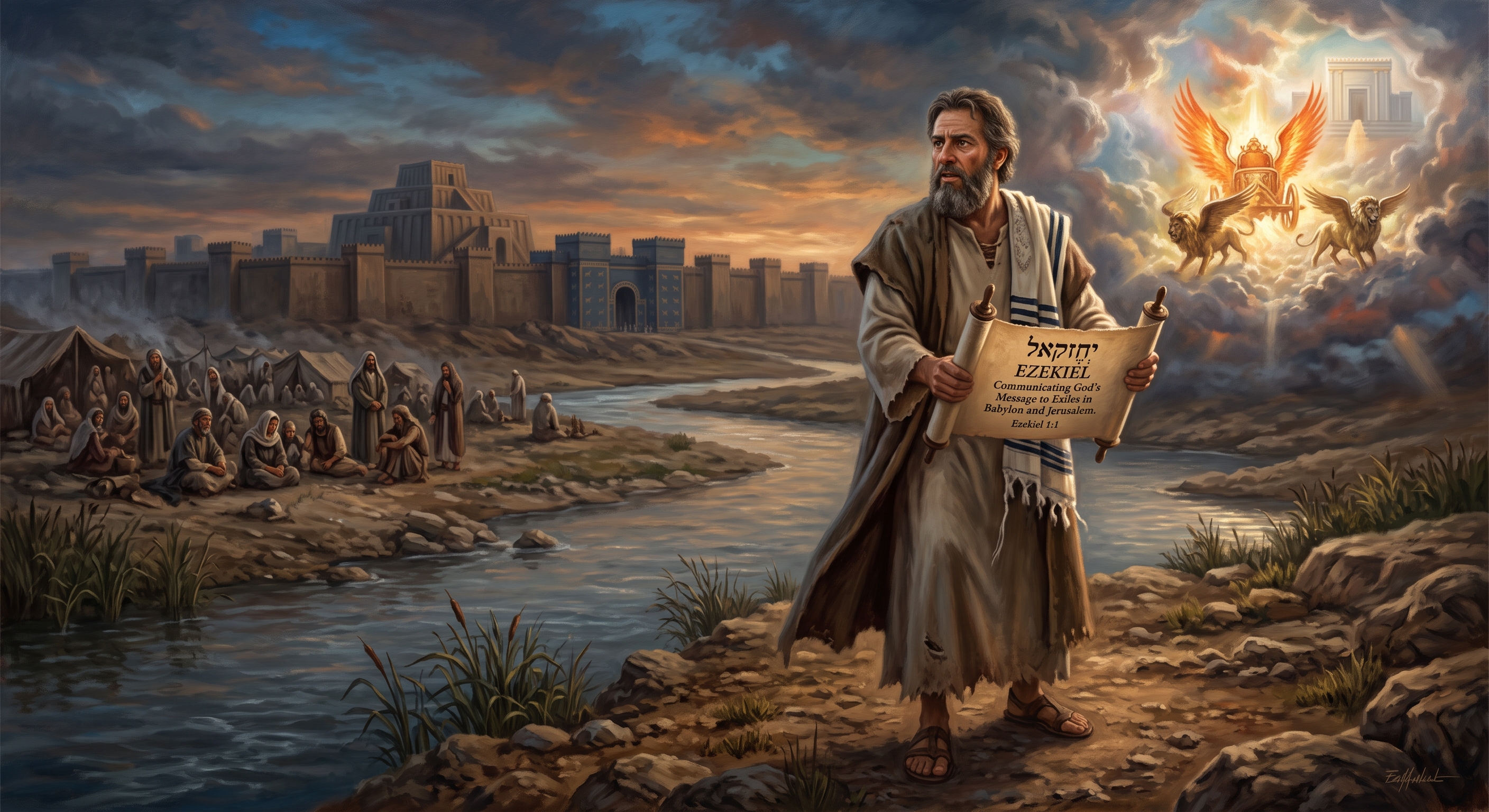
The book of Ezekiel is a fascinating book. The task faced by the prophet Ezekiel was to communicate a message to the people in Jerusalem and to the captives in Babylon. The people in exile were a community without a king, a holy people without a temple, and a nation without land. The mission of Ezekiel was to bridge the transition between pre-exilic faith and the demands of a new reality.
Ezekiel’s prophecies show the influence of Babylonian art, myths, and customs where he lived. His call comes in a vision while he was among the exiles. The strangeness of the visions shows unmistakably that Yahweh was present among the people in captivity.
Ezekiel was a priest, the son of Buzi, and he belonged to the generation of Judeans deported to Babylon in 597 B.C., along with King Jehoiachin, several years before the final destruction of Jerusalem in 587 B.C. As a priest, Ezekiel had intimate knowledge of the temple, its rituals, and its theology. This priestly formation shaped how he understood the crisis of exile and how he announced both judgment and hope to his fellow captives. He prophesied among the exiles who settled near the Chebar canal, a community that had lost every visible sign of Yahweh’s favor: the monarchy, the temple, and the land promised to their ancestors.
The book opens with one of the Old Testament’s most extraordinary visions. Ezekiel saw four living creatures, each with four faces and four wings, moving beside wheels within wheels, beneath a throne of sapphire from which the glory of Yahweh appeared in human form. This vision, often called the merkabah, or chariot vision, communicated a truth that the exiles desperately needed to hear: the God of Israel was not confined to the temple in Jerusalem. Yahweh could ride upon this heavenly chariot into a foreign land and appear to his people even in the territory of their captors. The vision reoriented Israel’s theology, moving the exiles away from a faith bound to one sanctuary and toward a faith in a God whose presence and sovereignty extended over the whole earth.
Ezekiel communicated his message not only in words but also in his own body. Yahweh commanded him to perform a series of symbolic acts that dramatized the fate awaiting Jerusalem: he lay on his side for extended periods to bear the sin of Israel and Judah, he shaved his hair and divided it to portray the destruction of the city and its inhabitants, and he prepared his food under conditions of ritual defilement to depict the hardships of the coming siege. At the death of his wife, he was forbidden to mourn in the customary way, so that his silence would itself become a sign to the exiles of the grief that awaited them. These enacted prophecies turned the prophet into a living parable, a man whose entire existence testified to the word he had been given to speak.
The book of Ezekiel divides naturally into four major sections. The first section, chapters one through twenty-four, contains oracles of judgment against Jerusalem and Judah, delivered before the city fell in 587 B.C. The second section, chapters twenty-five through thirty-two, contains oracles against the foreign nations that had mocked or exploited Judah in its distress. The third section, chapters thirty-three through thirty-nine, turns toward hope and restoration once news of Jerusalem’s fall reached the exiles; here the reader finds the vision of the valley of dry bones and the promise of a new heart and a new spirit. The fourth and final section, chapters forty through forty-eight, presents an elaborate vision of a new temple, a restored land, and a community reordered around the presence of God.
Several theological themes run through the entire book and continue to shape Christian and Jewish reflection today. Ezekiel repeatedly speaks of the glory of Yahweh, the kabod, which departs from the corrupted temple in chapters eight through eleven and returns to the new temple in chapters forty-three through forty-eight, framing the whole book as the story of God’s presence lost and regained. Ezekiel also insists, against the assumption that children suffer for the sins of their parents, that each person bears responsibility for his or her own conduct before God (chapter eighteen). And in the vision of the valley of dry bones (chapter thirty-seven), Ezekiel proclaims that Yahweh can restore a nation as lifeless as a valley of bones, breathing into it the same spirit that first gave life to humanity in the garden.
Ezekiel, the man and his book, stands as a witness to the resilience of Israel’s faith in its darkest hour. He took a people who believed that God could be worshiped only in Jerusalem and taught them that Yahweh reigns over every land, even Babylon. He took a people crushed by loss and taught them that God could give them a new heart, a new spirit, and a future. His strange visions and stranger acts were not eccentricities; they were the necessary language for a message that mere words could not fully carry. Ezekiel remains one of the most theologically creative voices in the Old Testament, and his book continues to reward careful, patient study.
I will be taking a few days off to do research for my new book. Setting time apart to read, study, and conduct careful research is essential to writing a book. A book of substance cannot be produced in the margins of a busy schedule; it requires sustained attention to primary texts, to the best of the secondary literature, and to the slow work of testing one idea against another until an argument takes a clear and defensible shape. Uninterrupted time allows a writer to follow a difficult question wherever it leads, to sit with ancient sources long enough to hear what they are actually saying, and to write with the kind of care that a reader deserves. I have always found that the quality of a book is determined as much by the discipline of the research that precedes it as by the writing itself, and so I am setting these days aside gladly, in the hope that they will bear fruit in the pages ahead.
I will be back on Wednesday, September 23. Then I will continue my series of studies on the book of Ezekiel. I have already published several essays on Ezekiel. To read these essays, read my post, “An Introduction to the Book of Ezekiel.”
As always, I am grateful that you read my posts. If you have not done so already, subscribe to my blog. Enter your email address to subscribe to this blog and receive notifications of new posts by email.
Claude Mariottini
Emeritus Professor of Old Testament
Northern Baptist Seminary
If you enjoyed reading this post, you will enjoy reading my books.
VISIT MY AMAZON AUTHOR’S PAGE
BUY MY BOOKS ON AMAZON (Click here).
NOTE: Did you like this post? Do you think other people would like to read this post? Be sure to share this post on Facebook and share a link on X so that others may enjoy reading it too!
If you are looking for other series of studies on the Old Testament, visit the Archive section and you will find many studies that deal with a variety of Old Testament topics.