The book of 2 Samuel continues, without interruption, the story begun in 1 Samuel. In the Hebrew canon, the two books were originally a single work, “Samuel,” and were divided only in the Greek translation (where they appear as 1–2 Kingdoms). That original unity is worth remembering, because 2 Samuel picks up precisely where 1 Samuel leaves off: with Saul dead on Mount Gilboa and David, the shepherd anointed in secret at Bethlehem, poised to become king in fact as well as in promise.
The book has no named author. Its material appears to draw on royal archives, prophetic records, and court traditions, some composed close to the events it describes, some shaped later within the larger Deuteronomistic History that runs from Joshua through Kings. What results is not a flattering royal chronicle but a remarkably candid history of David’s reign, one that records his triumphs and his sins with nearly the same unsparing honesty.
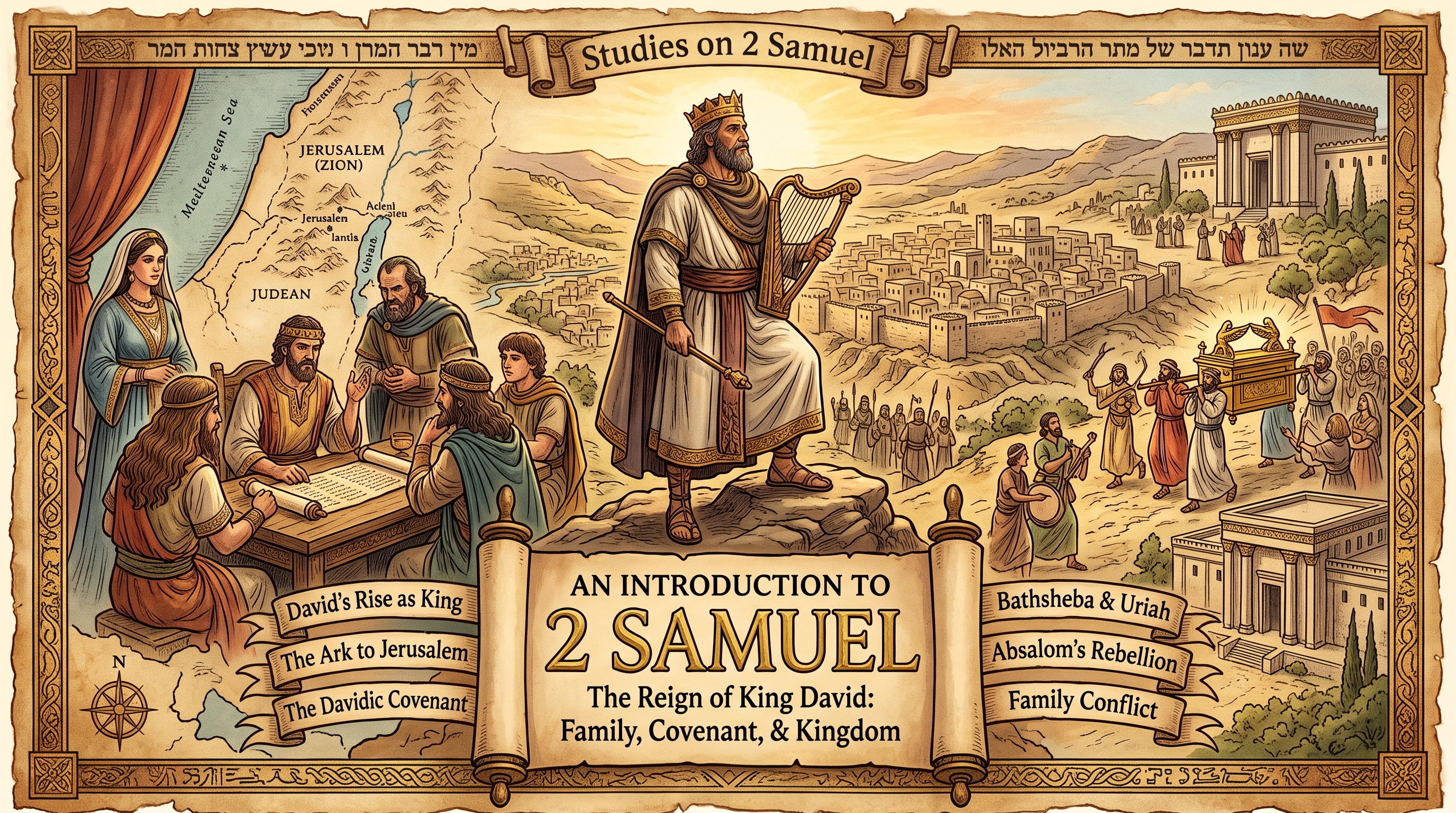
Structurally, 2 Samuel falls into three movements. Chapters 1–10 narrate the rise and consolidation of David’s kingdom: his accession first over Judah, then over all Israel, his capture of Jerusalem, and his early victories and covenant. Chapters 11–20, often called the “Court History” or “Succession Narrative,” turn from public triumph to private catastrophe, tracing the bitter family and political consequences of David’s sin with Bathsheba. Chapters 21–24 form an appendix of miscellaneous material, poems, lists, and narratives that steps outside strict chronological sequence to reflect on David’s reign as a whole.
Theologically, the book turns on a single hinge: the Davidic covenant announced in chapter 7. When David proposes to build God a house, Nathan the prophet reverses the offer: God will build David a house, an enduring dynasty, and establish David’s throne forever. This unconditional promise becomes the theological center not only of 2 Samuel but of the Old Testament’s developing hope for a coming king, later taken up by the prophets and, in Christian reading, by the New Testament’s portrait of Jesus as Son of David.
Yet the book refuses to let that promise obscure David’s failures. The narrator who records the covenant in chapter 7 is the same narrator who records adultery, murder, and family collapse a few chapters later, and lets the consequences play out at length. Second Samuel is, among other things, a sustained meditation on the coexistence of divine faithfulness and human sin, on how God’s covenant purposes advance not because David is righteous but despite his unrighteousness.
Main Historical and Theological Events
1. David’s profound mourning for Saul and Jonathan, highlighting loyalty, covenant faithfulness, and the refusal to rejoice over an enemy’s fall (2 Samuel 1).
2. David anointed king over Judah at Hebron, while Ish-bosheth, Saul’s son, reigns over the northern tribes (2 Samuel 2).
3. Civil war between the house of David and the house of Saul (2 Samuel 2–4).
4. David anointed king over all Israel; his conquest of Jebusite Jerusalem and its establishment as the political capital, the “City of David” (2 Samuel 5).
5. Philistine wars and campaigns against Moab, Ammon, Aram, and Edom, extending Israel’s borders (2 Samuel 5, 8, 10).
6. The Ark of the Covenant brought to Jerusalem, including the death of Uzzah and David’s dance before the ark (2 Samuel 6).
7. The Davidic covenant: Nathan’s oracle promising David an everlasting dynasty (2 Samuel 7).
8. David’s kindness to Mephibosheth, the remnant of Saul’s house (2 Samuel 9).
9. David’s adultery with Bathsheba and the murder of Uriah the Hittite (2 Samuel 11).
10. Nathan’s confrontation of David and the prophet’s parable of the poor man’s ewe lamb; David’s repentance (2 Samuel 12; compare Psalm 51).
11. The death of Bathsheba’s first child and the birth of Solomon (2 Samuel 12).
12. Amnon’s rape of Tamar and Absalom’s revenge (2 Samuel 13).
13. Absalom’s rebellion, David’s flight from Jerusalem, and Absalom’s death (2 Samuel 15–18).
14. David’s return to the throne and Sheba’s revolt (2 Samuel 19–20).
15. Appended material: the famine and the Gibeonites, the exploits of David’s mighty men, and David’s psalms of thanksgiving (2 Samuel 21–23).
16. David’s census, the plague that follows, and his purchase of Araunah’s threshing floor—the future site of Solomon’s temple (2 Samuel 24).
Running through these episodes are the book’s larger theological threads: the nature of covenant kingship, the reality of sin and its consequences even for the elect, the persistence of divine grace, and the first seeds of messianic hope that later prophets and, still later, the New Testament would take up and develop.
Did you find this study helpful?
If so, consider subscribing to Dr. Claude Mariottini’s Blog. Subscribers receive new posts on the Old Testament, biblical archaeology, and current issues in biblical studies delivered directly, so you never miss a study like this one.
I write for a global readership — currently spanning readers in 235 countries and territories — and your subscription helps this ministry of teaching continue to grow and reach even further.
If today’s post was meaningful to you, please share it with others on Facebook, X, or your platform of choice. A single share can introduce someone new to the study of God’s word.
Thank you for reading, and I look forward to sharing more with you soon.
STUDIES ON 2 SAMUEL
The Rise and Reign of David
Portraits of David
David: Celebrating God Wholeheartedly
The Davidic Covenant and the Messianic Hope
The Messianic Promise of the Old Testament
Bathsheba and the House of Uriah
Bathsheba and Her Menstrual Period
The Death of Bathsheba’s Child
Studies on the Death of Bathsheba’s Child
The Death of Bathsheba’s Child – Part 1
The Death of Bathsheba’s Child – Part 2
The Death of Bathsheba’s Child – Part 3
Tamar, Amnon, and the Wounds of David’s Family
Tamar: Raped, Abandoned, But Not Forgotten
Absalom’s Rebellion and the Death of Ahithophel
Rizpah and the Mothers of 2 Samuel
The Plight of Rizpah: A Mother’s Vigil of Love and Devotion
The Sons of Rizpah: Reflections on a Mother’s Love
David’s Court and the Institutions of the Kingdom
Rereading 2 Samuel 8:18: “David’s Sons Were Priests”
Forced Labor Under Solomon – Part 6
Goliath and the Champions of Gath
Archaeology and the World of David
A Fortress From the Time of David
Standing Stones in the Old Testament
Standing Stones – Returning to God
Reading and Translating the Text
Translating the Bible: The Problem of Untranslated Hebrew Words
The NIV and the TNIV: Two Bibles with Contradictory Views
Sherlock Holmes and the Old Testament
Claude Mariottini
Emeritus Professor of Old Testament
Northern Baptist Seminary
If you enjoyed reading this post, you will enjoy reading my books.
VISIT MY AMAZON AUTHOR’S PAGE
BUY MY BOOKS ON AMAZON (Click here).
NOTE: Did you like this post? Do you think other people would like to read this post? Be sure to share this post on Facebook and share a link on X so that others may enjoy reading it too!
If you are looking for other series of studies on the Old Testament, visit the Archive section and you will find many studies that deal with a variety of Old Testament topics.