
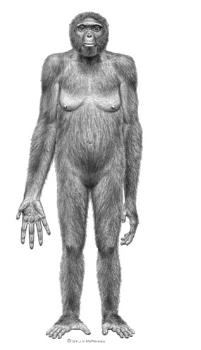
Ardipithecus Ramidus
Ardi Fossil Reconstruction
National Geographic News is announcing that scientists have found the oldest “human” skeleton which, according to the scientists involved in the discovery, refutes the view that there was a missing link in the evolutionary chain. Below is part of the report published by National Geographic:
October 1, 2009–In 1994 a research team led by Tim White of the University of California, Berkeley; Berhane Asfaw, former director of the National Museum of Ethiopia; and Giday WoldeGabriel of the Los Alamos National Laboratory announced the discovery of the first fossils of a new human ancestor, Ardipithecus ramidus. The researchers presented tantalizing evidence that the species was a biped living in woodland conditions more than a million years before the famous “Lucy” fossil of the species Australopithecus afarensis.
The research, to be published in an October 2, 2009, special issue of the journal Science, reveals that our earliest ancestors underwent a previously unknown phase of evolution, shedding new light on the nature of the last common ancestor of chimpanzees and humans.
An artist’s reconstruction of the face of Ardipithecus ramidus was made possible by a digital reconstruction of skull parts from two individuals. The face of “Ardi” did not project as much as those of modern apes, but was not as flat and massive as the later australopithecines. Researchers who studied the species suggest this difference is related to the small size of the species’ incisor teeth compared to those of chimps. Based on the relatively small size of its brow ridge and canine teeth, scientists suggest this fossil is of a female.
Other scientists disagree that Ardi is the fossils of a new human ancestor.
Esteban Sarmiento of the Human Evolution Foundation in East Brunswick, N.J., wrote in the new analysis that he’s not convinced Ardi belongs on the evolutionary tree branch leading to modern humans.
Instead, he said in an interview, he thinks it came along earlier, before that human branch split off from the ancestors of chimps and gorillas.
The specific anatomical features of teeth, the skull and elsewhere that the researchers cited just don’t make a convincing case for membership on the human branch, he argued. Some, like certain features in the wrist and where the lower jaw connects to the skull, indicate instead that Ardi arose before humans split off from African apes, he said.
The controversy between science and Scriptures is an issue that will not go away anytime soon. Scientists continue to affirm that there was an evolutionary process in which a common ancestor became the progenitor of all human beings. First it was “Lucy,” now it is “Ardi.”
Evolution also argues that through a process of descent, a basic common ancestor became the progenitor of all forms of life on Earth. Thus, evolution teaches that all forms of life on this earth are related: humans are related to oak trees, birds, and other animals. The evolutionary process excludes God from the process of bringing life into existence.
Christians believe that all forms of life on this earth are the work of a God who is the creator of the universe, and that human beings are a special creation of God, because human beings were created in the image and likeness of their creator.
Although scientists are saying that “Ardi”refutes the view that there was a missing link in the evolutionary chain, the Bible teaches us that there was a time when the beast became human and that time was when God “breathed into his nostrils the breath of life; and the man became a living being” (Genesis 2:7).
If there was evolution, God was involved in the process. Because Christians believe human beings were created in the image and likeness of God, human beings are different than the animals. And honestly, when I look at the recreation of “Ardi” above, I do not see any family resemblance.
Claude Mariottini
Emeritus Professor of Old Testament
Northern Baptist Seminary
NOTE: Did you like this post? Do you think other people would like to read this post? Be sure to share this post on Facebook and share a link on Twitter or Tumblr so that others may enjoy reading it too!
I would love to hear from you! Let me know what you thought of this post by leaving a comment below. Be sure to like my page on Facebook, follow me on Twitter, follow me on Tumblr, Facebook, and subscribe to my blog to receive each post by email.
If you are looking for other series of studies on the Old Testament, visit the Archive section and you will find many studies that deal with a variety of topics.














 Dr. Claude Mariottini - Professor of Old Testament