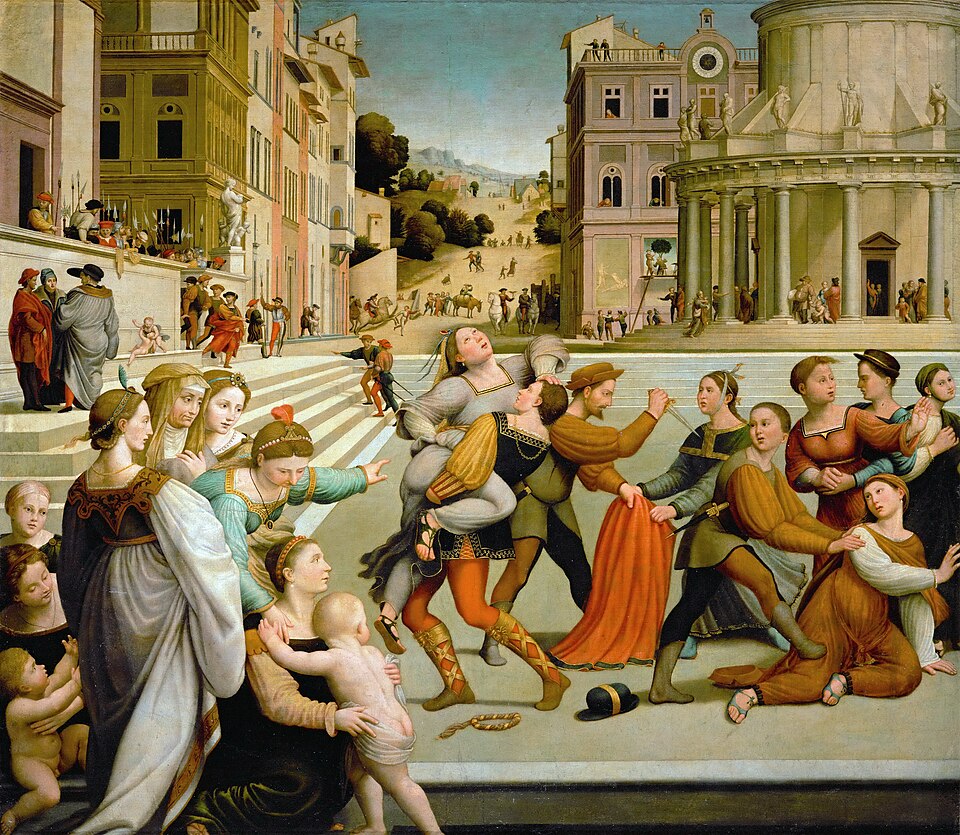
Rape of Dinah
By Giuliano Bugiardini (b. 1475)
Public Domain, Wikipedia Commons
The Text
“Now Dinah the daughter of Leah, whom she had borne to Jacob, went out to visit the women of the region. 2 When Shechem son of Hamor the Hivite, prince of the region, saw her, he seized her and lay with her by force. 3 And his soul was drawn to Dinah daughter of Jacob; he loved the girl, and spoke tenderly to her. 4 So Shechem spoke to his father Hamor, saying, ‘Get me this girl to be my wife.’” (Genesis 34:1–4 NRSV).
Dinah Goes Out
Dinah’s story opens with a deceptively simple statement: “Now Dinah the daughter of Leah, whom she had borne to Jacob, went out to visit the women of the region” (Gen 34:1). This single verse has generated considerable interpretive controversy because Dinah’s act of going out has sometimes been read as reckless, immodest, or even morally culpable. One Jewish commentator said that her going out was evidence of immodesty, as though her movement through public space implicitly invited the violence that followed.
Such interpretations, however, reflect the anxieties of a patriarchal culture far more than they illuminate the text itself. The Hebrew verb “to go out” is a perfectly ordinary word for movement and carries no intrinsic moral connotation. The phrase “to visit” or “to see” the women of the land describes nothing more than a young woman seeking social connection with her female contemporaries. Jacob’s family had recently settled near the city of Shechem (Gen 33:18–20), and Dinah, living in a newly established household in an unfamiliar territory, would have had every natural reason to seek out the company of other women. Her action was not reckless; it was simply human.
What the text reveals in this opening verse, however, is more than Dinah’s own motivation. It reveals the vulnerability that attended ordinary female life in the ancient world. Women in ancient Israel moved through social space under constant risk, not because of any inherent moral deficiency on their part, but because of the social and legal structures of a patriarchal society in which a woman’s body was, in practice, the property of her father until it became the property of her husband. Dinah’s going out was not an act of rebellion or immorality. It was simply an ordinary act of sociality that exposed her to an extraordinary act of violence.
Dinah’s Encounter with Shechem
Genesis 34:2 records the encounter between Shechem and Dinah in stark and disturbing language: “When Shechem son of Hamor the Hivite, prince of the region, saw her, he seized her and lay with her by force.” The Hebrew of this verse employs three verbs in rapid succession—“he took”; “he lay with”; and “he humiliated” or “he violated.” These words together constitute the Hebrew idiom for sexual assault. The Hebrew verb translated “humiliated” carries the clear sense of coercive violation. The emphasis that the humiliation was done “by force” makes the coercive nature of the act explicit: it was rape.
Some scholars have attempted to soften the reading of Genesis 34:2 by arguing that the subsequent verses, which describe Shechem’s love and desire for Dinah, complicate any simple reading of the event as rape. Verse 3 states that “his soul was drawn to Dinah daughter of Jacob; he loved the girl and spoke tenderly to her.” The phrase “spoke tenderly to her” (literally, “spoke upon her heart”) is sometimes cited as evidence of a more complex emotional reality. However, the appearance of affection after the fact does not retroactively transform a coercive act into a consensual one. The narrative sequence is unambiguous: seizure and violation precede any expression of affection. The love described in verse 3 is the love of a man who has already taken what he wanted; it is desire expressed after the fact, not a relationship established by mutual consent.
The text, therefore, does not leave genuine ambiguity about the nature of the initial encounter. What it does leave ambiguous, and what is equally important for understanding Dinah’s situation, is everything that follows. After the assault, Dinah remains in Shechem’s house. She does not flee. She does not appear again until verse 26, when Simeon and Levi take her out. The text offers no explanation for her continued presence, and this silence is itself theologically and socially significant
Dinah in Shechem’s House
One of the most significant features of Genesis 34 is that Dinah is never brought home after the assault. She remains in Shechem’s house throughout the entire negotiation between the men of the two families. Jacob learns of the violation and “held his peace” until his sons returned from the field (v. 5). The brothers come home, are furious, and begin a negotiation with Hamor and Shechem about the terms under which the matter might be settled (vv. 6–17). Nowhere in this negotiation does anyone ask Dinah what she wants. Nowhere does anyone go to bring her home before the terms are settled.
Why did Dinah remain in Shechem’s house? The text does not say. Three possibilities present themselves, and the deliberate silence of the narrator refuses to privilege any one of them definitively.
First, it is possible that Dinah was held against her will, effectively a prisoner in Shechem’s house, and that her continued residence there was an extension of the coercion that began with the assault itself. Second, it is possible that, having been violated, Dinah had nowhere safe to go—that returning to her father’s house as a woman who had lost her virginity outside of marriage would have exposed her to social consequences scarcely less devastating than her current situation. Third, and most uncomfortably for modern readers, it is possible that Shechem’s subsequent tenderness had created some form of emotional bond, however complex and compromised its origins.
The text, by its silence, denies us the comfort of a clean answer. And this denial is itself a form of honesty about the reality of women’s lives in the ancient world. Dinah’s inner life is inaccessible not because the narrator forgot to include it, but because in the world the narrative reflects, Dinah’s inner life was socially irrelevant. What mattered was not what Dinah thought or felt or wanted, but what the men around her decided to do. Her silence in the text is not an accidental omission; it is a faithful representation of her social invisibility in the world of ancient Israel.
Shechem’s Desire for Marriage
Shechem’s desire to marry Dinah is presented in the text with some degree of sincerity. Verse 3 describes his love for her, and verse 4 records that he asked his father Hamor to arrange the marriage: “Get me this girl to be my wife.” Verse 8 reiterates Hamor’s report to Jacob and his sons that “My son Shechem longs for your daughter; please give her to him in marriage.”
Shechem himself, in verse 11, addresses Jacob and the brothers directly: “Let me find favor with you, and whatever you say to me I will give. Put the marriage present and gift as high as you like, and I will give whatever you ask me; only give me the girl to be my wife.”
On the surface, this desire for marriage might appear to mitigate the severity of what Shechem had done. In the ancient Near Eastern legal context, a man who had violated an unbetrothed virgin was required to pay the bride price and marry her.
The ancient legal framework that required marriage after rape was not designed to protect the victim; it was designed to protect the economic interests of her father, whose property (the bride’s virginity) had been damaged without compensation. Shechem’s desire to marry Dinah does not erase or even substantially address the fact that his initial act was coercive. Marriage to one’s rapist, however normalized in the ancient world, is not justice for the rape victim.
His appeal to Hamor is not “Consult Dinah and ask whether she wishes to marry me” but rather “Get me this girl.” She is the object of desire, not a subject with whom desire is to be negotiated. His tenderness toward her may be genuine within the framework of his cultural world, but it is a tenderness that does not recognize her as an agent with the right to accept or refuse.
The Dishonorable Actions of the Brothers
Simeon and Levi’s response to the violation of their sister has often been described as an act of righteous vengeance, and there is a sense in which it is motivated by genuine anger at a genuine wrong. But a careful reading of the text reveals that their actions are, in important respects, dishonorable in their own right, and that their conception of justice is one in which Dinah’s own interests are entirely secondary to their wounded pride.
The brothers’ stratagem is deceptive. They agree to the circumcision requirement in bad faith, “because he had defiled their sister Dinah” (v. 13), with the explicit intent to use the period of convalescence to carry out a massacre (v. 25). Jacob’s rebuke of Simeon and Levi in verse 30 focuses entirely on the practical political dangers their actions have created: “You have brought trouble on me by making me odious to the inhabitants of the land.” In the final exchange of the chapter, the brothers justify their actions with the rhetorical question: “Should our sister be treated like a prostitute?” (v. 31). This closing question is the only moment in the entire chapter in which Dinah is treated as a person with dignity worth defending, but even here, the indignation is framed in terms of the brothers’ honor, not Dinah’s person.
Moreover, the massacre of the Shechemites, however morally comprehensible as an act of rage at the violation of a family member, kills every man in the city (v. 25), including those who bore no personal responsibility for Shechem’s act. The subsequent plundering of the city (vv. 27–29), which involves the taking of “their flocks and their herds and their donkeys” and the capture of “their little ones and their wives,” is explicitly noted as an act of all the brothers, not merely Simeon and Levi.
The women of Shechem—who, like Dinah, had no agency in the events that led to the massacre—are themselves now reduced to war captives. The cycle of violence that began with Shechem’s violation of Dinah ends with the brothers committing their own acts of violence against women who had no voice or power in the matter.
Most tellingly, the brothers’ actions never consult Dinah. There is no moment in the narrative where Simeon or Levi asks Dinah whether she wishes to be “rescued” from Shechem’s house, whether she wished to marry Shechem, or what kind of resolution she herself desired. When Simeon and Levi “took Dinah out of Shechem’s house and went away” (v. 26), the language is identical to the possessive seizure that characterized Shechem’s initial act: she is taken, not consulted. One violation is answered with another form of taking, and the woman at the center of it all is moved from location to location by the decisions of men, without ever being granted the dignity of a voice.
Conclusion: Honor, Shame, and the Economics of the Female Body
The entire social logic of Genesis 34 is related to the ancient concept of honor and shame system. In this system, honor was a public, social reality that attached to families and to male household heads, and shame was the consequence of acts that violated the community’s expectations of proper social behavior. A woman’s sexual purity was not conceived primarily as her own personal asset; it was a component of her family’s honor, managed by the male household head and transferred intact to a husband upon marriage.
When Shechem violated Dinah, the harm that the text registers most explicitly is not the harm to Dinah but the harm to the brothers’ sense of honor. Verse 7 states that the brothers were “indignant and very angry, because he had committed an outrage in Israel by lying with Jacob’s daughter, for such a thing ought not to be done.”
The brothers’ anger is real, and their sense of violation is understandable within their cultural framework. But their framing of the event is telling: Shechem “made their sister a prostitute” (v. 31, literally “treated our sister as a prostitute”), language that places the shame squarely on Dinah’s compromised social status rather than on her suffering as a person.
The negotiations between Hamor and the brothers proceed entirely on the terrain of economic and social exchange. Hamor proposes intermarriage between the two peoples and mutual sharing of the land (vv. 9–10). Shechem offers an unlimited bride price (vv. 11–12). The brothers counter with the demand for circumcision (vv. 14–17). Nowhere in this extended negotiation does Dinah’s welfare, her desires, or her emotional state appear as a consideration. She is the occasion for the negotiation, not a participant in it. She has been reduced, in the logic of the honor-shame economy, to a unit of social currency.
NOTE: The story of Dinah is one of the many story of abused women in the Old Testament. For other stories of abused women in the Old Testament, read my book, Ancient Israel’s Women of Faith: A Survey of the Heroines of the Old Testament.
CHECK OUT MY NEW BOOK. Click here: Praying the Psalms: Finding Your Voice in Israel’s Prayer Book.
Claude Mariottini
Emeritus Professor of Old Testament
Northern Baptist Seminary
If you enjoyed reading this post, you will enjoy reading my books.
VISIT MY AMAZON AUTHOR’S PAGE
BUY MY BOOKS ON AMAZON (Click here).
NOTE: Did you like this post? Do you think other people would like to read this post? Be sure to share this post on Facebook and share a link on X so that others may enjoy reading it too!
If you are looking for other series of studies on the Old Testament, visit the Archive section and you will find many studies that deal with a variety of Old Testament topics.