
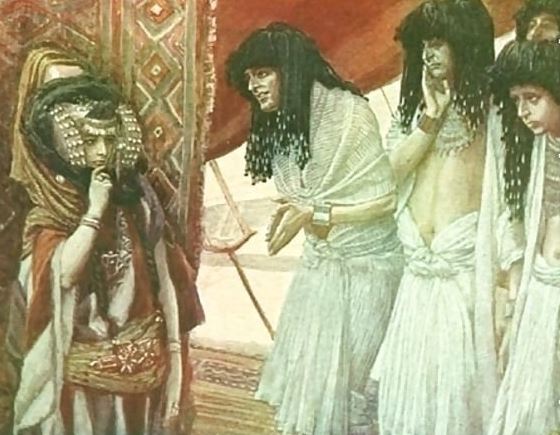
The Egyptians Admire Sarah’s Beauty
by James Tissot
The story of Abraham’s descent into Egypt, recorded in Genesis 12:10–20, stands as one of the most morally troubling episodes in the entire patriarchal cycle. Coming so swiftly on the heels of the great divine call in which God promised Abraham land, posterity, and blessing for all nations (Gen. 12:1–3), the Egyptian sojourn reveals the patriarch not as a towering figure of faith but as a man whose trust in God collapsed under the pressure of circumstance. It is a story of spiritual failure, marital betrayal, and providential rescue, in which the promise itself teetered on the edge of annihilation while Sarah, the woman at the center of God’s redemptive design, was handed over to a foreign king and absorbed into a royal harem. The hero of this account, if there is one, is not Abraham. It is God.
The Failure of Trust: Abraham’s Descent
The narrative opens with famine, a test of precisely the kind God’s people will face again and again throughout the biblical story. Abraham had received extraordinary promises. God had told him to go to the land of Canaan, and that land had been designated as the inheritance of his descendants (Gen. 12:7). The very ground beneath his feet was meant to be a statement of faith: I am here because God brought me here. Yet when famine struck, Abraham did not inquire of the LORD. He did not pray. He did not wait. He went down to Egypt.
The verb is telling. In the biblical imagination, to “go down” to Egypt is rarely a neutral act. Egypt represents the world in its self-sufficiency, a land of human provision that does not depend on rain from heaven (Deut. 11:10–11), a civilization that built its security on the Nile rather than on divine promise. When Abraham chose Egypt over trust, he was not simply making a geographic decision. He chose the certainty of Egyptian grain over the uncertainty, as he perceived it, of divine provision. The man whom God had called to be a blessing to all families of the earth (Gen. 12:3) was already retreating from that vocation before he had barely begun.
This failure to trust God is not peripheral to the story. It is its engine. Every subsequent catastrophe, Sarah’s humiliation, the danger to the promise, the expulsion of Abraham from Egypt, flows directly from this single act of faithless pragmatism. Abraham went down because he did not believe God was adequate to the crisis.
The Scheme: Sarah Offered as a Shield
As Abraham approached the Egyptian border, his anxiety crystallized into a plan, and what a plan it was. He turned to his wife and said: “I know that you are a woman beautiful in appearance, and when the Egyptians see you, they will say, ‘This is his wife.’ Then they will kill me, but they will let you live. Say you are my sister, that it may go well with me because of you, and that my life may be spared for your sake” (Gen. 12:11–13).
The candor of the text is devastating. Abraham did not disguise his motives. He stated them plainly: that it may go well with me … that my life may be spared for your sake. He was not proposing to protect Sarah. He was proposing to use her. She was to become the instrument of his survival, the price of his safety. His life, he calculated, could be purchased at the cost of her honor.
The half-truth at the heart of the scheme, Sarah was, in fact, his half-sister (Gen. 20:12), only deepens its moral ugliness. It was a deception crafted to produce a specific result: that Abraham would be welcomed in Egypt while Sarah’s status as a wife, and therefore as a woman under the protection of a husband, would be concealed. The plan was designed to make Sarah available.
What is most striking in the text is Sarah’s silence. The narrator records no protest, no negotiation, no refusal. Whether her silence indicates consent, submission, or the quiet devastation of a woman with no recourse within the social structures of her world, the reader cannot know with certainty. What is certain is that Abraham spoke, and Sarah complied. The woman who would one day be called the mother of nations was being positioned as an acquisition.
Sarah Taken: The Royal Harem and the Danger to the Promise
The prediction proved accurate with terrifying speed. “When Abram entered Egypt, the Egyptians saw that the woman was very beautiful. And when the princes of Pharaoh saw her, they praised her to Pharaoh. And the woman was taken into Pharaoh’s house” (Gen. 12:14–15).
The passive construction is chilling: the woman was taken. Sarah had no voice in this transaction. She was seen, reported upon, commended to a king, and taken, all in the sweep of a single verse. The machinery of royal acquisition ground forward without pause or complication, because Abraham had removed the one legal and social barrier that might have given Pharaoh reason to hesitate. A married woman was untouchable. A sister was available.
The text then records a detail of enormous significance: “And for her sake he dealt well with Abram; and he had sheep, oxen, male donkeys, male servants, female servants, female donkeys, and camels” (Gen. 12:16). This is not an incidental detail. In the ancient Near East, the transfer of substantial property from a man’s household to the household of a prospective bride’s family, or in this case, her brother, was the mohar, the bridal price. It was the payment that sealed a marriage. What Abraham received was not a gift of hospitality. It was a bride price. Pharaoh was paying for Sarah.
This means the transaction was legal, formal, and complete by the standards of the ancient world. Sarah had been given to Pharaoh as a wife. She was no longer simply in his house as a guest or a concubine awaiting a decision. The economic exchange had finalized her status. And Abraham, standing in his growing wealth of sheep and oxen and camels and servants, had received the payment. He had sold his wife. He had taken the mohar and said nothing.
The crisis this transaction created was not merely personal or domestic. It was eschatological. Everything God had promised depended on Sarah bearing Abraham’s son. The covenant child, the one through whom all nations would be blessed, the one through whom the land promise would be fulfilled, the one through whom the great redemptive story of Israel would unfold, could only be born of these two people together. If Sarah conceived a child by Pharaoh, the lineage of the promise would be corrupted at its source, or the promise would be delayed, or it would belong to a people it was never intended for. The scheme that Abraham devised to save his life had placed the entire future of salvation history in jeopardy.
Sarah’s Humiliation: The Weight of What the Text Does Not Say
The narrative of Genesis 12 is famously restrained at precisely the point where the reader most wants to know what happened. The text does not tell us how long Sarah remained in Pharaoh’s house. It does not tell us what she endured. It does not record her prayers, her tears, her fear, or her grief. It says only that she was taken, and that God struck Pharaoh’s house with plagues “because of Sarai, Abram’s wife” (Gen. 12:17).
That silence is itself eloquent. The ancient world did not sentimentalize the experience of women absorbed into royal harems. Sarah’s situation was one of profound vulnerability. She was a foreign woman, separated from her husband, who was at this moment her false brother, in the household of the most powerful man in Egypt. She had no protector, no advocate, no legal status as a wife. She had been reduced, by Abraham’s design, to an object of royal desire and an instrument of diplomatic acquisition.
Her humiliation was total. It was not merely physical, though the text’s silence on that score is itself ominous, but social, relational, and spiritual. The man who had promised to walk with her through the journey of faith had traded her for livestock. The God who had made her part of a covenant she may not yet have fully understood had not visibly acted on her behalf. She was alone in a foreign palace, beautiful and helpless, while her husband prospered on the bridal price he had accepted for her.
Abraham, by contrast, was doing well (Gen. 12:16). He was accumulating wealth. He was safe. The scheme was working — for him. The life he had sought to save was preserved, and the cost of its preservation was borne entirely by Sarah.
God Intervenes: The Rescue Abraham Did Not Provide
The rescue, when it came, came not from Abraham but from God, and God’s instrument was not the patriarch but the plague. “But the LORD afflicted Pharaoh and his house with great plagues because of Sarai, Abram’s wife” (Gen. 12:17). The divine name, Yahweh, appears here for the first time in the Egyptian narrative, conspicuous precisely because it has been absent. God had not been consulted. God had not been invoked. God had not been trusted. Yet God acted.
How Pharaoh came to understand the connection between the plagues and Sarah is not explained. Perhaps through dreams, perhaps through divine communication, perhaps through the word of his court, the text preserves a mystery. What the text does record is Pharaoh’s response, which is one of the most ironically dignified speeches in all of Genesis. “What is this you have done to me? Why did you not tell me that she was your wife? Why did you say, ‘She is my sister,’ so that I took her for my wife? Now then, here is your wife; take her, and go” (Gen. 12:18–19).
The pagan king was more forthright than the patriarch. Pharaoh had been deceived, and he knew it, and he said so. He asked the questions the text itself has been asking: “Why did you not tell me?” Why did you lie? Abraham had no recorded answer. The silence of the patriarch at this moment is the moral verdict of the narrator. There was nothing to say.
The final action of Pharaoh seals the nature of what had occurred. He did not merely ask Abraham to leave. He commanded it, and he enforced it with authority: “And Pharaoh gave men orders concerning him, and they sent him away with his wife and all that he had” (Gen. 12:20). Abraham was expelled from Egypt under royal escort. Pharaoh’s men accompanied the patriarch to the border, not as an honor guard but as enforcers of a royal edict. The man who had gone to Egypt to survive had been marched out of it by an army. The man who had feared the Egyptians would kill him for his wife had instead been publicly shamed by their king and removed from the country under military supervision.
He left with his wife restored, his livestock intact, and his reputation in ruins, though only the first of those three things truly mattered.
The Promise Preserved: Grace in Spite of Abraham
What the Egyptian episode ultimately discloses is not the strength of Abraham’s faith but the tenacity of divine grace. God had made promises to a man who proved, within the first test of those promises, that he could not be trusted to protect them. Abraham had failed to trust God with his safety. He had failed to protect his wife. He had failed to preserve the integrity of the covenant lineage. He had taken the bride price and said nothing.
And yet the promise held. Sarah was returned. The child who would be born was not Pharaoh’s. The lineage that would run from Abraham through Isaac and Jacob and eventually to the one in whom all nations would find their blessing remained intact, not because of Abraham’s faithfulness, but in spite of his failure.
Sarah, for her part, emerges from this narrative as a figure of profound pathos. She is the one who suffered for Abraham’s cowardice. She is the one whose name Pharaoh finally spoke, Abram’s wife, restoring to her the identity that Abraham himself had stripped away. She is the one whose plight God acknowledged by striking the royal house with plagues, while her husband stood silent and enriched. She bore the humiliation. She endured the palace. She had no voice in the scheme that placed her there and no power to remove herself from it.
Conclusion
The descent of Abraham into Egypt is a story about the gap between calling and character, between promise received and promise trusted. God called Abraham to be a blessing. Abraham, standing at the Egyptian border, chose to make himself a beneficiary at Sarah’s expense. He did not trust God to provide safety, and so he provided for himself in the most morally devastating way available: he handed Sarah over to a foreign king, took the bride price, and waited.
The mohar that passed from Pharaoh’s hand to Abraham’s was not merely payment for a bride. It was the price of Abraham’s life, paid in the currency of Sarah’s dignity. Pharaoh took her as a wife. Abraham accepted her sale. The promise nearly died in a royal harem before Israel had even begun.
That it did not die is no tribute to the patriarch. It is a testament to the God who keeps covenant with faithless people, who strikes foreign palaces with plague, restores dishonored women to their husbands, and drives unfaithful men out of Egypt under military escort, still carrying the promises they had done so little to deserve.
Sarah endured. The promise endured. Abraham went home a wealthier and, one hopes, a wiser man, though the repetition of the episode in Genesis 20 suggests that wisdom, like faith, is not always learned the first time.
CHECK OUT MY NEW BOOK. Click here: Praying the Psalms: Finding Your Voice in Israel’s Prayer Book.
Claude Mariottini
Emeritus Professor of Old Testament
Northern Baptist Seminary
If you enjoyed reading this post, you will enjoy reading my books.
VISIT MY AMAZON AUTHOR’S PAGE
BUY MY BOOKS ON AMAZON (Click here).
NOTE: Did you like this post? Do you think other people would like to read this post? Be sure to share this post on Facebook and share a link on X so that others may enjoy reading it too!
If you are looking for other series of studies on the Old Testament, visit the Archive section and you will find many studies that deal with a variety of Old Testament topics.












 Dr. Claude Mariottini - Professor of Old Testament