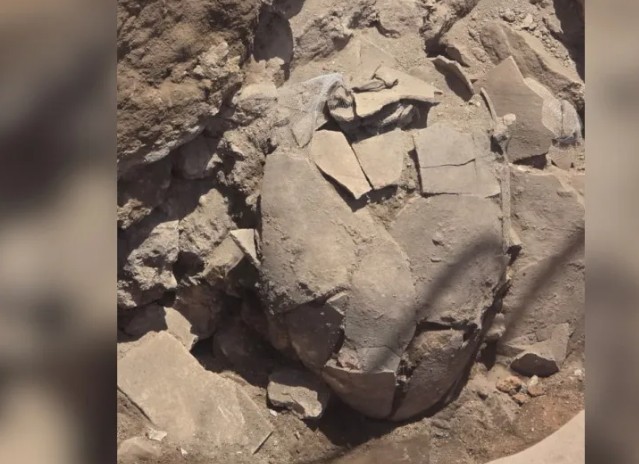
Remains of Bronze Age storage jar recently discovered at the ancient site of Shiloh, June 12, 2026.
Credit: Mishkan Shiloh Foundation
A recent report from The Jerusalem Post has once again drawn attention to one of the most important religious sites in ancient Israel. During the annual excavations at Tel Shiloh, archaeologists working under the direction of Dr. Scott Stripling uncovered three well-preserved storage jars dating to the Middle Bronze Age. The jars were found in a layer beneath later Late Bronze Age and Iron Age remains, and researchers suspect that they once held agricultural products such as grapes, wine, or olive oil. The discovery, announced just before the site’s annual wine festival, joins earlier finds at the same location, including thousands of animal bones and offerings of gold and silver.
For most readers, a few buried jars may seem like a modest discovery. For students of the Hebrew Bible, however, every spade of earth turned at Shiloh touches a place that stood at the very center of Israel’s worship for more than two centuries. Before there was a temple in Jerusalem, before David captured the city of the Jebusites, before Solomon laid the foundations of the house of the Lord, there was Shiloh.
The First Central Sanctuary
The Old Testament presents Shiloh as the place where Israel first gathered as a worshiping community in the land of Canaan. According to Joshua 18:1, after the conquest, the whole congregation of the Israelites assembled at Shiloh and set up the tent of meeting there. The location was deliberate. Shiloh lay in the hill country of Ephraim, north of Bethel and south of Shechem, in territory that was central to the tribes and relatively secure from the coastal threat of the Philistines. It was here that Joshua completed the allotment of the land among the tribes that had not yet received their inheritance (Joshua 18–19).
The significance of Shiloh is best appreciated when the site is set within the wider development of Israelite worship in the central highlands. My friend, Dr. Ralph K. Hawkins, professor of religion at Averett University and a seasoned field archaeologist, has traced this trajectory in his study of the Iron Age I structure discovered on Mount Ebal. While Tel Shiloh is traditionally celebrated as the enduring home of the tabernacle during the era of the judges, its place in early Israelite worship must be understood within a broader regional pattern. Before the institutionalized tent sanctuary was established at Shiloh, early Israelite cultic activity had already begun at simpler, open-air highland enclosures, such as the Iron Age I installation on Mount Ebal. The tabernacle sanctuary at Shiloh, in other words, served as the chronological and institutional successor to these earlier highland sites during the pre-monarchic period of Israel’s emergence.[1]
Hawkins also draws upon the excavations at Shiloh in order to interpret the material remains at Mount Ebal. Comparing the finds from Adam Zertal’s excavations at Ebal with those recovered by Israel Finkelstein at Tel Shiloh, he examines the distribution of the characteristic Iron Age I collared-rim storage jars, along with the structural enclosures and specialized installations that mark these highland sites. The shared ceramic and architectural features help to confirm a common regional culture and a broadly contemporary date.[2] Such comparisons remind us that Shiloh did not stand alone. It belonged to a network of early Israelite settlements and worship that spread across the central hill country, and its sanctuary represented a later, more organized stage in a longer story of devotion that had begun in the open air of the highlands.
Shiloh, then, was not merely one shrine among many. It was the resting place of the tabernacle, the portable sanctuary that the Israelites had carried through the wilderness. For a people who had wandered for a generation, the establishment of the tabernacle at Shiloh marked a profound transition. The God who had traveled with them in a tent now had a dwelling place among them in the land of promise. The sanctuary at Shiloh became the focal point of the covenant relationship between Yahweh and his people during the period of the judges.
A Place of Pilgrimage and Festival
Shiloh was also a place of pilgrimage. The book of Judges preserves the memory of an annual feast of the Lord celebrated there, complete with dancing in the vineyards (Judges 21:19–21). This detail is worth pausing over in light of the recent discovery. The jars unearthed at Tel Shiloh, possibly used to store wine and the produce of the land, fit naturally into a setting where the harvest and the vineyard were bound up with the worship of God. The agricultural rhythms of planting and harvest were never separated from Israel’s religious life. The firstfruits belonged to the Lord, and the festivals of ancient Israel were, in large measure, agricultural celebrations transformed into acts of covenant remembrance.
The image of Israelite families making their yearly journey to Shiloh gives us one of our clearest windows into ordinary religious devotion during this early period. It was at one such pilgrimage that we meet a woman whose prayer would change the course of Israel’s history.
Hannah, Samuel, and the House of Eli
No account of Shiloh is complete without the family of Elkanah. Year after year, Elkanah went up from his town to worship and to sacrifice at Shiloh, where Eli served as priest along with his sons Hophni and Phinehas (1 Samuel 1:3). It was at the doorpost of the sanctuary that Hannah, barren and grieving, poured out her soul before the Lord and vowed that if God granted her a son, she would dedicate him to divine service (1 Samuel 1:9–11).
The Lord answered Hannah’s prayer, and the child Samuel was brought to Shiloh and given over to the service of the sanctuary. There the boy ministered before the Lord under Eli, and there he received his prophetic call in the night, when the word of the Lord was rare and visions were not widespread (1 Samuel 3:1–10). Shiloh thus became the cradle of the prophetic ministry of Samuel, the man who would anoint Israel’s first two kings.
Yet the same narrative that celebrates Samuel’s rise records the moral collapse of the priesthood at Shiloh. The sons of Eli treated the offerings of the Lord with contempt and abused their priestly office (1 Samuel 2:12–17). The sanctuary that had been the glory of Israel had become, in the hands of corrupt priests, a place of scandal. The biblical writer makes it clear that the failure of Shiloh was not the failure of the place but of those entrusted with its sacred responsibilities.
The Fall of Shiloh
The judgment came swiftly. When Israel went out to fight the Philistines, the people carried the Ark of the Covenant from Shiloh into battle, treating the sacred object almost as a talisman that would guarantee victory (1 Samuel 4:3–4). The strategy failed catastrophically. Israel was defeated, the ark was captured, and both sons of Eli were killed. When the news reached Shiloh, Eli fell from his seat and died, and his daughter-in-law, dying in childbirth, named her son Ichabod, saying that the glory had departed from Israel (1 Samuel 4:21–22).
The biblical text does not narrate the destruction of Shiloh directly, but its echoes resound throughout later Scripture. The psalmist remembered that God abandoned his dwelling at Shiloh, the tent where he had lived among mortals, and gave his strength into captivity (Psalm 78:60–61). Centuries later, the prophet Jeremiah stood in the gate of the temple in Jerusalem and warned the people not to trust in the presence of the temple as a guarantee of safety. He urged them to go to Shiloh and see what the Lord had done to the place where he first made his name to dwell, because of the wickedness of his people (Jeremiah 7:12–14; 26:6). Shiloh had become a sermon in ruins, a warning that the presence of God could not be presumed upon by those who abandoned the covenant.
The archaeological record appears to support this picture of a violent end. Excavations at the site have revealed a significant destruction layer dating to the eleventh century before the common era, the period associated with the Philistine wars described in 1 Samuel.
Why Shiloh Still Matters
The renewed attention to Tel Shiloh, prompted by the discovery of these ancient storage jars, offers us an occasion to reflect on what this site meant for the faith of ancient Israel. Shiloh reminds us that Israel’s worship was rooted in particular places and particular history. It was at Shiloh that the people learned to gather around the presence of God, to celebrate the festivals of the agricultural year, and to bring their prayers and their children before the Lord.
Shiloh also stands as an enduring theological warning. The sanctuary was holy not because of its stones or its jars but because of the God who chose to dwell there. When that God was treated with contempt, the glory departed. Jeremiah understood this, and he used the memory of Shiloh to call his own generation to repentance.
When the soil of Shiloh yields its jars and its bones and its offerings of silver and gold, it is giving back to us the material remains of a community that once gathered there to worship. For those of us who read the Scriptures, these finds are more than artifacts. They are reminders that the story of Israel’s faith unfolded in real places, among real people, who knew that the living God had chosen to make his dwelling among them.
Note: The archaeological details concerning the recently discovered storage jars at Tel Shiloh are drawn from “Ancient jars unearthed at biblical Shiloh days before annual wine festival,” an article published in The Jerusalem Post.
NOTES
[1] Ralph K. Hawkins, The Iron Age I Structure on Mt. Ebal: Excavation and Interpretation, Bulletin for Biblical Research Supplement 6 (Winona Lake, IN: Eisenbrauns, 2012), 24–28.
[2] Hawkins, Iron Age I Structure on Mt. Ebal, 218–20.
CHECK OUT MY NEW BOOK. Click here: Praying the Psalms: Finding Your Voice in Israel’s Prayer Book.
Claude Mariottini
Emeritus Professor of Old Testament
Northern Baptist Seminary
If you enjoyed reading this post, you will enjoy reading my books.
VISIT MY AMAZON AUTHOR’S PAGE
BUY MY BOOKS ON AMAZON (Click here).
NOTE: Did you like this post? Do you think other people would like to read this post? Be sure to share this post on Facebook and share a link on X so that others may enjoy reading it too!
If you are looking for other series of studies on the Old Testament, visit the Archive section and you will find many studies that deal with a variety of Old Testament topics.