
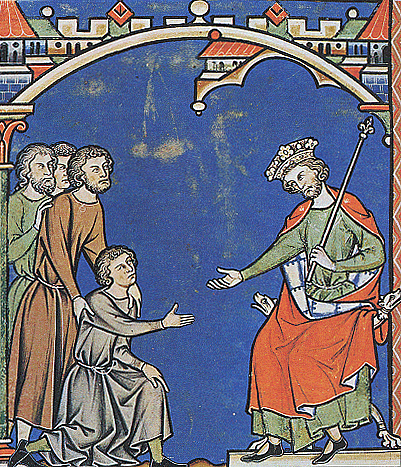
Mephibosheth is brought to David by Ziba
(Author Unknown, c. 1240)
Wikimedia Commons
The end of Saul’s reign came after a tragic battle against the Philistines on Mount Gilboa (1 Samuel 31:1–13). Saul was wounded in the battle and fearing humiliation at the hands of the Philistines, Saul asked his armor-bearer to kill him. Saul’s servant refused to kill the king. Saul, knowing that the Philistines would torture him if he was captured alive, “took his own sword and fell upon it” (1 Samuel 31:4).
The defeat of Israel’s army by the Philistines reveals the danger the Philistines posed to the survival of Israel. After Saul’s death by his own hands, his armor-bearer also killed himself. Three of Saul’s sons, Jonathan, Abinadab, and Malchishua, were killed in battle. Only Ishbosheth escaped, probably because he did not join his father to fight against the Philistines.
After the death of Saul, Abner, the commander of Saul’s army, made arrangements for Ishbosheth to rule over the northern tribes. Ishbosheth reigned over the northern tribes two years (2 Samuel 2:10). The tribe of Judah anointed David as their king and David reigned as king of Judah seven years and six months (2 Samuel 2:11).
David and Jonathan
The death of Jonathan greatly affected David. When the sad news reached David that Jonathan was killed in battle, together with his father Saul, David lamented their death by composing a song known as “The Song of the Bow” (2 Samuel 1:17–27) to honor their death. Although three of Saul’s sons died in the battle, only Jonathan is mentioned in the song, an indication of the close friendship that existed between David and Jonathan.
David’s friendship with Jonathan is seen in what David said about his friend, “I grieve for you, Jonathan, my brother. You were such a friend to me” (2 Samuel 1:26 CSB). When David was serving in Saul’s army, Jonathan saved David’s life when his father tried to kill him.
As a result of their friendship and fearing what Saul could do to David, Jonathan and David made a covenant in which Jonathan asked David to show to him “ the faithful love (ḥesed) of the LORD” (1 Samuel 20:14) in perpetuity.
Jonathan said to David, “May the LORD be with you, as he has been with my father. If I am still alive, show me the faithful love of the LORD; but if I die, never cut off your faithful love from my house, even if the LORD were to cut off every one of the enemies of David from the face of the earth. . . . Go in peace, since both of us have sworn in the name of the LORD, saying, ‘The LORD shall be between me and you, and between my descendants and your descendants, forever’” (1 Samuel 20:13–15, 42).
Mephibosheth
Mephibosheth was the son of Jonathan and the grandson of Saul. According to the book of Chronicles (1 Chronicles 8:34), Mephibosheth’s original name was Merib-baal. The name Merib-baal contains the name of Baal, the name of the Canaanite god. In order not to associate Saul with the worship of the Canaanite god, the name of Baal was removed and changed to “bosheth,” a Hebrew word which means “shame” (Avioz 2011: 12).
When the news about the death of Saul and his sons reached the royal house, the royal family were afraid of what would come next. Generally, when a king died, those pretending to the throne would kill the members of the royal family and usurp the throne.
This happened after Jehu killed Ahaziah, king of Judah, “when Athaliah, Ahaziah’s mother, saw that her son was dead, she set about to destroy all the royal family” (2 Kings 11:1). The house of Saul knew that David had aspirations to succeed Saul as king of Israel.
The woman who took care of Mephibosheth believed that his life was in danger. Fearing that David would come and kill the remaining members of Saul’s family and take the throne that belonged to Saul, Mephibosheth’s nurse acted to save the life of the child, “His nurse picked him up and fled, but as she hurried to leave, he fell and became crippled” (2 Samuel 4:4 NIV).
Mephibosheth was five years old when his nurse told him the bad news that his father had died together with his grandfather in the war against the Philistines. Mephibosheth and his nurse fled to Lo-dabar. Lo-dabar was a city located on the other side of the Jordan River.
Mephibosheth and his nurse came to the house of Machir, who probably was the ruler of the city. Since Machir granted political asylum to Jonathan’s son, it is possible that there was a political alliance between the house of Saul and the house of Ammiel, Machir’s father.
In the haste to flee from David, Mephibosheth’s nurse dropped him, breaking his legs and he became crippled for the rest of his life. In antiquity, people with disabilities were often marginalized. When David commanded his men to attack the Jebusites who lived in Jerusalem, he said to them, “Whoever would strike down the Jebusites, let him get up the water shaft to attack the lame and the blind, those whom David hates” (2 Samuel 5:8).
According to Brueggemann, David’s feelings toward the disabled led to “a programmatic expulsion of the blind and lame from the city, and perhaps later from the temple” (Brueggemann 1990: 252).
By emphasizing the physical condition of Mephibosheth, the writer of 2 Samuel “acts to bind Mephibosheth with qualities which in turn divide him from greater society. Mephibosheth in his weakened condition is not at all a threat; he is physically helpless and defenseless” (Rouse 2008: 188).
David and Ziba
After David had established his throne, David asked, “Is there still anyone left of the house of Saul to whom I may show kindness for Jonathan’s sake?” (2 Samuel 9:1). The time-frame for David’s question is problematic.
When Mephibosheth was taken to Lo-dabar he was five years old. When he came before David, Mephibosheth was already the father of a young son “whose name was Mica” (2 Samuel 9:12). This means that Mephibosheth lived in Lo-dabar fifteen to twenty years.
Ishbaal, Saul’s son was assassinated after David became king of Judah at Hebron (2 Samuel 4:5). Early in David’s reign there was a famine in the land that lasted for three years. According to the biblical writer, the famine was caused by the bloodguilt on Saul and on his house “because he put the Gibeonites to death” (2 Samuel 21:1).
To make atonement for Saul’s bloodguilt and to stop the famine, the Gibeonites demanded that seven sons of Saul be executed. With David’s permission the Gibeonites impaled Saul’s sons in Gibeah of Saul, the place where Saul had established the capital of his reign (2 Samuel 21:6). Only Mephibosheth was spared, “the king spared Mephibosheth, the son of Saul’s son Jonathan, because of the oath of the LORD that was between them, between David and Jonathan son of Saul” (2 Samuel 21:7).
David remembered the promise he had made to Jonathan. It is even possible that David remembered that he had spared the life of Jonathan’s son several years before. David asked his servants, “Is there still anyone left of the house of Saul to whom I may show kindness for Jonathan’s sake?” (2 Samuel 9:1).
David was told there was a servant of Saul whose name was Ziba who could provide an answer to his question. Ziba is called “Saul’s steward” (2 Samuel 9:9 TNK), an indication that he probably served as an administrator of Saul’s properties.
At the summons of the king, Ziba came before David who asked him if there were any survivors from the house of Saul. Without mentioning Mephibosheth by name, Ziba told David, “There remains a son of Jonathan; he is crippled in his feet” (2 Samuel 9:3). When David heard that Jonathan’s son was alive, David sent his servants to bring him from the home of Machir.
David and Mephibosheth
The reason David wanted to show kindness to Mephibosheth was for Jonathan’s sake. David had promised to show “the faithful love of the LORD” to Jonathan’s descendants in perpetuity. Now that David knew that Jonathan’s son was alive, he wanted to keep the promise he had made to his friend.
The Hebrew word translated “faithful love” and “kindness” is ḥesed. The word ḥesed refers to the special love that God has for his people. The word also reveals one aspect of the character of God. God abounds in ḥesed. He is a God “abounding in steadfast love” (Exodus 34:6). The word ḥesed is associated with God’s grace, his mercy, and his faithfulness.
David said that he wanted to show ḥesed to Jonathan’s son. The word ḥesed is used three times in this narrative between David and Mephibosheth (vv. 1, 3, 7). David was on a mission to fulfil the promise he had made to his friend Jonathan.
David was committed to helping Mephibosheth because of his friendship with his father: “David was intentional about helping Mephibosheth. . . . David was willing to show love and kindness to Mephibosheth. . . . this was David at his best, and an example of David living as a man after God’s own heart” (Griffin 2018: 171).
When Mephibosheth came before David, he was afraid. Mephibosheth had reason to fear, because David had already put to death his seven half-brothers and now he was afraid for his life and the life of his son. At the summons of the king, Mephibosheth had no other choice but to obey the summons. When he arrived at the palace, Mephibosheth bowed down and prostrated himself before the king.
David said to Mephibosheth, “Do not be afraid, for I will show you ḥesed.” I will show you kindness for the sake of your father Jonathan. David assured Mephibosheth that he had no reason to fear. As a demonstration of his willingness to show ḥesed to the son of Jonathan, David promised to restore to him the property that had belonged to Saul’s family. In addition, David allowed Mephibosheth to eat at the king’s table.
Some scholars believe that David had an ulterior motive in keeping Mephibosheth as a dependent of the king. It is possible that the restoration of Mephibosheth was intended for David to maintain surveillance on the heir to Saul’s throne. However, Mephibosheth’s words reveal David’s intention.
The fact that Mephibosheth “ate at David’s table, like one of the king’s sons” indicates that David’s generosity was genuine. The honor David bestowed upon Mephibosheth was an expression of ḥesed. David went above and beyond in his kindness to Jonathan’s son.
In doing so, David became an agent of God’s kindness. David had experienced God’s ḥesed, his faithful love throughout his life and now he was willing to show the same kind of love to the son of his best friend.
Application
My pastor, Jeff Griffin, Senior Pastor of The Compass Church in Naperville, Illinois preached a sermon on May 28, 2023 titled “David: Loving the Overlooked.” The sermon was based on 2 Samuel 9:1–13. Many of the ideas and concepts mentioned in the post above are based on Jeff’s sermon.
In his sermons, Jeff emphasized that David wanted to show the kindness of God to Mephibosheth just as he had promised to Jonathan. Jeff said that David was committed to show God’s love to a member of the family of the man who tried to kill him. David was committed to show ḥesed to Mephibosheth, to love a person who was often overlooked by society because of his disability.
Jeff emphasized that ḥesed is an extraordinary love; ḥesed is a love that goes beyond that which is expected. It is a love that is undeserved, a love that is sacrificial, the kind of love that seeks to bless people who do not deserve love.
Jeff emphasized that Christians have received ḥesed from God. For this reason now they should give ḥesed to others, the kind of love that goes above and beyond.
In order to share God’s love with others, Christians must ask: “what can I do to show love that goes above and beyond?” Christians must become agents of God’s kindness in a world that desperately needs to experience God’s love.
Jeff concluded his sermon by saying that agents of God’s kindness must ask: “whom can I love, what can I give, what can I say, and what can I do in order to give to others the ḥesed I have received from God?
A Video Presentation
David: Loving the Overlooked – A Sermon by Jeff Griffin
For the complete list of sermons of the life of David, read my post, David – The Life of a King.
For a complete list of posts based on Jeff Griffin’s sermons, visit my post The Sermons of Jeff Griffin.
Claude Mariottini
Emeritus Professor of Old Testament
Northern Baptist Seminary
If you enjoyed reading this post, you will enjoy reading my books.
VISIT MY AMAZON AUTHOR’S PAGE
BUY MY BOOKS ON AMAZON (Click here).
NOTE: Did you like this post? Do you think other people would like to read this post? Be sure to share this post on Facebook and share a link on Twitter or Tumblr so that others may enjoy reading it too!
I would love to hear from you! Let me know what you thought of this post by leaving a comment below. Be sure to like my page on Facebook, follow me on Twitter, follow me on Tumblr, Facebook, and subscribe to my blog to receive each post by email.
If you are looking for other series of studies on the Old Testament, visit the Archive section and you will find many studies that deal with a variety of Old Testament topics.
BIBLIOGRAPHY
Avioz, Michael. “The Names Mephibosheth and Ishbosheth Reconsidered.” The Journal of the Ancient Near Eastern Society 32 (2011): 11–20.
Brueggemann, Walter. First and Second Samuel. Interpretation. Louisville: John Knox Press, 1990.
Griffin, D. Darrell. “Keeping Our Word” (2 Samuel 9). Ex Auditu 34 (2018): 169-175.
Rouse, Christopher D. “Scripture and the Disabled: Redeeming Mephibosheth’s Identity.” Journal of Pentecostal Theology 17 no 2 (2008): 183–199.












 Dr. Claude Mariottini - Professor of Old Testament