
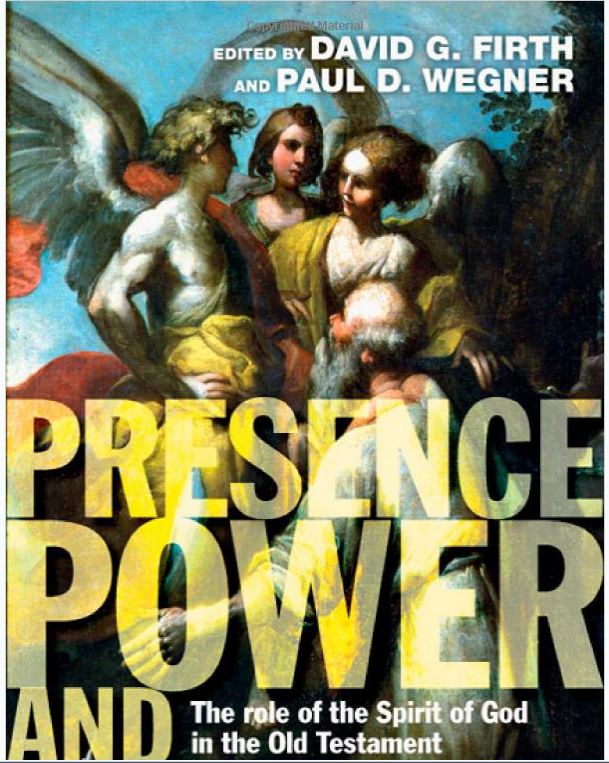
David G. Firth and Paul D. Wegner, eds. Presence, Power, and Promise: The Role of the Spirit of God in the Old Testament. Downers Grove, InterVarsity Press, 2011. ISBN 978-0-8308-3957-5. 415 pp. $30.00.
The Spirit of God is mentioned several times in the Old Testament. The work of the Spirit of God begins at creation (Genesis 1:2) and continues throughout the history of Israel, empowering people to carry out God’s work in the world. Most books written in the area of Old Testament theology will have a section dealing with the Spirit of God. However, there are not many scholarly works dealing specifically with the Spirit of God in the Old Testament. This is the reason Firth and Wegner’s book is such a welcome addition to the field.
Presence, Power, and Promise is a collection of articles dealing with the work of the Spirit of God in the Old Testament. The articles are written by known evangelical scholars who deal with specific topics related to the work of the Spirit in the Hebrew Bible. Several of the articles are exegetical in nature, dealing with specific passages where the Spirit of God is mentioned.
Since there are twenty-one articles plus an introduction in the book, it is impossible to provide a comprehensive review of the book in one post. For this reason, in the present post, I will lists the titles of the articles and present a brief summary of the introductory remarks by Firth and Wegner. Then, in future posts, I will review a few of the articles and summarize their content.
The book is divided into 8 sections; each section contains one or more articles. Below is the titles of the articles and the names of the authors of each article.
David G. Firth and Paul D. Wegner, “Introduction,” 15-21.
Part 1; Orientation to the Spirit of God in the Old Testament and the Ancient Near East
1. Richard E. Averbeck, “Breath, wind, spirit and the Holy Spirit in the Old Testament,” 25-37.
2. John H. Walton, “The Ancient Near Eastern background of the Spirit of the Lord in the Old Testament,” 38-67.
Part 2: The Spirit and creation
3. Robert L. Hubbard, Jr., “The Spirit and creation,” 71-91.
Part 3: The Spirit and Wisdom
4. Tremper Longman, III, “Spirit and wisdom,” 95-110.
5. Rosalind Clarke, “Job 27:3: the Spirit of God in my nostrils,” 111-121.
6. Daniel J. Estes, “Spirit and the psalmist in Psalm 51,” 122-134.
7. Jamie A. Grant, “Spirit and Presence in Psalm 139,” 135-146.
8. Lindsay Wilson, “Spirit of wisdom or Spirit of God in Proverbs 1:23?” 147-158.
Part 4: The Spirit and Creativity
9. Richard S. Hess, “Bezalel and Oholiab: Spirit and creativity,” 161-172.
Part 5: The Spirit and Prophecy
10. Daniel I. Block, “The view from the top: the Holy Spirit and the Prophets,” 175-207.
11. John N. Oswalt, “Is Balaam’s donkey the real prophet (Numbers 24:1-4)?” 208-219.
12. Hilary Marlow, “The Spirit of Yahweh in Isaiah 11:1-9,” 220-232.
13. Paul D. Wegner, “Isaiah 48:16: a trinitarian enigma?” 233-244.
14. Erika Moore, “Joel’s promise of the Spirit,” 245-256.
Part 6: The Spirit and leadership
15. David G. Firth, “The Spirit and leadership: testimony, empowerment and purpose,” 259-280.
16. Eugene H. Merrill, “The Samson saga and spiritual leadership,” 281-293.
17. David G. Firth, “Is Saul among the prophets? Saul’s prophecy in 1 Samuel 19:23,” 294-305.
18. Robert B. Chisholm, Jr., “The ‘Spirit of the Lord’ in 2 Kings 2:16,” 306-317.
Part 7: The Spirit and the future
19. Willem VanGemeren and Andrew Abernethy, “The Spirit and the future: a canonical approach,” 321-345.
20. Robin Routledge, “The Spirit and the future in the Old Testament: restoration and renewal,” 346-367.
Part 8: The Spirit at Qumran
21. Geert W. Lorein, “The Holy Spirit at Qumran,” 371-395.
The book contains a list of abbreviations of works cited in the articles. The book also has an author index, a Scripture index, and an index of ancient sources. A list of contributors provides a brief bibliographical information on each author.
In the Introduction of the book, Firth and Wegner provide a brief overview on how the Hebrew rûaḥ is used in the Old Testament. The word rûaḥ appears 394 times and, depending on the context where the word is used, it is generally translated as “breeze, breath, wind, and spirit.”
Of the 394 times that the word rûaḥ is used in the Old Testament, 39 times the word is used in connection with God: “the Spirit of God” appears 11 times, “the Spirit of the Lord” appears 25 times, and “the Holy Spirit” appears 3 times. There are several other places where a pronominal suffix is attached to the word rûaḥ and it refers to God (p. 16).
One answer that many Christians want to know is whether a reference to the Holy Spirit in the Old Testament is a reference to the Third Person of the Trinity. Firth and Wegner address this issue by saying that whenever the word “Spirit” appears in the Old Testament, the passage should be understood from the perspective of “what the original author intended it to mean” (p. 18).
Firth and Wegner say that one reason God did not make the concept of the Trinity clear to the people of the Old Testament was because the problem of polytheism was a reality and a problem in Israelite society. The “Shema,” Israel’s declaration of faith in the unity of God found in Deuteronomy 6:4, taught the people that the God of Israel was one. For this reason, Firth and Wegner claim that “a ‘trinity’ concept would have been considered polytheism at the time” (p. 19).
Another issue addressed by Firth and Wegner is about the difference between the work of the Spirit in the Old Testament and the work of the Holy Spirit in the New Testament. In evaluating the work of the Spirit, Firth and Wegner wrote:
To the OT reader, God’s spirit emanated from God and came upon people to empower them to do some service for him (i.e. ruling, defeating Israel’s enemies, judging, prophesying), though reference to the spirit might also symbolize God’s presence. It is interesting that one of the primary roles of the ‘Spirit’ in the NT is to empower believers to live a godly life. However, there are also significant distinctions between the ‘spirit’ in the two Testaments. In the OT, the ‘spirit of the Lord’ was considered more as a force emanating from God, while the NT the ‘Holy Spirit’ is a person and part of the Godhead. Also the spirit’s role in the OT is centred upon physical empowerment, while in the NT it seems to be centred upon spiritual empowerment (p.17).
These essays provide a comprehensive overview of the work of the Spirit of God in the Old Testament. I enjoyed reading each article and learned much from them. Most Christians are familiar with the work of the Holy Spirit in the New Testament. Readers who want to know more about the work of the Spirit of God in the Old Testament will find this book to be a rich source of information.
I want to thank InterVarsity Press for making the book available for review. In future posts I will review some of the articles in the book and discuss different aspects of the work of the Spirit of God in the Old Testament.
Claude Mariottini
Professor of Old Testament
Northern Baptist Seminary
NOTE: Did you like this post? Be sure to click the “Like” button and then share this post on Facebook, and tweet it on Twitter! I would love to hear from you! Let me know what you thought of this post by leaving a comment below. Be sure to like my page on Facebook, follow me on Twitter, and subscribe to my blog to receive each post by email.











 Dr. Claude Mariottini - Professor of Old Testament