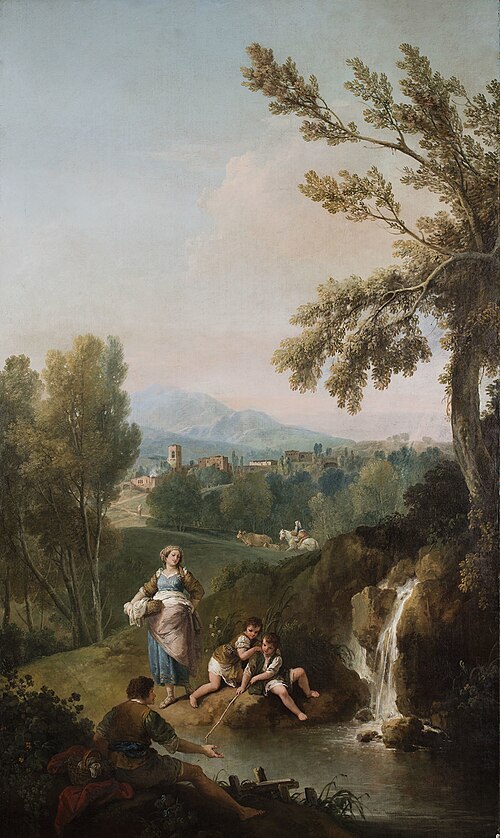
Jacob and Leah with their Sons
Francesco Zuccarelli (1702–1788)
Wikimedia Commons – Public Domain
The Unloved Mother
On this Mother’s Day, we pause to celebrate the women whose love, sacrifice, and endurance have shaped the lives of their children and the course of human history. This is a day for children to honor their mothers and for husbands to express gratitude for the remarkable women who stand beside them. It is a day to remember that motherhood is not merely a biological fact but a vocation demanding courage, faithfulness, and an often unreciprocated love.
On this Mother’s Day, we turn our attention to one of the most overlooked and underappreciated mothers in the entire biblical narrative: Leah, the wife of Jacob. Leah loved her husband with a devotion that never wavered and cared for her children with a faithfulness that never failed. Yet she lived her entire married life as the unloved wife: present in Jacob’s household, bearing his sons, fulfilling every obligation of marriage, but never receiving the one thing she most desperately desired: her husband’s love. She poured out her life in service to a man whose heart belonged to another woman, and the heartbreak of that reality is encoded in the very names she gave her children.
This post is a salute to Leah, the unloved mother, the overlooked wife, the woman who gave everything and received so little in return. Hers is a story of extraordinary perseverance under the weight of rejection, and it deserves to be told with the honesty and sympathy it has always merited. On this day set apart to honor mothers, may we take a moment to honor Leah, to see her as the biblical narrator saw her, and to recognize that what she was denied throughout her life, she ultimately received in death: the permanent and irrevocable acknowledgment that she, and not her sister Rachel, was Jacob’s true wife, buried beside him in the covenantal ground of their ancestors.
Introduction
The story of Leah is one of the most poignant and psychologically complex narratives in the entire Hebrew Bible. She was a woman who spent her entire life in the pursuit of something she could never fully obtain: the love of her husband, Jacob. Caught in the shadow of her younger sister Rachel—the woman Jacob had chosen, the woman Jacob adored—Leah navigated her days in a household defined by comparison, rejection, and longing. Yet the biblical narrator does not allow Leah to disappear into the background. Her story is told with a candor and depth of feeling that elevates her above the status of a minor figure and places her at the very center of Israel’s origins. Every son she bore, every negotiation she made, and every year she endured as the unloved wife was, at its core, an expression of the same desperate hope: that Jacob would one day turn to her and truly see her as his wife.
The account of Leah begins with a deception that was not of her making. Her father Laban substituted her for Rachel on the night of the wedding, and Jacob awoke the following morning to discover that the woman he had married was not the one he loved (Gen 29:21–25). From that single moment forward, Leah’s position in Jacob’s household was defined by a fundamental deficit. She had come to her husband through trickery, and no amount of time, devotion, or childbearing could fully overcome that shadow. The text states the reality plainly and without apology: “Jacob loved Rachel more than Leah” (Gen 29:30). The narrator then adds a detail of profound theological weight: “When the LORD saw that Leah was hated, he opened her womb; but Rachel was barren” (Gen 29:31). In that verse, two truths are placed side by side: the human rejection of Leah, and the divine recognition of her suffering. God saw what Jacob refused to see. God honored what Jacob withheld. But for Leah herself, it was not God’s regard that she most desperately sought—it was her husband’s.
The Sons: A Mother’s Plea Encoded in Names
In ancient Israel, the naming of a child was not a mere formality. A name carried meaning, memory, and intention. It was a declaration about the circumstances of birth, the hopes of the parents, and the relationship between the family and God. When Leah named her sons, she was not simply recording genealogical data. She was composing, in the only medium available to her, a running testimony of her inner life—a life consumed by the longing for her husband’s love.
The first son she named Reuben, saying: “Because the LORD has looked on my affliction; surely now my husband will love me” (Gen 29:32). The name Reuben (rĕʾūbēn) is connected to the verb rāʾâ (“to see”) and the noun ben (“son”)—“See, a son!” The LORD had seen her affliction. But the sentence does not end there. Leah immediately pivots from divine attention to human longing: “surely now my husband will love me.” The birth of her firstborn son, a moment of tremendous achievement in the ancient world, becomes in Leah’s telling not an end in itself but a means to an end. She hoped that the son would do what she could not: open Jacob’s heart toward her.
The second son she named Simeon, saying: “Because the LORD has heard that I am hated” (Gen 29:33). The name derives from shāmaʿ, “to hear.” Once again, Leah acknowledges divine attentiveness to her condition. But the word she uses to describe that condition—“hated” (sənūʾāh)—is shattering in its bluntness. Whether understood comparatively or literally, the term reveals the depth of her perceived rejection. Two sons, two divine acknowledgments of her suffering, and still Jacob’s love had not come.
The third son she named Levi, saying: “Now this time my husband will be joined to me, because I have borne him three sons” (Gen 29:34). The name Lēwī comes from the root lāwāh, meaning “to join” or “to attach.” Three sons, and still Leah was reasoning with herself that the arithmetic of childbearing might accomplish what love had not. The logic of her hope is evident: surely three sons constitute an irreversible bond between a wife and her husband. Surely now he will be joined to me. The verb she chose reveals what she most desired—not merely cohabitation, but genuine attachment, the emotional and relational union that had eluded her from the wedding night onward.
Only with the fourth son does the tone shift. She named him Judah, saying: “This time I will praise the LORD” (Gen 29:35). The name derives from yādāh, “to praise.” Remarkably, no mention is made of Jacob. No hope is expressed that this birth will at last secure his love. Scholars have interpreted this silence in various ways: as a sign that Leah had finally found sufficiency in God; as a moment of spiritual maturation in which she transferred her deepest need from husband to Creator; or simply as a pause in her grief before it resumed. Whatever the interpretation, the contrast with the three preceding names is unmistakable. Leah, at least momentarily, looked away from Jacob.
But the longing was not finished. After a period in which Rachel’s servant Bilhah bore sons for Jacob through the custom of surrogate motherhood, Leah herself ceased bearing and gave her own servant Zilpah to Jacob (Gen 30:9–13). When Leah’s own womb reopened, she bore a fifth son, Issachar, saying: “God has given me my wages because I gave my servant to my husband” (Gen 30:18). With the sixth son, Zebulun, she declared: “God has endowed me with a good gift; now my husband will honor me, because I have borne him six sons” (Gen 30:20). The word “honor” (zābal) means to exalt or dignify. After six sons, Leah was still counting, still calculating, still hoping that the sheer weight of her maternal contribution would translate into the recognition she craved from Jacob. The specific language she chose—“now my husband will honor me”—echoes her earlier cries in Reuben and Levi. After six sons, the hope had not died. It had simply aged.
The Mandrakes: Purchasing What Should Have Been Given
Perhaps no episode in Leah’s story reveals the desperation of her situation more starkly than the account of the mandrakes in Genesis 30:14–21. Reuben, Leah’s firstborn, found mandrakes in the field during the wheat harvest and brought them to his mother. Mandrakes (dūdāʾim) were plants associated in ancient Near Eastern culture with romantic attraction, fertility, and the power to stimulate desire. Their very name in Hebrew derives from a root meaning “love.” Rachel, seeing them, immediately demanded them from Leah.
Leah’s response to Rachel’s request is one of the most raw and emotionally honest statements in the patriarchal narratives: “Is it a small matter that you have taken away my husband? Would you take away my son’s mandrakes also?” (Gen 30:15). In that single sentence, Leah names the defining reality of her marriage. Rachel had “taken away” her husband. Not through any act of malice, perhaps, but through the simple and irresistible fact of Jacob’s love. Leah had the legal status of wife, but Rachel had Jacob’s heart, his time, his attention—the very things that constitute a marriage in its fullest sense.
Rachel negotiated: she would give Leah the mandrakes in exchange for one night with Jacob. Leah agreed. And so the deeply painful scene unfolds in which Leah, the first wife, the mother of six of Jacob’s sons, had to purchase a single night with her own husband (Gen 30:16). When Jacob came in from the field, Leah met him and said: “You must come in to me; for I have hired you with my son’s mandrakes” (Gen 30:16). The verb “hired” (sākār) is a commercial term, the same word used for a day laborer’s wages. Leah had reduced her conjugal relationship with her husband to a financial transaction—not by choice, but by necessity. Jacob went in to her that night, and from that union came Issachar.
The mandrake episode is a devastating commentary on the state of Leah’s marriage. She had hoped the mandrakes might restore some natural desire in Jacob. She had instead been forced to trade them away. And what she received in return was not love freely given but a night of access purchased from her own sister. It is difficult to imagine a more complete illustration of how utterly Leah’s legitimate claims upon her husband had been eclipsed by Rachel’s hold on his affections. Leah went to extraordinary lengths—even submitting to the humiliation of this transaction—in the persistent hope that she might yet win what she deserved as Jacob’s first wife.
Death, Burial, and the Recognition She Was Denied in Life
Rachel died before Jacob, on the road near Bethlehem, in the travail of giving birth to Benjamin (Gen 35:16–20). Jacob buried her there, on the roadside, and erected a pillar over her grave. It was an act of grief and devotion. But Rachel did not make it to Machpelah. She did not lie in the cave that Abraham had purchased from Ephron the Hittite as the first permanent covenantal holding of his family in the land of promise (Gen 23). That place—reserved for the bearers of the covenant, the patriarchs and matriarchs of Israel—Rachel never entered.
Leah did.
When Jacob gathered his sons around him in Egypt to speak his dying words, he charged them with a specific and deliberate request concerning his burial: “Bury me with my ancestors—in the cave in the field of Ephron the Hittite, in the cave in the field at Machpelah, near Mamre, in the land of Canaan, in the field that Abraham bought from Ephron the Hittite as a burial site. There Abraham and his wife Sarah were buried; there Isaac and his wife Rebekah were buried; and there I buried Leah” (Gen 49:29–31 NRSV). The formulation is exact and purposeful. Jacob recited the covenantal pedigree of the cave, named those already interred there, and then—with the quiet possessiveness of a man finally claiming what he had perhaps long taken for granted—said: “there I buried Leah.”
Three things in this dying declaration deserve careful attention. First, Jacob spoke of Leah’s burial as his own act: “I buried Leah.” He did not say merely that Leah happened to be buried there. He claimed the act as his own, acknowledging her as his responsibility, his wife, the one whom he had laid to rest in the most sacred ground available to his family. Second, Rachel’s name is entirely absent from the passage. The woman who had everything in life—Jacob’s love, his years of labor, his preferential devotion—is not mentioned in connection with the covenantal burial cave. She lies elsewhere, on the road to Bethlehem, separated from the patriarchal narrative’s final chapter. Third, Jacob requested to be buried in the same cave. He was not merely directing his sons to a location. He was choosing, in the one irrevocable act remaining to him, to lie beside Leah for eternity.
The cave of Machpelah was not simply a family cemetery. It was covenantal space, theologically charged ground in which to be interred meant being counted among the covenant bearers of Israel. Abraham and Sarah were there as the founding pair. Isaac and Rebekah were there as the second generation of the promise. By placing himself beside Leah, Jacob completed the triad in a way that no living arrangement in his household had ever reflected. In death, Leah stood where she had always rightly belonged: as Jacob’s wife, his partner in the covenant, his companion in the land of promise.
The Hebrew Bible contains a theology of divine reversal—a recurring pattern in which God honors in the end what human beings dishonored in the moment. The barren become mothers of nations. The younger supplant the older. The overlooked become the chosen. Leah’s story participates in this pattern, but with a particular poignancy: the reversal was accomplished not by a direct divine act but through Jacob’s own dying will. Whether out of a deepened affection that had grown quietly over decades, a late recognition of covenantal obligation, or the clarifying honesty that dying men sometimes find, Jacob chose Leah. He chose her irrevocably and permanently, in a way that could not be undone by Rachel’s beauty or the living warmth of Rachel’s memory.
Conclusion: The Dignity of the Unloved
Leah spent her life trying to earn what ought to have been hers by right. She was Jacob’s first wife, bound to him by covenant, the mother of six of his twelve sons, the foremother of Levi and Judah—the tribes from which Israel’s priests and kings would descend. She gave Jacob everything she had: her body, her sons, her persistent hope, even her willingness to humiliate herself for a single night of access to the man she loved. And yet Jacob’s heart remained, to the end, more fully Rachel’s than hers.
But Leah is not buried on the roadside. She is not a footnote in someone else’s love story. She lies in the cave of Machpelah, beside her husband, among the great covenantal figures of Israel’s faith. What she could not get in life—recognition, honor, the full acknowledgment that she was Jacob’s wife—she received in death. The man who could not bring himself to love her freely, in the end chose to be buried with her. In that one act, Jacob gave Leah what no name she ever cried over a newborn son had been able to secure: the permanent, public, unrevocable declaration that she was his wife.
The narrator who recorded these events understood something profound about the economy of divine justice. God saw Leah’s affliction early, and opened her womb when Jacob would not open his heart. And God ensured that the record of Leah’s life—her sons, her suffering, her endurance, and her burial—would be preserved in the sacred story of Israel. The unloved mother of a people became, in the end, one of the founding mothers of the covenant. She is buried in the land of promise, beside the man she loved, recognized at last as what she always was: Jacob’s wife.
Claude Mariottini
Emeritus Professor of Old Testament
Northern Baptist Seminary
If you enjoyed reading this post, you will enjoy reading my books.
VISIT MY AMAZON AUTHOR’S PAGE
BUY MY BOOKS ON AMAZON (Click here).
NOTE: Did you like this post? Do you think other people would like to read this post? Be sure to share this post on Facebook and share a link on X so that others may enjoy reading it too!
If you are looking for other series of studies on the Old Testament, visit the Archive section and you will find many studies that deal with a variety of Old Testament topics.