Archaeologists Evidence of the Earthquake in Jerusalem
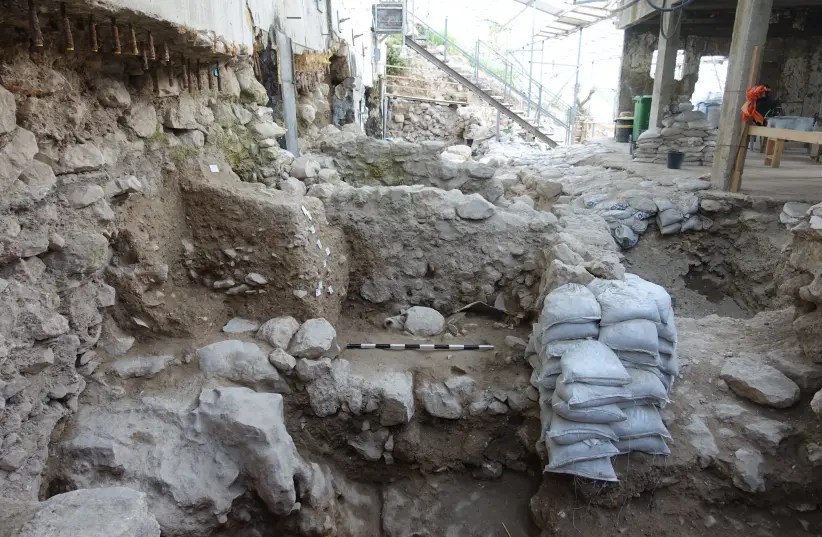
Photo Credit: Ortal Chalaf
Courtesy of the Israel Antiquities Authority
One of the most important earthquakes in the Bible happened in the days of Uzziah, King of Judah, around 760 BCE. The call of the prophet Amos to the prophetic ministry is dated from this event: “The words of Amos, who was among the herdsmen of Tekoa, which he saw concerning Israel in the days of Uzziah king of Judah, and in the days of Jeroboam the son of Joash king of Israel, two years before the earthquake” (Amos 1:1).
This earthquake probably was very devastating because it remained in the memory of the people of Israel for centuries. Two hundred years later, the prophet Zechariah spoke of that earthquake as a divine judgment upon the sins of Jerusalem: “And you shall flee to the valley of the mountains; for the valley of the mountains shall reach unto Azal: yes, you shall flee, like as you fled from before the earthquake in the days of Uzziah king of Judah” (Zechariah 14:5).
Many earthquakes have been recorded over the years in Israel. For instance, Josephus, the Jewish historian, mentioned an earthquake in the seventh year of the reign of Herod (31 BCE), an earthquake “such a one as had not happened at any other time, and which earthquake brought a great destruction upon the cattle in that country” (Antiquities XV, v.2). According to Josephus, about ten thousand people perished in the devastation caused by the earthquake.
Until recently, archaeologists have not found any evidence for the earthquake that produced the great devastation in the days of Amos. Archaeologists had found the destruction layer of Jerusalem that came as a result of the conquest of Jerusalem by Nebuchadnezzar, king of Babylonian in 587 BCE. Writing for The Times of Israel, Amanda Borschel-Dan writes that “Now, for the first time, a team of Israel Antiquities Authority archaeologists in Jerusalem’s City of David report that they have found unprecedented concrete evidence of this 8th century BCE earthquake in the ancient capital.”
In an article titled “Archaeologists unearth 1st Jerusalem evidence of quake from Bible’s Book of Amos,” Borschel-Dan writes,
In an upcoming research paper, the archaeologists chart, for example, that in one particular 8th century BCE structure the destruction layer did not show signs of fire, yet other factors suggested the building had been damaged in a traumatic event, apparently an earthquake. “This was most notable on the earliest floor of the southernmost room,” they write. “In this room, a row of smashed vessels was uncovered along its northern wall, above which fallen stones had been found. It appears that these stones were the upper part of the walls of the room, which had collapsed, destroying the vessels which had been set along the wall.”
According to Uziel, an additional contemporary 8th century BCE earthquake destruction layer can be found less than 100 meters south of the area being now excavated.
According to the archaeologists “The earthquakes’ epicenters were focused in the Jordan Valley, and there is ample evidence of destruction at ancient sites in modern Jordan, where they had even more destructive impact.”
The archaeologists involved in the excavation believe that the earthquake “provides an archaeological anchor for Jerusalem, which can now begin to be developed for the relative dating of assemblages before and after this anchor. In this sense, the Amos earthquake may serve Jerusalem’s archaeology in the same manner as the destruction of Lachish in 701 BCE.”
This archaeological discovery and many others in the past provide clear evidence that events in the Old Testament are based on historical events. It took 2800 years for archaeologists to find archaeological evidence for this earthquake. It is possible that other findings in the future will have major relevance to the narratives found in the Bible.
Archaeology does not prove the Bible. What it does is to demonstrate that the biblical narratives have a historical foundation that can be affirmed by archaeological discoveries.
Other Studies on Amos
NOTE: For other articles on archaeology, archaeological discoveries, and how they relate to the Bible, read my post Can Archaeology Prove the Bible?.
Claude Mariottini
Emeritus Professor of Old Testament
Northern Baptist Seminary
NOTE: Did you like this post? Do you think other people would like to read this post? Be sure to share this post on Facebook and share a link on Twitter or Tumblr so that others may enjoy reading it too!
I would love to hear from you! Let me know what you thought of this post by leaving a comment below. Be sure to like my page on Facebook, follow me on Twitter, follow me on Tumblr, Facebook, and subscribe to my blog to receive each post by email.
If you are looking for other series of studies on the Old Testament, visit the Archive section and you will find many studies that deal with a variety of topics.