
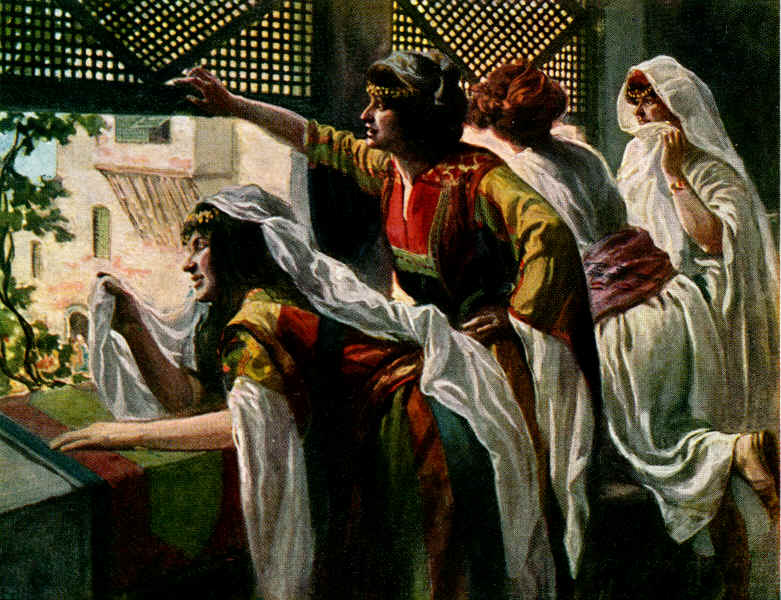
Michal Watching David From a Window
by James Tissot (1896 -1902)
Wikimedia Commons
The rise of David to become the king of Israel coincided with God’s rejection of Saul because of his failure to obey the voice of God. When Yahweh commanded Saul to fight against the Amalekites (1 Samuel 15:1–2), Saul did not do what God had commanded him to do to the Amalekites.
Yahweh told Samuel, “I regret that I made Saul king, for he has turned back from following me, and has not carried out my commands” (1 Samuel 15:11). Samuel came to Saul and told him what Yahweh had decided to do about his kingdom: “The LORD has torn the kingdom of Israel from you this very day, and has given it to a neighbor of yours, who is better than you” (1 Samuel 15:28).
God’s Election of David and Jerusalem
Saul’s neighbor, the one who was better than him, was a young man called David, a man after God’s own heart (1 Samuel 13:14). After the death of Saul on Mount Gilboa (1 Samuel 31:1–13), the people of Judah crowned David king over the tribe of Judah.
It took the northern tribes seven years to agree to elect David as their king: “Then all the tribes of Israel came to David at Hebron, and said, ‘Look, we are your bone and flesh. For some time, while Saul was king over us, it was you who led out Israel and brought it in. The LORD said to you: It is you who shall be shepherd of my people Israel, you who shall be ruler over Israel.’ So all the elders of Israel came to the king at Hebron; and King David made a covenant with them at Hebron before the LORD, and they anointed David king over Israel” (2 Samuel 5:1–3).
David reigned as king over Judah for seven years and six months. After David’s covenant with the northern tribes, David reigned over all Israel and Judah thirty-three years (2 Samuel 5:5). After David became king, he sought to establish a new capital for the united monarchy.
When Saul became king, he established the city of Gibeah as his capital. The city was called “Gibeah of Benjamin” (1 Samuel 13:2), “Gibeah of God” (1 Samuel 10:5 NIV), and “Gibeah of Saul” (Isaiah 10:29). After David became king, David decided to establish a new capital for the monarchy. David’s army conquered Jerusalem from the Jebusites and he selected Jerusalem to become the new capital of the united Israel. Jerusalem was a neutral city, a city located on the border of Judah and Benjamin.
The writer of the book of Chronicles emphasizes that David and Jerusalem were chosen by God. Jerusalem was chosen to be the place where God’s temple would be built. David was chosen to be the new leader of God’s people.
In expressing his desire to build a temple for God, Solomon gathered the people of Israel for a solemn assembly and said to them, “Blessed be the LORD, the God of Israel, who with his hand has fulfilled what he promised with his mouth to my father David, saying, ‘Since the day that I brought my people out of the land of Egypt, I have not chosen a city from any of the tribes of Israel in which to build a house, so that my name might be there, and I chose no one as ruler over my people Israel; but I have chosen Jerusalem in order that my name may be there, and I have chosen David to be over my people Israel’” (2 Chronicles 6:4–6).
Solomon’s words are very significant. The Hebrew word bāḥar, translated in English as “chosen,” implies the idea of election. God elected Jerusalem as the city in which God’s name would be manifested and God’s house would be located. God also chose David to be the “shepherd of my people Israel” (2 Samuel 5:2). Because of God’s election of David and Jerusalem, Jerusalem became known as “the city of David” (2 Samuel 5:9).
The Ark Is Brought to Jerusalem
After David became king of the united monarchy and after he had established Jerusalem as the new capital of Israel, David decided to bring the Ark of the Covenant to Jerusalem and placed it inside the tent David had prepared for the Ark (2 Samuel 6:17).
The Ark of the Covenant represented the presence of Yahweh with his people and it also represented a legitimation of David as the king of the northern and southern tribes of Israel. There is no evidence that Saul ever made any attempt at bringing the Ark to his capital. Since the Ark played an important role in the religious traditions of Israel, the presence of the Ark in Jerusalem would provide legitimation for the united monarchy.
The Ark was one of the most important religious symbols in Israel. The Ark represented the presence of Yahweh with his people. The Ark was Yahweh’s throne. Yahweh was “enthroned on the cherubim” (1 Samuel 4:4) from where he ruled as king over Israel. The people of Israel believed that Yahweh was enthroned above the outstretched wings of the cherubim, and from there “the LORD sits enthroned as king forever” (Psalm 29:10).
The transport of the Ark to Jerusalem happened in two stages with festive celebration. The parade was designed to honor David as the new king and to proclaim Jerusalem as the new capital of the nation.
The first attempt at bringing the Ark to Jerusalem was a failure. David selected a group of men to carry the Ark of God on a new cart (2 Samuel 6:3) pulled by a yoke of oxen (2 Samuel 6:6). This was the way the Philistines chose to return the Ark to Israel. After the Philistines captured the Ark and their cities were afflicted with plagues, the Philistines decided to return the Ark to Israel on a new cart pulled by a yoke of cows (1 Samuel 6:7).
This was not the proper way to transport the Ark from place to place. According to God’s instruction to Moses, the Ark was to have four rings, two rings on each side of the Ark. Two poles were to be made which would go into the rings on the sides of the ark so that the Levites could carry the Ark from place to place (Exodus 25:12–14).
When David made an attempt to bring the Ark to Jerusalem, the men carrying the Ark were not Levites and the Ark was not transported according to God’s instructions. So, when the oxen stumbled and a man named Uzzah tried to hold the Ark from falling, he was killed because he was not ritually clean to touch the Ark.
“David was angry because the LORD had struck Uzzah so violently” (2 Samuel 6:8). David recognized that he had failed. In his second attempt at bringing the Ark to Jerusalem, “David commanded that no one but the Levites were to carry the ark of God, for the LORD had chosen them to carry the ark” (1 Chronicles 15:2).
The death of Uzzah taught a lesson to David and to the people. The Ark of the Covenant was God’s throne, a symbol of his holiness, a visible representation of the presence of God with his people. By not transporting the Ark according to God’s instructions, David and the people realized they should not get casual with the way God was worshiped and how the Ark was transported.
As Brueggemann writes, “the ark must not be presumed upon, taken for granted, or treated with familiarity. The holiness of God is indeed present in the ark, but that holiness is not readily available. To touch the ark is to impinge on God’s holiness, to draw too close and presume too much” (Brueggemann 1990: 261).
After the failed attempt, David recognized that he was not ready to bring the Ark to Jerusalem, “David was afraid of the LORD that day; he said, ‘How can the ark of the LORD come into my care?’ So David was unwilling to take the ark of the LORD into his care in the city of David; instead David took it to the house of Obed-edom the Gittite” (2 Samuel 6:9–10).
Obed-edom was not an Israelite. He probably was a Philistine warrior who served in David’s army. The Ark remained in the house of Obed-edom for three months. Because Obed-edom kept the Ark in his house, “the LORD blessed the household of Obed-edom and all that belongs to him” (2 Samuel 6:12).
When David was told that Yahweh had blessed the household of Obed-edom because of the presence of the Ark of God in his house, David decided to make a second attempt at bringing the Ark to Jerusalem.
David called the Levites to carry the Ark and commanded them to follow God’s instruction about moving the Ark: “the Levites carried the ark of God on their shoulders with the poles, as Moses had commanded according to the word of the LORD” (1 Chronicles 15:15).
The Ark was brought to Jerusalem with great celebration. After the Ark was first moved, David offered a sacrifice to God. During the procession, “David danced before the LORD with all his might; David was girded with a linen ephod.
The ephod was a short garment worn by the priest. “Its shortness is implied by the ancient law of Exod 20:26 (cf. Exod 28:42), which prohibits that the altar be built so high that steps were necessary to reach it, ‘so that your nakedness may not be exposed on it’” (Cartledge 2001: 438).
David was wearing the ephod because of the ritualistic nature of the procession. “In normal, moderate activity, [the ephod] provided adequate cover to safeguard the wearer from public exposure. It was insufficient, however, to keep David covered during his ecstatic dance” (Cartledge 2001: 438).
During the procession to bring the Ark to Jerusalem, “David danced before the LORD with all his might.” David and the people brought up the Ark with shouting, and with the sound of the trumpet. In the first attempt at bringing the Ark to Jerusalem, the people carried the Ark with songs and lyres and harps and tambourines and castanets and cymbals (2 Samuel 6:5). Although these musical instruments are not mentioned on the second attempt, it is implied that they were used by the fact that David danced before the Ark in both processions.
David and Michal
David’s joy and jubilation were not pleasing to his wife Michal, “Michal daughter of Saul looked out of the window, and saw King David leaping and dancing before the LORD; and she despised him in her heart” (2 Samuel 6:16). Michal watched the parade from the window. This may indicate that she chose not to participate in the festivities.
Michal was the younger daughter of Saul, king of Israel (1 Samuel 14:49). Saul had offered David his daughter Merab as a wife, but when Saul heard that Michal loved David, he changed his mind and allowed Michal to marry David.
Later on, when Saul was planning to kill David, Saul took Michal away from David and gave her to Paltiel as a wife. After David became king of Judah, Abner, the commander of Saul’s army, wanted to make David king over all Israel. David agreed but demanded that Michal be given back to him. By the order of Ishbaal, Saul’s son, Michal was taken away from Paltiel and given to David as his wife.
Michal was appalled that in his jubilation, David exposed himself to some of the people in the parade. When David returned home from the parade, “Michal, the daughter of Saul, came out to meet him. She said in disgust, ‘How distinguished the king of Israel looked today, shamelessly exposing himself to the servant girls like any vulgar person might do’” (2 Samuel 6:20).
There are several possible reasons for Michal’s criticism of David. It is possible that Michal believed that David was not acting with royal dignity. Her words to David suggest that David was not acting like a king. As the daughter of a king, Michal was aware of life in the palace and knew how a king should act.
Gerardo Sachs believes that Michal was angry that she was taken away from her husband Paltiel. When Michal was returned to David, “David did not welcome her as a person, nor as his beloved wife, but as a sort of title or symbol of nobility, an adornment” (Sachs 2006: 263). According to Sachs, Michal was facing a serious emotional conflict for being removed from her husband and this emotional conflict “reached a crisis when she saw David dancing in the way he did.”
Ellen White believes that by exposing himself in public, David compromised Michal’s role as the wife of the king. White writes, “A woman’s status in the home is the only type of status an Israelite woman could gain and Michal held the highest level of status that a woman could get—wife of the king—and yet, her husband has behaved in such a way that has taken what is rightfully hers and given it to any who would look” (White 2007: 460).
Clines says that David’s behavior was an insult and a humiliation to Michal and took away her dignity as the wife of the king. According to Cline, David’s public exposure was a humiliation to Michal “because it proclaims David’s indifference in matters of sexual loyalty. It is David’s ‘sexual vulgarity’ that she is protesting against, certainly; but it is more than that: it is his neglect of her” (Clines 1991: 138).
In response to Michal’s criticism of his behavior, David said to Michal that he was not like Saul. He also told her that the reason he was dancing was because God had chosen him and had rejected her father, “It was before the LORD, who chose me in place of your father and all his household, to appoint me as prince over Israel, the people of the LORD, that I have danced before the LORD” (2 Samuel 6:21).
David was concerned about pleasing and honoring God by bringing the Ark to Jerusalem. David had a strong desire to worship God with music and dancing even to the point of forfeiting royal decor. He said to Michal, “I am willing to look even more foolish than this, even to be humiliated in my own eyes” (2 Samuel 6:22 NLT).
Application
My pastor, Jeff Griffin, Senior Pastor of The Compass Church in Naperville, Illinois preached a sermon on May 21, 2023 titled “David: Celebrating God Wholeheartedly.” The sermon was based on 2 Samuel 6:1–23. Many of the ideas and concepts mentioned in the post above are based on Jeff’s sermon.
In his sermon Jeff emphasized that the reason David was dancing before the Lord was because he was trying to please God. Worshiping God is not trying to please people. David focused on celebrating God with great enthusiasm because of what God had done for him.
In his sermon, Jeff mentioned the song David composed to celebrate the moving of the Ark, a song in which in which David proclaimed, “O give thanks to the LORD, for he is good; for his steadfast love endures forever” (1 Chronicles 16:34).
The bringing of the Ark to Jerusalem brought much joy to David. David was dancing before God, celebrating the auspicious occasion with all kinds of musical instruments. Jeff concluded his sermon by calling the congregation to worship God by remembering the steadfast love of God, “The steadfast love of the LORD never ceases, his mercies never come to an end; they are new every morning” (Lamentation 3:22–23).
A Video Presentation
“David: Celebrating God Wholeheartedly.” A Sermon by Jeff Griffin.
For the complete list of sermons of the life of David, read my post, David – The Life of a King.
For a complete list of posts based on Jeff Griffin’s sermons, visit my post The Sermons of Jeff Griffin.
Claude Mariottini
Emeritus Professor of Old Testament
Northern Baptist Seminary
If you enjoyed reading this post, you will enjoy reading my books.
VISIT MY AMAZON AUTHOR’S PAGE
BUY MY BOOKS ON AMAZON (Click here).
NOTE: Did you like this post? Do you think other people would like to read this post? Be sure to share this post on Facebook and share a link on Twitter or Tumblr so that others may enjoy reading it too!
I would love to hear from you! Let me know what you thought of this post by leaving a comment below. Be sure to like my page on Facebook, follow me on Twitter, follow me on Tumblr, Facebook, and subscribe to my blog to receive each post by email.
If you are looking for other series of studies on the Old Testament, visit the Archive section and you will find many studies that deal with a variety of Old Testament topics.
BIBLIOGRAPHY
Brueggemann, Walter. First and Second Samuel. Interpretation. Louisville: John Knox Press, 1990.
Cartledge, Tony W. 1 & 2 Samuel. Smyth & Helwys Bible Commentary. Macon: Smyth & Helwys, 2001.
Clines, David J. A. “The Story of Michal, Wife of David, in its Sequential Unfolding.” Pages 129–140 in Telling Queen Michal’s Story: An Experiment in Comparative Interpretation. Sheffield: JSOT Press, 1991.
Sachs, Gerardo G. “David Dances – Michal Scoffs.” Jewish Bible Quarterly 34 no 4 (2006): 260–263.
White, Ellen. “Michal the Misinterpreted.” Journal for the Study of the Old Testament 31 no 4 (2007): 451–464.














 Dr. Claude Mariottini - Professor of Old Testament