
>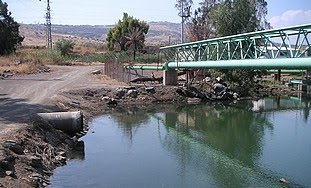
Photo: The Jordan River
Photo by: Friends of the Earth/Middle East
Several years ago, Samuel Stennett (1727-1795) wrote a beautiful song describing the believer’s anxiety to enter God’s promised land. The hymn, “On Jordan’s Stormy Banks I Stand,” mentions Jordan’s stormy banks:
On Jordan’s stormy banks I stand,
and cast a wishful eye
to Canaan’s fair and happy land,
where my possessions lie.
Refrain:
I am bound for the promised land,
I am bound for the promised land;
oh, who will come and go with me?
I am bound for the promised land.
According to an article in The Jerusalem Post (a shorter version of the article appears in Israel Today), Jordan’s stormy banks soon will be no more. According to the news report, the lower section of the Jordan River may run dry by next year.
Below is an excerpt from the article:
Unless urgent action is taken, large sections of the Lower Jordan River, which runs from Lake Kinneret to the Dead Sea, will dry out next year, according to a study released on Sunday by EcoPeace/Friends of the Earth Middle East (FoEME).
The NGO ran tests over a year to determine how much water would be needed to rehabilitate the river and damage had been caused by the lack of water in it. Israel, Jordan and Syria divert 98 percent of the flow for their respective country’s use.
In the 19th and early 20th century, 1.3 billion cubic meters of water cascaded each year down rapids and rolled over waterfalls on the way down to the lowest point on Earth – the Dead Sea.
In 2009, just 20 m.cu.m. to 30 m.cu.m of water pooled and sluggishly flowed through the river’s channels – all of it sewage. Sewage runs from Israel, the Palestinian Authority and Jordan into the river. However, two new sewage treatment plants, one in the Beit She’an area and the other in the Jordan Valley Regional Council area, are set to begin operating over the next year and a half.
While FoEME praised the construction of the two plants, it warned that unless fresh water replaced the amounts of sewage water that would be removed, the once mighty Lower Jordan River would become a cracked and dry riverbed through much of its 100-km. length.FoEME’s studies looked at how much water would be needed to totally rehabilitate the river, and an accompanying economic analysis recommended ways to free up the necessary amount.
The lack of fresh water has also destroyed much of the ecosystem both within and next to the river, the study found. Fifty percent of macro-invertebrates have disappeared because the river no longer flows swiftly and is highly saline. Examples of macro-invertebrates include flatworms, crayfish, snails, clams and insects.
Otters have disappeared from the Jordan and the willow trees that once lined its shores have all disappeared, FoEME Israel Director Gidon Bromberg said during a media tour of the river on Sunday
Read the article in its entirety by clicking here.
It is a shame if the Lower Jordan River is allowed to run dry. The diversion of water from the river and its tributaries for agricultural and residential use has caused the problem. Let us hope that the Israeli and Jordanian governments find a solution to this problem.
Claude Mariottini
Professor of Old Testament
Northern Baptist Seminary
If you enjoyed reading this post, subscribe to my posts here.
Tags: Jordan River, Drought, Water














 Dr. Claude Mariottini - Professor of Old Testament
>already very dry. when i went in to israel in 2006, the jordan at allenby bridge crossing was down to a drain size! there were pumps draining out water from the river to irrigate the fields on both sides of jordan and israel.i heard even the dead sea has significantly receded in its waterline.
LikeLike
>Anthony,The last time I was in Israel, the river was also down. I just wonder when was the last time that the Jordan River had stormy banks.You heard right: the Dead Sea is also much smaller than it used to be.Claude Mariottini
LikeLike