
CNN is reporting that a 3,400-year-old Mittani palace has been discovered in Iraq. According to the report, archaeologists also found ten clay tablets written in cuneiform, an ancient system of writing developed by the Sumerians between 3500-3000 BCE. The following is an excerpt from the article:
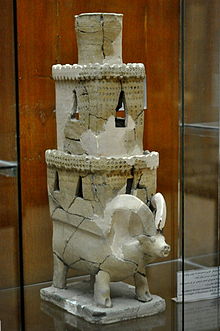
Hurrian Incense Container
(CNN) – A 3,400-year-old palace has emerged from a reservoir in the Kurdistan region of Iraq after water levels dropped because of drought.
The discovery of the ruins in the Mosul Dam reservoir on the banks of the Tigris River inspired a spontaneous archeological dig that will improve understanding of the Mittani Empire, one of the least-researched empires of the Ancient Near East.
“The find is one of the most important archaeological discoveries in the region in recent decades,” Kurdish archeologist Hasan Ahmed Qasim said in a press release.
The palace would have originally stood just 65 feet from the river on an elevated terrace. A terrace wall of mud bricks was later added to stabilize the building, adding to the imposing architecture.
“From the texts we hope to gain information on the inner structure of the Mittani empire, its economic organisation, and the relationship of the Mittani capital with the administrative centers in the neighboring regions.”
Although most Christians have never heard of the Mittani Empire, Mittani was a Hurrian-speaking state in northern Syria. According to most scholars, the Hivites and the Horites of the Old Testament were Hurrians who lived in Canaan. In the days of Chedorlaomer, king of Elam, he and the other kings from the East who came with him, conquered the Horites who lived in the hill country of Seir (Genesis 14:1-6). The Hivites were one of the seven nations which lived in Canaan at the time Joshua and the army of Israel conquered the land (Deuteronomy 7:1).
When Abraham left Ur to go to Canaan, he and his family went to the city of Haran: “Terah took his son Abram and his grandson Lot son of Haran, and his daughter-in-law Sarai, his son Abram’s wife, and they went out together from Ur of the Chaldeans to go into the land of Canaan; but when they came to Haran, they settled there” (Genesis 11:31).
Haran, the city where Abraham lived, was a city where the population was predominantly Hurrian. Because Abraham and many of his descendants lived in a Hurrian city, the stories of the patriarchs reflect some of the cultural practices common in Hurrian society.
For instance, many of the regulations outlined in the Nuzi tablets were also practiced by the patriarchs. Nuzi was a Hurrian city near Kirkuk in Iraq. According to John Bright (1981: 78), “Numerous incidents in the Genesis narrative have been explained in the light of customs that were current in the second millennium. The Nuzi texts . . . reflect the customary law of a predominantly Hurrian population in the East-Tigris region.”
Bright goes on by listing several Hurrian practices that were similar to the practices of the patriarchs in the book of Genesis. Below is a quotation from Bright (1981: 79). Although it is a lengthy quotation, the examples cited by Bright serve to explain puzzling practices by the patriarchs and also, they show how much Hurrian influence appears in the Old Testament. Bright wrote:
Abraham’s fear (Gen. 15:1-4) that his slave Eliezer would be his heir becomes understandable in the light of slave adoption as practiced in Nuzi. Childless couples would adopt a son who would serve them as long as they lived and inherit on their death. But, should a natural son be born, the adopted son would have to yield the right of inheritance.
Again, as Sarah gave her slave Hagar to Abraham as a concubine (ch. 16:1-4), so at Nuzi a marriage contract obliged the wife, if childless, to provide her husband with a substitute. Should a son be born of such a union, the expulsion of the slave wife and her child was forbidden—which explains Abraham’s reluctance to send Hagar and Ishmael away (ch. 21:10f.).
In the case of the Laban-Jacob stories the Nuzi texts are especially illuminating. The adoption of Jacob by Laban (suggested by ch. 31:43), the condition laid on him to take no other wives than Laban’s daughters (Ch. 31:50), the resentment of Leah and Rachel against Laban (ch. 31:14f.), and finally Rachel’s theft of Laban’s gods, all are illustrated by Nuzians customs.
The examples cited above, and a few more serve to illustrate that some of the practices of the patriarchs were practices that seem strange and alien in today’s society. These practices reflect common customs that were observed by some societies in the Ancient Near East at the time when the patriarchs lived.
In his study of the connections between the Hebrews and other peoples who lived in Mesopotamia, William Harms quotes Harry Hoffner, Professor in the Oriental Institute of the University of Chicago who specializes in Hurrian and Hittite studies. Harms wrote,
Although some people have thought that many of the ideas expressed in the Bible are unique to the Hebrew culture, scholars are gathering evidence that points to similarities between Israelite experiences and those of other Near Eastern peoples.
“We’ve always known that the Bible was an international book. It reflects life in a richly varied world with lots of meeting points. But it’s not until we have texts like this that we begin to realize how interconnected the people of biblical times were,” Hoffner said.
The Hurrians, a neighboring tribe of the Hittites, probably had even closer contact with the Hebrews than did the Hittites, Hoffner said. Two groups mentioned in the Bible, the Horites and Hivites, were probably Hurrians, and Abdi-hepa, a Jebusite king who ruled Jerusalem three centuries before its conquest by Israel’s King David, had a Hurrian name, Hoffner said.
Given this connection, it is not surprising to find an echoing of ideas between the Scriptures and the texts of other peoples in the area, he said. They shared similar problems as well as similar values.
“Because the narratives of the Bible are familiar to many of us from church and synagogue, we often unconsciously divorce them from their ancient roots,” Hoffner said. “We do this because we value their moral teachings as expressions of timeless truth. But it is a mistake to fail to see that the particular biblical forms of expressing these timeless truths can be associated with particular groups of people in specific geographical and chronological settings.”
The parallel that exists between the biblical narrative and some of the customs and practices of the Fertile Crescent in the second millennium does not provide a fixed date for the stories of the patriarchs. However, the fact that these practices appear nowhere else in the Old Testament, not even in the laws of the Pentateuch, indicates that the patriarchs came from outside of Canaan and that their stories reflect the social conditions that existed in Mesopotamia in the second millennium.
Thus, the discovery of these cuneiform tablets is important because they have the potential to provide valuable information about the social, cultural, and religious life of the Hurrian people who lived in the kingdom of Mittani.
NOTE: For other articles on archaeology, archaeological discoveries, and how they relate to the Bible, read my post Can Archaeology Prove the Bible?.
Claude Mariottini
Emeritus Professor of Old Testament
Northern Baptist Seminary
VISIT MY AMAZON AUTHOR’S PAGE
BUY MY BOOKS ON AMAZON (Click here).
NOTE: Did you like this post? Do you think other people would like to read this post? Be sure to share this post on Facebook and share a link on Twitter or Tumblr so that others may enjoy reading it too!
I would love to hear from you! Let me know what you thought of this post by leaving a comment below. Be sure to like my page on Facebook, follow me on Twitter, follow me on Tumblr, Facebook, and subscribe to my blog to receive each post by email.
If you are looking for other series of studies on the Old Testament, visit the Archive section and you will find many studies that deal with a variety of topics.














 Dr. Claude Mariottini - Professor of Old Testament