
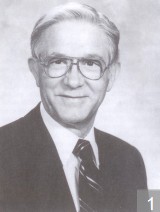
Page H. Kelley
Today, March 13, marks the anniversary of the death of Page H. Kelley, one of the most distinguished Old Testament scholars and educators produced by the Southern Baptist tradition. He died on March 13, 1997, in a Louisville, Kentucky, hospital following a recent heart attack. He was seventy-two years of age. This essay is a tribute to his life, his work, and his enduring contribution to biblical scholarship — particularly to the study of Biblical Hebrew and the interpretation of the Old Testament.
Early Life and Formation
Page H. Kelley was born on July 19, 1924, in Hartford, Alabama. He came of age in the American South during an era when the Baptist tradition was deeply invested in pastoral formation and biblical literacy. His academic journey took him first to Samford University in Birmingham, where he earned a Bachelor of Arts degree in 1945. He then pursued theological study at The Southern Baptist Theological Seminary in Louisville, Kentucky, where he received his Bachelor of Divinity degree in 1948 and subsequently his Doctor of Theology degree in 1953.
Even before completing his doctoral studies, Kelley had already begun his teaching career. He served as an instructor in Hebrew at Southern Seminary from 1951 to 1952, an appointment that foreshadowed what would become the defining commitment of his scholarly life: the teaching of the Hebrew language to aspiring ministers and biblical scholars.
Pastoral Ministry and International Service
Kelley was not merely a scholar cloistered in the academy. He was first and foremost a minister of the gospel, and he served the church in several pastoral roles throughout his career. He began his ministry as an assistant pastor at Hunter Street Baptist Church in Birmingham, Alabama, in 1942 — even before the completion of his formal theological education. Over the following decades, he served as pastor of four other churches, demonstrating a persistent commitment to the life of the congregation alongside his academic vocation.
Among the most formative chapters of his ministry was a period of international service. From 1955 to 1959, Kelley served at a Baptist church in Rio de Janeiro, Brazil, during which time he also taught at the Baptist seminary there. This experience of cross-cultural ministry and international theological education deepened his understanding of the global reach of biblical scholarship and left a lasting impression on his pedagogical vision.
A Career of Teaching at Southern Seminary
In 1959, Kelley returned to The Southern Baptist Theological Seminary as a full member of the faculty, accepting the position of Professor of Old Testament Interpretation. He would hold this position for thirty-three years, retiring in 1992. This tenure of more than three decades made him one of the most influential Old Testament teachers in the history of Southern Seminary and, by extension, in the broader Southern Baptist academic world.
Seminary President R. Albert Mohler Jr. offered this assessment of his colleague upon his death:
“Dr. Kelley was a distinguished professor of Old Testament interpretation who gave more than 30 years of his life to the teaching of ministers through The Southern Baptist Theological Seminary. He was a genuinely gracious teacher, and a man who shared his passion for understanding Scripture with his students.”
This testimony captures something essential about Kelley’s reputation. He was not known primarily as a polemicist or a controversialist but as a teacher — patient, rigorous, and deeply invested in his students’ formation. Colleagues and former students alike remembered him for his extraordinary ability to make the complexities of the Hebrew language and the Old Testament accessible to those who encountered them for the first time.
Following his retirement from Southern Seminary in 1992, Kelley continued his teaching ministry at the Baptist Theological Seminary at Richmond, Virginia. His commitment to the classroom persisted even in retirement, a testament to his sense of vocation and his love for the work of theological education.
The Study of Biblical Hebrew: His Central Contribution
If Page Kelley is remembered for one thing above all others in the world of biblical scholarship, it is his contribution to the teaching and study of Biblical Hebrew. The language of the Old Testament was, for him, not merely a technical tool but the very medium through which the Word of God was first communicated to Israel. He believed that no interpreter of the Hebrew Bible could afford to remain ignorant of its original language, and he devoted his professional life to equipping students to engage the text on its own terms.
His most celebrated work in this area is Biblical Hebrew: An Introductory Grammar, published in 1992 by Eerdmans. This volume quickly became a standard textbook in seminary classrooms across the country and beyond. It was widely praised for its clarity, its pedagogical organization, and its ability to guide the beginning student through the intricacies of Hebrew morphology and syntax without overwhelming or discouraging. Reviewers and teachers consistently described it as an unusually reliable and accessible introduction — a solid beginning for the Hebrew novice that nonetheless prepared the student for serious engagement with the biblical text.
The grammar did not appear in isolation. In 1994, Kelley co-authored A Handbook to Biblical Hebrew: An Introductory Grammar with Terry L. Burden and Timothy G. Crawford. This companion volume served as a practical guide to the exercises and readings in the primary grammar, providing the additional scaffolding that students in structured classroom settings require. Together, the grammar and the handbook formed a coherent pedagogical system for the introduction of Biblical Hebrew, one that reflected decades of classroom experience and careful attention to the needs of beginning students.
A third major contribution to Hebrew scholarship was his co-authored work, The Masorah of Biblia Hebraica Stuttgartensia, prepared with Daniel S. Mynatt and Timothy G. Crawford. The Masorah — the elaborate system of marginal notes appended by medieval Jewish scholars to the received text of the Hebrew Bible in order to preserve its precise transmission — is one of the most technically demanding areas of Old Testament textual study. Kelley’s decision to produce an introductory guide to this material reflected his belief that serious students of the Hebrew Bible should be equipped to navigate the full apparatus of the Biblia Hebraica Stuttgartensia, the critical edition of the Hebrew Old Testament used by scholars worldwide. This work remains a valuable resource for advanced students and scholars who seek to understand the textual tradition underlying the canonical text.
Commentaries and Biblical Scholarship
Beyond his work in Hebrew pedagogy, Kelley made significant contributions to the interpretation of several Old Testament books. He authored the commentary on Isaiah in the Broadman Bible Commentary, a multi-volume series produced for use in Baptist churches and educational settings. He also wrote commentaries on the books of Amos and Exodus, engaging the prophetic and Pentateuchal traditions with the same care and accessibility that characterized all his scholarship.
His most substantial contribution to the technical commentary tradition was his participation in the Word Biblical Commentary series, one of the most rigorous academic commentary projects of the twentieth century. Kelley co-authored the volume on Jeremiah 1–25 (Word Biblical Commentary, Volume 26) alongside Peter C. Craigie and Joel F. Drinkard Jr. This commentary engaged the Hebrew text of Jeremiah with full scholarly apparatus, bringing Kelley’s linguistic expertise to bear on one of the most linguistically demanding and theologically rich books of the Old Testament prophetic corpus. The volume remains a standard reference in the scholarly study of Jeremiah.
In total, Kelley authored or co-authored ten books across the course of his career. This output, while not extraordinary in its volume, is remarkable for its consistent quality and for the breadth of its influence — spanning introductory pedagogy, Masoretic textual study, expository commentary, and technical critical scholarship.
A Personal Tribute
Page H. Kelley was my professor of Old Testament at The Southern Baptist Theological Seminary, and he served as a member of my doctoral dissertation committee. I came under his instruction at a formative period in my theological education, and his influence on my approach to the Hebrew Bible and to the task of Old Testament interpretation has never left me. He helped me to learn Hebrew — a gift whose value cannot be overstated, for it opened the door to the Old Testament in its original tongue and changed forever the way I read and teach the sacred text.
As a member of my doctoral dissertation committee, Kelley brought to bear on my work the same careful attention, the same commitment to linguistic precision, and the same gracious encouragement that he extended to all his students. His evaluation of my dissertation was both rigorous and generous, the mark of a scholar who took his responsibilities seriously and who genuinely cared about the formation of the next generation of biblical interpreters.
It was therefore a privilege of a particular and personal kind to serve as co-editor, together with Gregory Mobley, of a Festschrift published in honor of Page Kelley. The volume, titled Perspectives on the Old Testament and Hebrew, appeared as the Winter 2001 issue of the journal Perspectives in Religious Studies. A Festschrift — that venerable academic tradition of gathering essays by former students and colleagues in honor of a distinguished teacher — is among the highest tributes the scholarly community can pay to one of its own. That Kelley merited such a tribute is a measure not only of the esteem in which he was held by those who knew him personally but of the breadth of his influence on an entire generation of Old Testament scholars and ministers. To have had a part in honoring his memory in this way remains, for me, one of the most meaningful acts of my own scholarly career.
Today, on the anniversary of his death, it is fitting to remember Page Kelley not only as a scholar whose books remain in use in seminary classrooms around the world, but as a teacher in the deepest sense of that word — one who gave himself to his students with patience, wisdom, and grace.
Legacy
Page H. Kelley died on March 13, 1997, survived by his wife and their children. He was laid to rest after a funeral service at Broadway Baptist Church in Louisville, Kentucky, on March 14. He was seventy-two years old.
His legacy endures in the thousands of students who learned to read the Hebrew Bible under his instruction or through his textbooks, in the pastors and scholars who carry forward the interpretive tradition he embodied, and in the scholarly works he left behind. Biblical Hebrew: An Introductory Grammar continues to be used in seminaries and divinity schools decades after its publication. The Masorah of Biblia Hebraica Stuttgartensia remains indispensable for textual scholars. His commentary on Jeremiah in the Word Biblical Commentary series continues to be cited in scholarly literature.
More than any particular publication, however, Page Kelley’s legacy is the legacy of a teacher — a man who believed that the careful study of the Hebrew Bible in its original language was among the most important gifts that could be offered to those who would serve the church and interpret the Word of God. He gave that gift generously, faithfully, and with genuine love for the text and for the students who came to learn from him.
He was, in the fullest sense of the term, a servant of the Word.
Selected Bibliography of Works by Page H. Kelley
Kelley, Page H. Biblical Hebrew: An Introductory Grammar. Grand Rapids: Eerdmans, 1992.
Kelley, Page H., Terry L. Burden, and Timothy G. Crawford. A Handbook to Biblical Hebrew: An Introductory Grammar. Grand Rapids: Eerdmans, 1994.
Kelley, Page H., Daniel S. Mynatt, and Timothy G. Crawford. The Masorah of Biblia Hebraica Stuttgartensia: Introduction and Annotated Glossary. Grand Rapids: Eerdmans, 1998.
Craigie, Peter C., Page H. Kelley, and Joel F. Drinkard Jr. Jeremiah 1–25. Word Biblical Commentary 26. Dallas: Word Books, 1991.
Kelley, Page H. “Isaiah.” In The Broadman Bible Commentary. Nashville: Broadman Press.
Festschrift in Honor of Page H. Kelley
Mariottini, Claude F., and Gregory Mobley, eds. “Perspectives on the Old Testament and Hebrew.” Perspectives in Religious Studies 28, no. 4 (Winter 2001). [Festschrift in honor of Page H. Kelley.]
Claude Mariottini
Emeritus Professor of Old Testament
Northern Baptist Seminary
If you enjoyed reading this post, you will enjoy reading my books.
VISIT MY AMAZON AUTHOR’S PAGE
BUY MY BOOKS ON AMAZON (Click here).
NOTE: Did you like this post? Do you think other people would like to read this post? Be sure to share this post on Facebook and share a link on X so that others may enjoy reading it too!
If you are looking for other series of studies on the Old Testament, visit the Archive section and you will find many studies that deal with a variety of Old Testament topics.











 Dr. Claude Mariottini - Professor of Old Testament