
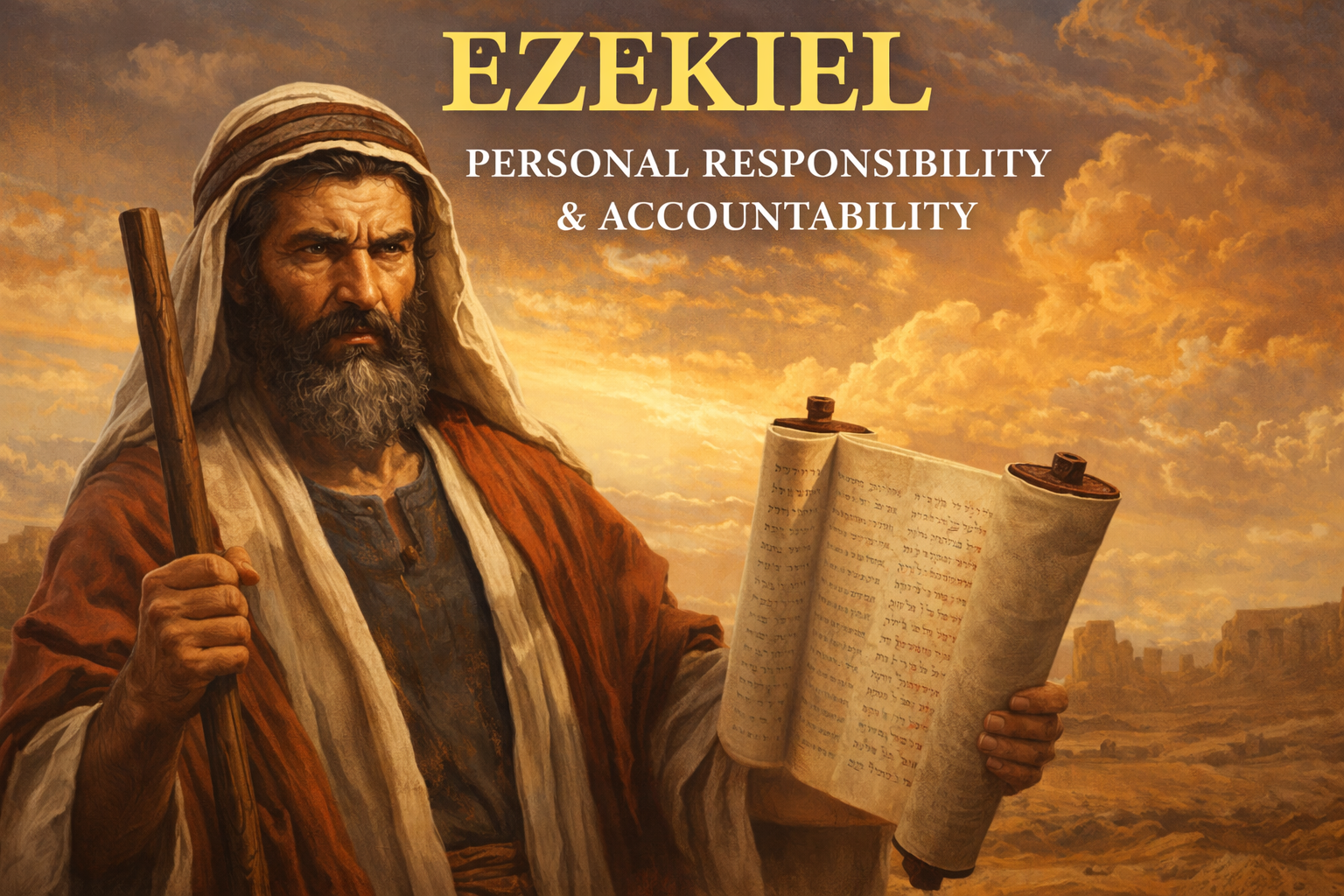
NOTE: Years ago, I served as a curriculum writer for the Sunday School Board of the Southern Baptist Convention, where I developed Spanish-language lessons to help adult Sunday School teachers prepare their classes. One series of lessons focused on the book of Ezekiel, which was published in 1986. I have since translated these lessons into English, updated the content, and reformatted them as essays. The complete series of Ezekiel studies can be found in my post “Studies on the Book of Ezekiel.” This post examines the just man of Ezekiel 18. The study in Chapter 18 will be divided into four parts:
Part 1: Personal Responsibility in Crisis
Part 2: The Just Man: Responsibility in Right Action
Part 3: The Evil Son: Responsibility in Transgression
Part 4: The Good Son: Redemption through Choice
The Text
“‘But if a man is just and does what is lawful and right—does not eat upon the mountains, nor lift up his eyes to the idols of the house of Israel, nor defile his neighbor’s wife, nor approach a woman during her menstrual period; does not oppress anyone, but returns a pledge to a debtor, does not rob, gives his bread to the hungry, and covers the naked with clothing; does not lend at interest nor take usury; withholds his hand from wrongdoing, does true justice between man and man, walks in my statutes and keeps my judgments faithfully—he is just; he shall surely live,’ says Jehovah the Lord” (Ezek. 18:5-9).
The Structure of Righteousness
To answer the question of God’s justice and individual responsibility, Ezekiel presents the case of the just man who will live because of his justice. This figure serves as a model, not an impossible ideal, but a realistic portrait of the covenant-keeping community member. The just man is the person who has made a personal decision to obey God’s demands. The just is someone who does what is lawful and right, one who is upright in his manner of living. The just man is identified not by intention or inner sentiment alone, but by the deeds he does. This emphasis on observable action reflects the biblical understanding that faith demonstrates itself through works (see Ps.15; Isa. 33:15–16).
The justice demanded by the prophet includes two interconnected dimensions: virtues in social relationships that exhibit equity with one’s neighbor, and an authentic personal relationship with the LORD. The description of the just man explicitly addresses both requirements, revealing that genuine piety cannot be compartmentalized into “spiritual” and “social” dimensions. One’s relationship with God necessarily expresses itself in just treatment of others.
The Thirteen Characteristics of the Just Man
Ezekiel lists thirteen specific characteristics of the just man: five positive injunctions and eight negative prohibitions. These characteristics address both ritual worship and social conduct, demonstrating that holiness encompasses the full spectrum of human life.
Matters of Religious Faithfulness
Not eating upon the mountains: Eating upon the mountains was associated with ritual, idolatrous feasts held in the high places as part of sacrifices to pagan gods. The prophet Hosea condemned the people of Israel who “sacrificed on the mountains and burned incense on the hills” (Hos. 4:13). Isaiah declared that burning incense on the mountains and hills was an affront to God (Isa. 65:7). The just man refuses to participate in syncretistic worship; he does not sacrifice on the mountains to pagan gods or share in idolatrous meals that blur the line between covenant loyalty and pagan religion.
Not lifting up his eyes to idols: This means worshipping idols through invocation and requesting their help or blessing. The second commandment explicitly prohibits the making of graven images and bowing down before them or honoring them with prayer or worship (Exod. 20:4–5; Deut. 5:8–9). The just man comprehends a theological principle: idols, fashioned by human hands, possess no life-giving power. To address them is to address emptiness.
Matters of Domestic Integrity
Not defiling his neighbor’s wife: The prohibition against adultery appears in the Ten Commandments (Exod. 20:14; Deut. 5:18) and also in the laws of holiness in Leviticus 20:10. This law teaches that God considers marriage a sacred relationship that must not be violated. Adultery constitutes both a violation of one’s marriage covenant and an injury to the neighbor. The just man respects the sanctity of another’s marriage as he would respect his own.
Not approaching a woman during her menstrual period: According to Leviticus 15:19–30, a woman in her menstrual period is ritually impure, and the man who has relations with her becomes ritually impure and incapable of entering the temple for worship. The just man’s concern for his own ritual purity reflects his desire to maintain access to God’s presence and to worship him faithfully in the temple. This practice demonstrates that piety includes attention to the holiness requirements that preserve one’s fitness to approach God.
Matters of Social Justice and Economic Righteousness
Not oppressing anyone: The just man does not oppress the poor or the socially disadvantaged. The law explicitly prohibits oppression of the poor, widows, orphans, and foreigners. In the biblical worldview, the vulnerable members of society have special significance; their treatment serves as a measure of society’s righteousness. The just man does not oppress the needy, but rather acknowledges his obligation to protect them (see Job 31:16–23).
Returning the pledge to the debtor: The law prohibits taking the debtor’s essential clothing as permanent security, as it is a necessity for survival. According to the law, if a garment was taken as a pledge or guarantee for a loan, it must be returned to the debtor before nightfall so that he might sleep warmly (Lev. 22:25–26; Deut. 24:17). This law reveals God’s mercy toward those in financial straits and demands that creditors maintain compassion even while protecting their interests. The just man honors this requirement.
Not robbing or stealing: Theft here means taking something that belongs to another through violence. In Hebrew, the word for theft (gāzal) conveys the idea of violent taking. The just man is not violent toward others, nor does he covet what belongs to his neighbor, which would violate the tenth commandment (Exod. 20:17). His justice extends to respect for the property rights of others.
Giving bread to the hungry and clothing the naked: The law does not specifically mandate giving bread to the hungry or clothing the naked, although it teaches that one must have compassion for the needy (Lev. 19:9–10; Deut 15:7–11). Yet Ezekiel includes these acts as essential to the just man’s character. The just man does these things because they reflect the proper character of God himself. Yahweh is described as “the one who does justice for the orphan and widow, who also loves the foreigner, giving him bread and clothing” (Deut. 10:18). The just man imitates God’s character in concrete action.
What Ezekiel teaches here is revolutionary in its implications: abstaining from doing evil is not sufficient to constitute justice. One must actively help the needy as much as possible. Not doing evil does not equal doing good. The just man takes the initiative to help the needy, demonstrating a proactive righteousness that extends beyond merely avoiding harm.
Not lending at interest or taking usury: The law explicitly prohibits taking interest: “If your brother becomes poor and is forced to turn to you, you shall help him…. do not take interest or profit from him, but fear your God, and your brother shall live with you. Do not lend him your money at interest, nor your food at profit” (Lev. 25:35–37). The just man helps his poor brother without seeking profit from his misfortune. He does not accept bribes against the innocent (Ps. 15:5).
Doing true justice between man and man: The just man treats everyone fairly; justice presides over his actions in all his relations with his neighbor. He does not play favorites based on wealth or status; he shows no partiality. His judicial decisions and everyday dealings are characterized by genuine equity.
The Foundation of Justification
Above all, the just man achieves his righteousness through his fundamental obedience to God. “Walking in his statutes” means shaping one’s entire life around God’s word, seeking in all things to please God. The just man is upright in his relationship with other people precisely because he is upright in his relationship with God. There is no contradiction between piety and ethics; rather, authentic piety necessarily produces ethical fruit.
Ezekiel asserts that whoever acts thus is just in the eyes of both men and God. His justice derives not from the accumulation of charitable works, though these are important, but from his obedient and humble dedication to God. The person who lives in this manner receives the divine promise: “He shall surely live.” This declaration is not merely about physical continuation but about life in the fullest biblical sense—life in right relationship with God, life abundant and blessed. This divine promise of life is evidence that his actions please God, because God gives life as a reward, opposed to the death of the sinner promised in verse 4.
To Be Continued: Part 3: The Evil Son: Responsibility in Transgression
Claude Mariottini
Emeritus Professor of Old Testament
Northern Baptist Seminary
If you enjoyed reading this post, you will enjoy reading my books.
VISIT MY AMAZON AUTHOR’S PAGE
BUY MY BOOKS ON AMAZON (Click here).
NOTE: Did you like this post? Do you think other people would like to read this post? Be sure to share this post on Facebook and share a link on X so that others may enjoy reading it too!
If you are looking for other series of studies on the Old Testament, visit the Archive section and you will find many studies that deal with a variety of Old Testament topics.












 Dr. Claude Mariottini - Professor of Old Testament
Pingback: The Just Man: Responsibility in Right Action | Talmidimblogging