
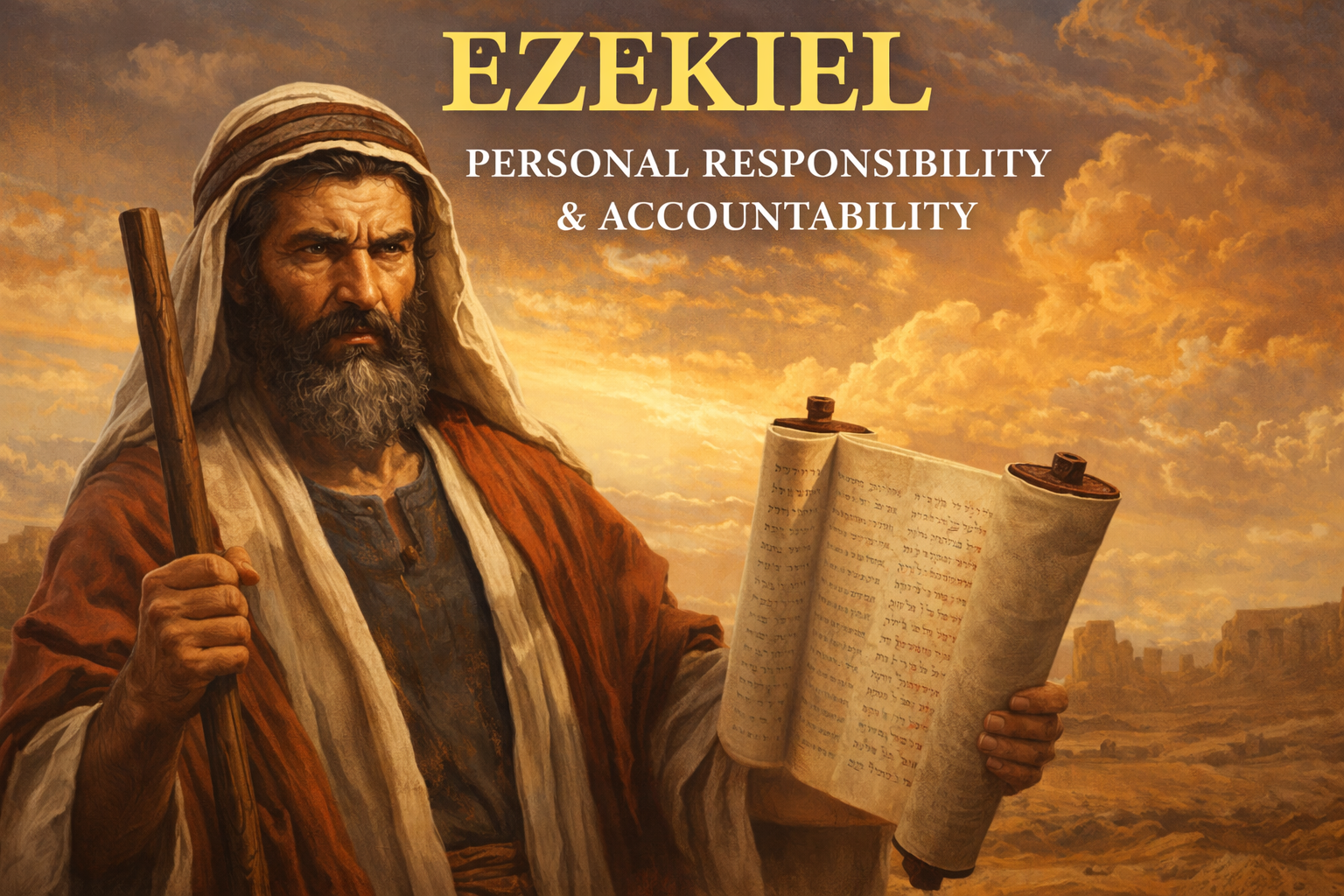
NOTE: Years ago, I served as a curriculum writer for the Sunday School Board of the Southern Baptist Convention, where I developed Spanish-language lessons to help adult Sunday School teachers prepare their classes. One series of lessons focused on the book of Ezekiel, which was published in 1986. I have since translated these lessons into English, updated the content, and reformatted them as essays. The complete series of Ezekiel studies can be found in my post “Studies on the Book of Ezekiel.” This post examines Ezekiel’s teaching on personal responsibility (Ezekiel 18). The study in Chapter 18 will be divided into four parts:
Part 1: Personal Responsibility in Crisis
Part 2: The Just Man: Responsibility in Right Action
Part 3: The Evil Son: Responsibility in Transgression
Part 4: The Good Son: Redemption through Choice
Part 1: Personal Responsibility in Crisis
The message of the prophet Ezekiel, like that of all the prophets who preceded him, was directed to the people of Israel, the community known as the people of God, united to Yahweh by the demands of the covenant established at Mount Sinai. However, Ezekiel’s prophetic ministry unfolded in extraordinary circumstances that profoundly shaped his message.
Ezekiel declared in his prophecies that the nation stood under God’s judgment and that the community, from the beginning of its history as a nation through his own day, had rebelled against God. The prophet recognized that the presence of the people in Babylon, their captivity and deportation, constituted evidence of God’s judgment. Yet Ezekiel perceived this national calamity from another, more hopeful perspective. The community in exile, although deserving divine punishment, remained composed of persons whom God had chosen as his people. What would become of each individual? This question became central to Ezekiel’s prophetic concerns.
The Covenant Foundation
The covenant made with Israel at Mount Sinai established not merely a national relationship with God, but also revealed God’s personal interest in each individual. This covenant created a profound double relationship: between the people and God, and among the people themselves. The covenant produces within the human community a bond that unites its members so that the welfare of some determines the welfare of others.
Within this covenantal community, the individual enjoys a personal relationship with God, and the community protects their legal rights. In biblical anthropology, the individual achieves full personhood only when living in community, in authentic relationship with both God and fellow believers. Apart from the community, the individual exists in isolation, incomplete and vulnerable.
The Crisis of Displaced Responsibility
However, the hour of national disaster created an unprecedented situation. When the community was temporarily separated, and the people were removed from their native land, the problem of guilt became acute and personal. Severed from the social context that had given meaning and support to individual lives, the people faced a spiritual and psychological crisis. Confronted with the problem of innocent suffering, the popular complaint echoed through the exile: “The fathers ate sour grapes, and the children’s teeth are set on edge” (Jeremiah 31:29; Ezekiel 18:2).
This proverb expressed a cynical resignation. The people insisted that they were not to blame for the sins of their parents, which had brought about God’s judgment. They sought a psychological escape from guilt by attributing their suffering entirely to inherited sin. In this fatalistic thinking, they sought to deflect responsibility from themselves and place it squarely on earlier generations.
Yet the people’s own sin had provoked God’s judgment upon the nation. Ezekiel was called as a prophet specifically to defend divine justice and to proclaim God’s judgment upon the nation while simultaneously offering a path to redemption through personal repentance and responsibility.
The Lesson for Today
Today’s lesson teaches a principle essential to biblical faith: each person is responsible for their relationship with God. The words of the prophet Ezekiel articulate various aspects of the biblical teaching of personal responsibility, a doctrine that addresses not only ancient Israel’s crisis but speaks with urgency to contemporary believers.
The Fundamental Principle of Personal Responsibility
“The word of the LORD came to me: What do you mean by repeating this proverb concerning the land of Israel, ‘The parents have eaten sour grapes, and the children’s teeth are set on edge’? As I live, says the Lord GOD, this proverb shall no more be used by you in Israel. Know that all lives are mine; the life of the parent as well as the life of the child is mine: it is only the person who sins that shall die” (Ezek. 18:1–4 NRSV).
The Prophet’s Authority
The prophet receives the word of God for the people. Ezekiel is presented throughout this passage as a prophet of Yahweh who zealously defends God’s justice. The oracle that follows unfolds as a dispute between the prophet and the people, with the people’s objections cited directly in verses 2, 19, 25, and 29. This rhetorical structure allows the people’s despair and cynicism to be fully articulated before being answered by divine truth. The prophet preaches a message of God’s justice to people condemned by their own thinking to live a life of personal guilt and punishment for the sins of their ancestors.
The People’s Complaint
The words of the people express the fundamental problem that Ezekiel confronted. The people in Babylon spoke ironically and maliciously: “Our fathers sinned and have died, and we bear their punishment” (Lam. 5:7). This popular saying, quoted here and also cited in Jeremiah 31:29–30, is evidence of a popular revolt against the present situation in exile. This attitude represents more than mere complaint; it constitutes a mockery of God’s justice because it lays the guilt upon the children for the sins of their fathers.
The people of Israel believed that Yahweh was indeed “a God who punishes the iniquity of the fathers upon the children to the third and fourth generation” (Exod. 20:5). From a historical perspective, this understanding was not without foundation. In human history, the sins of the fathers do visit future generations. Many of the afflictions present in contemporary society are demonstrably the result of the actions and decisions of past generations. Systemic injustice, broken family patterns, economic inequality, and spiritual decline do accumulate across generations.
Yet Ezekiel sought to correct the people’s fatalistic thinking and disposition. He did not deny that consequences ripple across time, but he challenged the assumption that this inevitable reality meant the present generation bore no responsibility for their own choices.
God’s Sovereign Response
Yahweh responds to the people’s accusation by appealing to his sovereignty and justice. The emphatic expression “As surely as I live” (literally, “As I live”) clearly indicates that the people’s accusation constitutes an attack upon God’s providence and justice. The people in Babylon had convinced themselves they were paying exclusively for the sins of earlier generations, and they interpreted both God’s judgment and the prophet’s preaching as confirmation of this injustice. They believed that Yahweh was not treating them justly.
God’s response is decisive: the insolent accusation graphically expressed in this proverb would not be used again in Israel. This was not merely a prohibition against a particular saying, but a divine declaration that the entire theological framework the proverb represented was being fundamentally revised.
The Principle of Individual Accountability
Instead of the popular proverb, the prophet declares the truth of God’s justice with three foundational affirmations:
First, Universal Ownership: “Behold, all souls are mine.” All fathers, all sons, all people belong to God. This principle teaches that all people stand in a direct relationship to God and are equal before God. We are all equal before God, and only the actions of the individual distinguish him or her from other persons. No one possesses an inherent advantage or disadvantage based on genealogy; all stand as God’s creatures accountable to him.
Second, Equal Personhood: “As the soul of the father, so also the soul of the son is mine.” Both generations possess equal standing before God. Neither receives preferential treatment based on ancestry. The father’s righteousness cannot shield the son; the father’s sin cannot condemn the son. Each soul belongs directly to God, unmediated by familial connection.
Third, Individual Accountability: “The soul who sins, shall die.” The Hebrew word for “soul” (nephesh) does not here represent merely the spiritual element that animates the human body, as in later theological usage. Rather, nephesh means the individual in his or her totality. The word would be better translated as “person.” Ezekiel emphasizes that each person is entirely responsible for his or her own actions. The individual is not a puppet controlled by God, nor a helpless victim of circumstance or family history. Rather, each is a responsible person who must answer for himself or herself to God and to no one else. Personal accountability is not negotiable; it is fundamental to the moral order.
To be continued: Part 2: The Just Man: Responsibility in Right Action
Claude Mariottini
Emeritus Professor of Old Testament
Northern Baptist Seminary
If you enjoyed reading this post, you will enjoy reading my books.
VISIT MY AMAZON AUTHOR’S PAGE
BUY MY BOOKS ON AMAZON (Click here).
NOTE: Did you like this post? Do you think other people would like to read this post? Be sure to share this post on Facebook and share a link on X so that others may enjoy reading it too!
If you are looking for other series of studies on the Old Testament, visit the Archive section and you will find many studies that deal with a variety of Old Testament topics.












 Dr. Claude Mariottini - Professor of Old Testament