
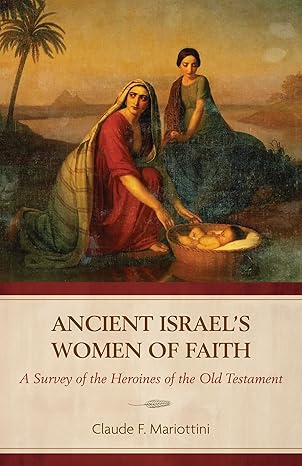
When we open the pages of the Old Testament, we encounter narratives shaped by male scribes, editors, and theologians—men who wrote primarily for male audiences within elite religious circles. Yet beneath these masculine editorial layers lies a more complex and compelling reality: women were not passive figures in ancient Israelite society, but active agents whose contributions shaped their nation’s spiritual legacy.
My new book, Ancient Israel’s Women of Faith: A Survey of the Heroines of the Old Testament, emerges from a question I posed to my students at Northern Baptist Seminary: If women were so central to Israel’s faith community, why does the biblical text often obscure their influence? The answer lies not in the absence of women’s roles, but in understanding how our sources came to us—filtered through male perspectives and priorities.
What becomes clear upon careful examination is that the Old Testament preserves remarkable evidence of women’s leadership and expertise. Israel’s communities included professional prophets, mourners, singers, weavers, diviners, musicians, dancers, and midwives—women whose specialized knowledge was sought and valued. Some women held power as city builders, clan leaders, and queens. Others, like Huldah and the wise women of Israel, served as counselors to kings and community elders. Their stories remind us that capability knows no gender.
Yet this reality coexists alongside a patriarchal legal structure. Israelite law positioned women as subordinates within households, restricted their autonomy, and treated them as property. This tension—between what women actually accomplished and what the law prescribed for them—reveals the texture of ancient Israelite society.
The most hopeful development in this story appears in Deuteronomy. This seventh-century reform movement attempted something revolutionary: to extend legal protections and social dignity to Israel’s most vulnerable members, including women. Here we find evidence of cultural movements toward greater justice.
The women whose stories fill these pages—from the matriarchs to lesser-known figures like Rizpah—speak across centuries. The injustices they navigated, the agency they exercised, and the barriers they faced find echoes in women’s experiences today. By studying their lives, we honor their memory and draw wisdom for our present moment.
To order the book, visit my author page on Amazon [https://www.amazon.com/dp/0825449502].
Claude Mariottini
Emeritus Professor of Old Testament
Northern Baptist Seminary
If you enjoyed reading this post, you will enjoy reading my books.
VISIT MY AMAZON AUTHOR’S PAGE
BUY MY BOOKS ON AMAZON (Click here).
NOTE: Did you like this post? Do you think other people would like to read this post? Be sure to share this post on Facebook and share a link on X so that others may enjoy reading it too!
If you are looking for other series of studies on the Old Testament, visit the Archive section and you will find many studies that deal with a variety of Old Testament topics.











 Dr. Claude Mariottini - Professor of Old Testament
Pingback: Ancient Israel’s Women of Faith, by Claude Mariottini. A Review | Veracity