
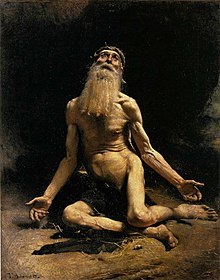
Job
by Léon Bonnat (1880)
Wikimedia Commons
This text portrays the gravity of Job’s illness and the extent of his suffering. The disease with which Job was afflicted had destroyed his flesh so that almost nothing was left: “My bones cling to my skin and to my flesh” (Job 19:20). Almost nothing was left except the skin of his teeth.
The reference in Job 19:20, “I have escaped by the skin of my teeth” (Job 19:20) has become a proverbial statement in the English language to refer to a narrow escape, but the Hebrew text is very difficult and has been interpreted in different ways.
Although the Hebrew text is difficult to translate, scholars believe that Job is saying that he barely escaped God’s attack. Other scholars believe that Job is referring to his poor physical condition, that is, that only the skin of his teeth has been spared of the disease (skin disease?) that has afflicted his body.
The idea that Satan kept Job’s mouth healthy so that he could blaspheme against God is not found in the text and it is just an interpretation, one that I believe is not a good interpretation.
Again, although the Hebrew text is difficult, Job is saying that he is only able to speak to his friends because his mouth has not been afflicted with the same disease that has afflicted the whole skin of his body.
In his explanation of Job’s words, Hartley wrote, “Feeling totally alienated, Job bemoans his wretched physical condition. . . . With it Job seems to express his amazement that his body continues to sustain any life at all. Just as his alienation is total, so too his physical suffering is complete” (Hartley 1988: 289).
For most readers today, it is very difficult to comprehend the immensity of Job’s suffering. It is also difficult to understand suffering in general. In the last three chapters of my book, Job and the Problem of Suffering, I offer a Christian perspective on the problem of suffering.
Looking at suffering from a Christian perspective, I wrote “the book of Job teaches every believer the importance of serving God unconditionally. If it is only good people who get all the breaks in life and live free of troubles and suffering, then human goodness becomes purely selfish, and people would be serving God only for material reward. This is what Satan insinuated in the opening of the book of Job. Satan believed that Job served God because of the rewards he had received from God. The book of Job teaches that Job, a righteous, faithful, and good man suffered when he did not deserve to suffer. The book also teaches that people should not be good only to avoid suffering” (Mariottini 2023: 155).
NOTE: For other studies on the Book of Job and the problem of suffering, read my post, An Introduction to the Book of Job.
BUY MY BOOK ON JOB on AMAZON (Click here).
Claude Mariottini
Emeritus Professor of Old Testament
Northern Baptist Seminary
If you enjoyed reading this post, you will enjoy reading my books.
VISIT MY AMAZON AUTHOR’S PAGE
NOTE: Did you like this post? Do you think other people would like to read this post? Be sure to share this post on Facebook and share a link on Twitter or Tumblr so that others may enjoy reading it too!
I would love to hear from you! Let me know what you thought of this post by leaving a comment below. Be sure to like my page on Facebook, follow me on Twitter, follow me on Tumblr, Facebook, and subscribe to my blog to receive each post by email.
If you are looking for other series of studies on the Old Testament, visit the Archive section and you will find many studies that deal with a variety of Old Testament topics.
BIBLIOGRAPHY
Hartley John E. The Book of Job. New International Commentary on the Old Testament. Grand Rapids: Eerdmans, 1988.
Mariottini, Claude F. Job and the Problem of Suffering. Lisle: KDP, 2023.














 Dr. Claude Mariottini - Professor of Old Testament