
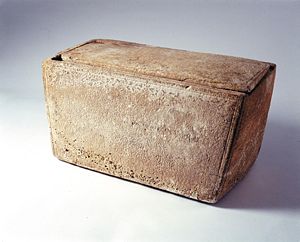
Image: The James Ossuary
The trial of Oded Golan is coming to an end. The defense has presented its argument and the case has gone to the judge to render his decision.
The case against Golan is whether the ossuary containing a Hebrew inscription that reads “James son of Joseph brother of Jesus” is authentic. This burial box was discovered in 2002. If the ossuary is authentic, then it may have a direct link to James, the brother of Jesus.
However, archaeologists at the Israel Antiquities Authority have declared the ossuary to be a forgery. Oded Golan, an antique collector, was charged in 2004 with faking the ossuary and other archaeological artifacts.
The judge in the Golan case, Judge Aharon Farkash, is expected to submit his ruling in a few months. He must decide on issues that the experts themselves could not agree. His decision will have a huge impact on the future of the market for archaeological artifacts.
A recent article on this case summarizes the implication of the judge’s ruling:
The criminal, scholarly and scientific implications of his verdict are immense. If genuine, the artifacts are of historic importance and worth millions. An acquittal would be a severe setback for the Israel Antiquities Authority and its special investigators, who accused Golan and his co-defendants of making millions of dollars as part of an international chain of forgers planting sophisticated fakes in the world’s museums.
An acquittal would also be an acute embarrassment for the isotope experts at the Israel Geological Survey and professor Yuval Goren of Tel Aviv University, who spent many days on the stand defending scientific tests that they said showed the items must be fakes.
A guilty verdict, on the other hand, would destroy the reputation of one of the world’s leading collectors of biblical antiquities and drive the entire Israeli market underground. The Israel Antiquities Authority has made no secret of its desire to shut down the trade in Bible-era artifacts, which it believes encourages grave robbers, who spirit the choicest finds out of the country.
Government officials and many scholars say the market is riddled with forgeries, and they are skeptical of any item that does not come from a licensed, supervised excavation where its provenance can be proved.
But Golan said he had never seen a forgery that wasn’t immediately obvious and pointed out that some of Israel’s greatest archaeological treasures came from dealers. Indeed, the most striking example is one of the most important biblical finds ever: the Dead Sea Scrolls, which a Bedouin shepherd sold to an Israeli professor half a century ago.
Read more about this case here.
Claude Mariottini
Professor of Old Testament
Northern Baptist Seminary
Tags: Archaeology, James Ossuary, Oded Golan













 Dr. Claude Mariottini - Professor of Old Testament