
>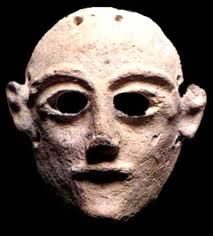
Image: Baal Mask Found at Hazor
In a previous post I mentioned that archaeologists digging at Hazor have found two fragments of a cuneiform tablet that contain what has been described as portions of a law code. It has been reported that these fragments contain laws similar to laws found in the Code of Hammurabi. Archaeologists are continuing their work, excavating a monumental structure dated to the Bronze Age, where more tablets are expected to be found.
When Joshua and the army of Israel began their campaign to conquer the northern part of Canaan (Joshua 11:1-15), he encountered a confederation of Canaanite kings, led by Jabin, king of Hazor. These kings were aware of what Israel had already done in the southern part of Canaan, and although the Canaanite kings were not friendly with each other, they realized that Israel posed a great threat to their survival.
According to the Biblical text, the size of the Canaanite army was impressive: “And they went out, they and all their armies with them, a great people, in number like the sand on the seaside, with horses and war-carriages in great number” (Joshua 11:4).
According to Josephus, the Jewish historian who wrote a history of Israel in the first century A.D., the Canaanites had mustered 300,000 infantry soldiers, 10,000 calvary troops, and 20,000 chariots.
The Canaanite kings joined forces, gathered their armies, and encamped at the waters of Merom in their preparation to fight against Israel. But Joshua surprised them. Instead of waiting to be attacked by the Canaanites, Joshua surprised Jabin and his army by the waters of Merom, striking them and pursuing them until the Canaanite army was defeated.
Joshua and the army of Israel then invaded the Canaanite cities and captured them. However, of all of the Canaanite cities conquered, only Hazor was burned: “And Joshua turned back at that time and captured Hazor and struck its king with the sword, for Hazor formerly was the head of all those kingdoms. And they struck with the sword all who were in it, devoting them to destruction; there was none left that breathed. And he burned Hazor with fire” (Joshua 11:10-11).
The reason Hazor was burned was because “Hazor was the head of all those kingdoms.” This means that Hazor was a strong and well-fortified city. That Jabin, the king of Hazor, was able to muster a coalition to fight against Israel shows the influence of the city among the other Canaanite city-states.
By the time of the judges, during the days of Deborah and Barak, the Canaanites were able to regain some strength and reconquer some of the territory they had lost to Israel. As a result, they were able to rebuild Hazor and establish a new king on the throne, identified as “Jabin, king of Canaan” (Judges 4:2). It is possible that Jabin was a dynastic name of the kings of Hazor.
Led by Deborah and Barak, the Israelites fought against Sisera, the commander of Jabin’s army, conquered the Canaanites, and took possession of Hazor, which became an Israelite city settled by the tribe of Naphtali (Joshua 19:32, 36).
During the time of the monarchy, Solomon fortified Hazor, Megiddo, and Gezer and established these cities as centers of defense against possible attacks by enemies from the north. Hazor was one of the cities conquered by Tiglath-pileser III during his war against the Northern Kingdom of Israel and the Arameans in 734 B.C. (2 Kings 15:29).
In antiquity, Hazor was an important city. The name of the city appears in the Execration Texts from Egypt (19th century B.C.), in the Mari Tablets (18th century B.C.), in the list of conquered cities from the times of Thutmose III, Amenhotep II, and Seti I, as well as in four Amarna Letters.
Hazor was first excavated by John Garstang in 1928. However, the major excavation of the tell was done by Yigael Yadin, who discovered twenty-two levels of occupation. Among the discoveries at Hazor were a Hyksos city, several Canaanite temples, and many religious artifacts.
As I mentioned above, archaeologists have found two fragments of a cuneiform tablet at Hazor. However, this discovery is not unique. In 1962, an American tourist found a cuneiform tablet on the surface of the tell. That tablet, written in Akkadian, described a lawsuit adjudicated by the king of Hazor. According to archaeologists, the tablet was dated to the 17th century B.C.
A cursory reading of the Bible does not reveal the greatness of the city of Hazor at the height of its power. During the Middle and Late Bronze ages, Hazor probably rivaled other great cities in the Ancient Near East, both in size and in influence.
Archaeology has provided extremely important evidence that Hazor was a great city in antiquity. Let us hope that the excavation of the tell will provide additional evidence of the greatness of “Hazor, the head of all those kingdoms.”
Read also: More about the Two Cuneiform Tablets
Claude Mariottini
Professor of Old Testament
Northern Baptist Seminary
If you enjoyed reading this post, subscribe to my posts here.
Tags: Archaeology, Hazor, Jabin, Joshua, Conquest













 Dr. Claude Mariottini - Professor of Old Testament
>Dr MariottiniSome years ago, in Belleview Florida, I attended a church function in which the pastor, a father, welcomed his son back from a volunteer dig at Hatzor. All during the sermon, because immediately when they dug they found burned and charred residue on a large floor, they were exulting, saying that they had found Joshua's burning of the city.Then, the floor was opened to questions. I asked – since this was a very large and shallow site that you found – wouldn't it make sense that you found evidence of the <> burning of Hatzor and not Joshua's? After all – even after Joshua's time the city was rebuilt and inhabited – even into later biblical times…Nope – it's Joshua – that was that. Question session closed.Bible Proved. Everyone Go Home Now.They were the nicest people – I just don't think it entered their minds that there were any other alternatives – and nobody wanted to spoil the homecoming – of courseAn unforgettable night I was privileged to be invited to.But was the Bible really proved?I wasn't so sure…You mentioned Hyksos layers at Hatzor. They make sense as the layers of inhabitance at the time of the conquest, since the Hyksos were the rulers of Egypt after the exodus. In my view then the first non-Hyksos layers would be those of the Israelite conquerors. There would be a burn layer there. But it seems that nobody thought to dig deeper or elsewhere – just call the first burned place Joshua's doing and content themselves with having "proved the Bible'. Both the Bible people and conventional archaeologists have no compunction about Hyksos.Therefore – reality is precluded.Of course, others would disagree.To most modern opinion, the Hyksos lived at a time separated from the time of the Benei Israel in Egypt, in the desert, or the conquest. However if the ancient biblical reality would be so audacious as to conflict with modern scholarly opinion, who today would really be right? I bet my farm on the ancients. THey were there. They say the Amalekites were Hyksos. But who today listens to autochthonous premohammedan arabian scholars? I think even though we might disagree on the chronology, that there was indeed more than one burning of Hatzor – all the way into late biblical history. With differences in chronology – or even with a Bible dedicated tunnel vision of 'Joshua goggles' – we really don't get an appreciation for the real – and multilayered – rightly debated and complex history of the site. Though we all might disagree about chronology – as some would say the Hyksos layer would not correspond with the inhabitants conquered by Joshua – nonetheless, your more complex portrayal of the long and complex history of the city does all of your readers a valuable service. If Hatzor was indeed burned more than once – how then shall we know which burn layer was due to Joshua? I look forward to learning more as more is uncovered from the site, whatever the various interpretations may be. I look forward to any further insight you might provide. As always, thank you for a most interesting and informative blog.Johnny C Godowski
LikeLike
>Dr MariottiniI didn't know that whatever appears between left and right arrows is deleted it was the "LastOrLatest" burning of Hatzor that I believe was found.When the north of Israel was conquered in later biblical times -was not fire employed at Hatzor? Was any burned layer you are aware of above or beneath the Hyksos layer? Isn't it true that there are indeed more than one burn layer at Hatzor?As always – agree, disagree or just still thinking – I welcome your insight.Johnny C Godowski
LikeLike
>Johnny,Thank you for your comment and for your observations.The way archaeologists dig a tell helps distinguish the different levels of occupation in a site. Since each level of occupation is built upon a previous level, the destruction of a level leaves evidence of the way that level was destroyed. This is the reason one can ascertain that the ashes found on a specific level belongs to a specific period. One of the levels were evidence of burning is found is in the Iron Age I. Now, if that level was burned by the Israelites, it is upon the interpreter to decide in light of the evidence.Your insistence in following Velikovski in identifying the Hyksos with the Amalekites prejudices the way you view the facts. When archaeologists use stratigraphy to study the different levels of occupation at Hazor, they can easily identify cities from the time of the Hyksos, from the Amarna and post-Amarna periods, from the Early Iron Age (the time of Joshua), from the time of Solomon, etc. The archaeological evidence clearly suggests that the Hyksos occupied Hazor prior to the Amarna Age. Velikovski places the Amarna Age in the days of Ahaz.Claude Mariottini
LikeLike
>Dr. MariottiniAs always, I welcome your insight. You are correct: my insistence on believing the premohammedan autochthonous Arabian scholars who say the Hyksos were Amalekites does – well as you say – "prejudice" my view of history. Everyone else today – not liking premohammedan Arabs – or whatever the current scholarly prejudicial case may be – everyone else today then – who chooses to dismiss these hundreds of years of premohammedan autochthonous arabian scholarship – they would, to my view, have some explaining to do to defend their own chosen particular "prejudices" – Velikovsky as such, needs no such defense. My 'prejudice' is this – I dare to believe the ancients – both the writers of scripture AND the writers of autochthonous premohammedan Arab history. In my view, they both agree.Modern scholarly constructs that ignore one or both of these sources are suspect – and subject to modern prejudices that the ancients could never have imagined. Therefore, the logical view is to trust the scripture itself, and to trust the ancients themselves, in cases like this. So agree or not, at least my point of view in approaching the data is clear. There are and should be different points of view in any discipline as we engage the evidence and study further. Why else would we study at all? At least it is honest for every scholar expounding on data to state his point of view, so that his conclusions can be evaluated accordingly. Your particular insight about stratigraphy is excellent – certainly what we do should be consistent with stratigraphy. That is why I particularly reject the idea of "percolation" wherein it is presumed that whenever artifacts are found that conflict with the conventional chronology, that the older artifacts "percolated upward" while the younger ones "percolated downward" as is taught today. I have a prejudice against such 'percolation', as it is physically without mechanism, and exists only as a testimony to the depth of scholarly prejudice in these cases. Your point about One of the levels of burning occurring in Iron Age 1 is appreciated. Is that the time of the Israelites? (Merely saying so in parenthesis does not make it so – it only indicates your 'point of view') If the actual burning of Hatzor under the Israelites happened sometime in middle to late bronze, for example – that would possibly mean the burning in the Iron age I happened after Joshua. Clearly the city was burned. Several times. Was Joshua the FIRST time the city was burned? if so – is the Iron Age 1 the first such layer? That would be my question.
LikeLike
>[continuing previous post]Also, as you correctly point out, the Hyksos lived well before the Amarna Age, in anyone's chronology.But the Iron Age was not everywhere at the same time. The modern Tasaday were found living today in what for them was still the stone age. No layer in the earth where they lived knew anything of Iron – or jetplanes… In scripture, Israel was prevented from working iron by the philistines – so what would have been iron age in philistine territory would still have been contemporaneous with bronze for Israelite territory – gasp! anathema!? Let the scripture stand also here on this kind of fact as well. So my rightful question is – (parenthetical suggestions aside) which was the first burning of the city of Hatzor – was that prior to Iron age 1 – and was that possibly Joshua then? Further – How many times – from Joshua forward at least, was Hatzor known to have been attacked/sacked/burned – all the way to its abandonment? Three times? Four? How many burn layers have been found? Are there more or fewer burn layers than we have burn accounts in history/scripture ? If more layers – who? Before Joshua? If less – what then? These are the nature of my questions – and rightly as you mention – we should all look to stratigraphy for the answers – by that I mean the actual data in the ground – not necessarily the early structures of scholarly interpretation, since these may be suspect, however firmly believed by their respective modern adherents. Since there is discrapancy and dialog – the assent is not universal, and investigation must continue. So I ask – were there any burn layers prior to Iron Age 1? how many since – and how many historical events corresponding since – all the way to the conquest of Judah… Do we have that complete date set yet? Again I thank you for your insights. Also I should point out, Velikovsky is not the problem here. I did not mention him per se. If Velikovsky did not exist, I would still have the premohammedan arabian scholars to think about.It is they who say Hyksos are Amalekites. That is not Velikovsky's fault. He merely had the audacity to quote them when modern scholars did not want to be reminded. What do you say about them? They cannot have been wrong from the beginning, simply because Velikovsky thousands of years later, whom modern scholars do not like, would quote their writings. They must have had real reasons in their own time for writing as they did.If you do not believe them, please tell me why they lied, or were not correct, in your view. Again as always – thanks. Like steel sharpens steel – I believe our genuine efforts in all these areas will only dispel illusions, and clarify our knowledge of scripture, history and humanity.As always, thank you for your insight – especially where it differs from my ownJohnny C Godowski
LikeLike
>Dr. Mariottini,Thank you for the above informative post regarding Hazor. I would like to be permitted to comment freely regarding it and other posts at your blog, but your comment policy prevents me from doing so. On January 10, 2010, you requested in a blog comment that I stop promoting views of Velikovsky at your blog. You indicated that no other comment promoting Velikovsky’s views would be accepted and that further comments promoting Velikovsky’s views would be deleted. I have honored your request for more than half a year. I will continue to honor your request unless you rescind it. This comment that I am submitting does not promote Velikovsky’s views. However, I will say that Velikovsky does not place the Amarna Age in the days of Ahaz as you indicated above. Also, you have continued to misspell Velikovsky’s last name at your blog. I previously clarified the spelling of his last name in an August 26, 2009 comment. If you, a professional scholar, after reading three of Velikovsky’s books, cannot spell his name correctly, then why should your readers believe that you have given Velikovsky’s views serious and careful consideration? As I mentioned to you by e-mail in March, it is, of course, your blog, and you have the right to limit comments to those that agree with your views if that is what you wish. However, I was hoping that you would take a more democratically and scientifically-minded approach in managing your blog. I mean, your blog deals quite a lot with history and archaeology, and if you are going to allow comments on these subjects, then you should tolerate views other than your own. Censorship of ideas has no place in a reasoned discussion on science, including archaeology, or history.Will you please rescind your January 10th request, and let your comment policy be one of allowing free and open discussion on archaeology and ancient history, including on Velikovsky’s views? Sincerely,Adam StuartJacksonville, Florida
LikeLike
>Dr MariottiniWhile I understand Mr Stuart's feelings and predicament, I also understand yours. We have all discussed Dr. V at sufficient length – as for me – my perspective is known – that is sufficient for me. THerefore in my Hatzor post, I did not mention Dr V per se – but only the arabian scholars themselves – and asked a simple set of questions – deliberately brief and relevant to the point itself:And these have not been answered – instead, your kind response seems to have been distracted by the Velikovsky thread, which I genuinely did not intend. I don't want to be distracted by the Velikovsky issue either – I didn't even mention it – I took deliberate care to avoid such distractions I truly would like to know the answer to these three questions rgarding the stratigraphy at Hatzor: 1-could it be that Hatzor was burned earlier than Iron Age I?2-and how many times in all has it been burned?3-and do these known times correspond fully with our historical records?Three simple honest questions about Hatzor itself. I did not even mention Velikofvsky -there was no need.But the arabian scholars still stand, and are indeed relevant to the Hatzor question – no matter who later quoted them – popular or notI would not shy away from ancient sources simply because Velikovsky had the audacity to mention them, and Velikovsky is too popular among some groups and not popular at all among other groups….It can be distractingPopularity doesn't decide scholarship – facts and evidence do. If popularity is the deciding factor, you have a social structure, but not scholarship.As far as alternate chronologies – Velikovsky is not the only one advocating changes or reductions, the latest AAAS precision tests notwithstanding. I need not advocate Dr V himself to acknowledge that there are differing schools of thought about chronology. I tend to feel that sometimes – any thought at all of any non-standard chronology tends to get lumped in with Velikovsky and also shut down – quite prejudicially – as the long and detailed record of such things has shown for these past sixty years. But Dr Mariottini – I don't really think you are trying to persecute or muzzle anyone or anything even remotely like that – You've done more to look at all this material -agree or not – than any professor I've encountered so far – therefore in all honesty, I believe you just simply want to keep your own blog on track. In that, I tend to agree with you myself! For my part, I am content to minimize mention of Velikovsky and keep my queries brief, original sourced where possible, and relevant to the post at hand. Had you not mentioned Velikovsky's name in response, I would have been content to leave it unmentioned. I would still genuinely be honored by your genuine answer to the Hatzor questions I did raise, without further distraction regarding Velikovsky himself.Johnny C Godowski
LikeLike
>Johnny and Adam,I am answering both of your comments because they deal with similar topics. This is my last word on this issue and after this, the comments will be closed.1. I have no time nor the disposition to discuss Velikovsky’s theories and views. My blog is not a forum to discuss Velikovsky’s views. If you want to discuss Velikovsky’s views, look for another venue. My blog is not it.2. I have no desire to discuss a revised chronology of Egypt. If you want to discuss Egyptian chronology, there are many blogs on the Internet dedicated to Egyptian study.3. I have read and reviewed three of Velikovsky’s books on my blog. In my posts I rejected Velikovsky’s views and gave the reasons I rejected his theories. My views are final. I am not willing to open the debate nor discuss the issues with people who want to promote or defend Velikovsky’s views.As for the issue of Hazor:Johnny, if you want to learn more about Hazor, I recommend that you read the archaeological report on Hazor published by Yadin. He has written three volumes on Hazor. There you will find which level of occupation was destroyed by fire. Hazor was destroyed several times, often by burning. After all, there are 22 strata of occupation. The iron age in Canaan did not begin when Israel acquired iron technology but when iron was introduced to Canaan by the Philistines.Most biblical scholars and most Egyptian archaeologists rejected a revised chronology for Egypt. I have discussed this issue with an archaeologist who has actually excavated in Egypt. He said that the revision proposed by Velikovsky’s and others contradicts historical and archaeological evidence. I reject the view that the Amalekites of the Bible were the Hyksos of history. Just because Arabian scholars who lived centuries after the Hyksos identify the Hyksos with the Amalekites does not make it so. Until recently, archaeologists knew little about the Hyksos. Not even Josephus new much about them.Probably what these Arabian scholars were trying to do was trying to prove an Arabian presence in ancient Egypt. Their claim is similar to the claim that Greek culture came out of Africa, that the Israelites were black because Abraham was black, or that the Philistines were black because they descended from Ham.In conclusion, I reject Velikovsky’s views because it is not based on archaeological or historical evidence. I reject a revised chronology of Egyptian history for the same reason. And I reject the identification of the Hyksos with the Amalekites, notwithstanding Arabian folklore.With this, the discussion is ended.Claude Mariottini
LikeLike