
NOTE:
This post has been withdrawn. The post has been published in my book, Rereading the Biblical Text: Searching for Meaning and Understanding. The approach taken in the book is to compare how different translations have approached difficult texts in the Old Testament. The goal of the book is to invite readers to reread the biblical text in light of the new understanding of the intent of the original writer of the text. You can order the book from Amazon.
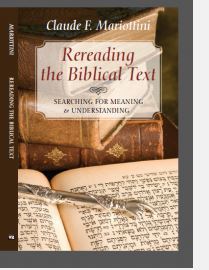
Rereading the Biblical Text
Visit my Amazon author’s page to purchase the book (click here).
Claude Mariottini
Emeritus Professor of Old Testament
Northern Baptist Seminary
A Note About This Post:
Before “Was Ruth Barren?” was withdrawn for publication, “Was Ruth Barren?” was read by 8782 readers. “Was Ruth Barren?” was also shared 9 times by readers who enjoyed reading the post. You can read “Was Ruth Barren?” and other articles on problems in Bible translation by reading my book Rereading the Biblical Text: Searching for Meaning and Understanding. Below is the content of the book:
CONTENTS
Acknowledgments – Page xi
Abbreviations – Page xii
Introduction – Page xv
SECTION 1 — THE PENTATEUCH
Chapter 1. The Creation of Animals in Genesis 2:19 – Page 3
Chapter 2. The Serpent Was Right (Genesis 3) – Page 7
Chapter 3. The Seed of the Woman (Genesis 3:15) – Page 11
Chapter 4. Were They Really Giants? (Genesis 6:4) – Page 17
Chapter 5. “As Far as Dan” (Gen 14:14) – Page 20
Chapter 6. Abraham and the Promises of God – Page (Genesis 12:7) – Page 23
Chapter 7. The Sacrifice of Isaac (Genesis 22:8) – Page 26
Chapter 8. The Rape of Bilhah (Genesis 35:22) – Page 29
Chapter 9. Miriam, a Leader in Israel (Exodus 15:20) – Page 32
Chapter 10. Azazel (Leviticus 16:8-10) – Page 35
Chapter 11. Understanding Numbers 24:24 – Page 38
SECTION 2 — THE HISTORICAL BOOKS
Chapter 12. The Levite and His Concubine (Judges 19:1–30) – Page 43
Chapter 13. The Sacrifice of Jephthah’s Daughter (Judges 10:6–12:7) – Page 47
Chapter 14. The Fate of Jephthah’s Daughter (Judges 10:6–12:7) – Page 4750
Chapter 15. The Virginity of Jephthah’s Daughter (Judges 10:6–12:7) – Page 54
Chapter 16. Who Went Back to the City? (Ruth 3:15) – Page 59
Chapter 17. Was Ruth Barren? (Ruth 4:13) – Page 59
Chapter 18. King Saul: Little in His Own Eyes (1 Samuel 15:17) – Page 63
Chapter 19. How Old Was Saul? (1 Samuel 13:1) – Page 64
Chapter 20. David and Melchizedek (Psalm 110:4) – Page 67
Chapter 21. David’s Sons Were Priests ((2 Samuel 8:18) – Page 70
Chapter 22. “Him that Pisseth against the Wall” (1 Samuel 25:22) – Page 72
Chapter 23. Whose Cloak Did Ahijah Tear? (1Kinga 11:4–7) – Page 78
Chapter 24. The Challenges of Parenthood (2 Kinga 21:25–26) – Page 82
SECTION 3 — THE WISDOM AND POETICAL BOOKS
Chapter 25. Psalm 8:5: In Search of a Better Translation – Page 87
Chapter 26. Understanding Psalm 17:14 – Page 90
Chapter 27. Jezebel’s Wedding Song (Psalm 45:1–17) – Page 93
Chapter 28. Psalm 100:3: In Search of a Better Translation – Page 99
Chapter 29. Sons or Children? (Psalm 127:3-5) – Page 103
Chapter 30. Proverbs 29:18 – Page 106
Chapter 31. “Black and Beautiful” or “Black but Beautiful”? (Song of Songs 1:5) – Page 108
SECTION 4 — THE PROPHETICAL BOOKS
Chapter 32. The Use of Gender Inclusive Language (Isaiah 9:1) – Page 115
Chapter 33. “You Have Increased Their Joy” (Isaiah 9:3) – Page 118
Chapter 34. Who Will the Messiah Strike? (Isaiah 11:4) – Page 120
Chapter 35. The Way of the Lord (Isaiah 40:3) – Page 122
Chapter 36. “All Their Goodliness” (Isa 40:6) – Page 126
Chapter 37. The Proclaimer of Good News (Isaiah 40:9) – Page 129
Chapter 38. The Problem of Divorce in the Old Testament (Isaiah 50:1) – Page 132
Chapter 39. Beulah Land (Isaiah 62:4) – Page 135
Chapter 40. The Balm of Gilead (Jeremiah 8:22) – Page 138
Chapter 41. The Mother of Seven (Jeremiah 15:9) – Page 142
Chapter 42. The Coming of the Messiah (Daniel 9:25–27) – Page 144
Chapter 43. The Seventy Weeks of Daniel (Daniel 9:25–27) – Page 148
Chapter 44. The Knowledge of God (Hosea 4:1) – Page 152
Chapter 45. The Word “Hesed” in the Book of Hosea (Hosea 4:1) – Page 154
Chapter 46. The Word “Justice” in Amos (Amos 5:24) – Page 157
Chapter 47. “What the Lord Requires” (Micah 6:8) – Page 160
Bibliography – Page 165
Index of Subjects – Page 169
Index of Authors – Page 171
Index of Scriptures and Other Ancient Documents – Page 173
Claude Mariottini
Emeritus Professor of Old Testament
Northern Baptist Seminary
VISIT MY AMAZON AUTHOR’S PAGE
BUY MY BOOKS ON AMAZON (Click here).
NOTE: Did you like this post? Do you think other people would like to read this post? Be sure to share this post on Facebook and share a link on Twitter or Tumblr so that others may enjoy reading it too!
I would love to hear from you! Let me know what you thought of this post by leaving a comment below. Be sure to like my page on Facebook, follow me on Twitter, follow me on Tumblr, Facebook, and subscribe to my blog to receive each post by email.
If you are looking for other series of studies on the Old Testament, visit the Archive section and you will find many studies that deal with a variety of topics.











 Dr. Claude Mariottini - Professor of Old Testament
>This makes sense. Although I don't know nearly as much Old Testament as yourself, I agree with you about Ruth. Even if the etymology of names is dismissed regarding the husbands of Orpah and Ruth, the fact that levirate marriage is enough to hint that Ruth is not barren in and of itself.
LikeLike
>Mitchell,Good point. I think the text clearly shows that Ruth was able to conceive a bear children.Thank you for your comment and welcome to my blog.Claude Mariottini
LikeLike
Why then did Ruth and Boaz have only One Child? Or did they have more children? Because it doesn’t seem like they use any form of birth control? It seems birth control is not even a thing in biblical days or is it? I’m. Not sure please leave your wisdom on this subject.
LikeLike
Dear Friend,
Thank you for your comment. It is possible that they had other children, but the others are not mentioned because the writer was trying to present the genealogy of David only. On the other hand, it is possible that Boaz was an old man and that they had only one child. Everyone used some form of birth control in antiquity. The form of birth control was generally counting the days of fertility and avoiding intimacy on those days.
Claude Mariottini
LikeLike
Thank you so much for your very helpful wisdom and response!:)
LikeLike
thank you, very insightful article
LikeLike
Charm,
You are welcome. Thank you for visiting my blog.
Claude Mariottini
LikeLike
Ruth was a priestest of the Moabites who offered up children to be scraficed. She may have kept herself from becoming pregnant in fear of seeing that child scraficed or GOD wanted her to wait until she married Boaz before having a child. Either way, God’s way is best.
LikeLike
Judy,
You statement that Ruth was a priestess of the Moabites is pure speculation. You cannot find any evidence, either in the Bible or in secular literature that Ruth was a priestess of the Moabites. It is this kind of statement that make people ridicule the Bible and those who believe that the Bible is the word of God.
Claude Mariottini
LikeLike
As a woman who’s walked through a 23-year infertility journey due to male factor infertility, I noticed that Ruth first marriage did not result in her becoming a mother. I’ve read other writers who speculate that though the text mentions a time period of 10 yrs (vs.4), those 10 yrs speak to the time that Naomi was in Moab, not the length of Ruth’s first marriage. In any case, I appreciate your perspective on this story, especially how the word barren cannot be found tied to Ruth. Infertility is so often and incorrectly blamed on the female, which is only the case approximately 1/3 of the time. The idea that Ruth’s story *might* contain an example of male factor infertility is meaningful. Thanks for sharing your insights!
LikeLike
Dawn,
Thank you for your comment. It is clear from the text that Ruth was not barren; her husband could not give her a son. The preacher was wrong putting the blame on Ruth.
A few days ago I saw a movie where a man divorced his wife because she could not give him a son. He said she was not a “full woman.” In the movie, the man married another woman and the divorced woman married another man. The divorced woman had three children and the man and his new wife had no children. She was not the problem; he was.
Thank you for visiting my blog.
Claude Mariottini
LikeLike
This was a very good read !! I’ve heard the story of Ruth and Naomi , but I guess I never caught the part that she was barren possibly because later in the story she conceived a son ….
We are fascinated with the first part of the story
that she left her family to go with Naomi so some of us being myself didn’t receive the other part❤️🙏
LikeLike
Buellas,
Thank you for your comment. This happens many times. We tend to dwell on one part of the story and fail to notice other things that are also part of the story. I am glad you enjoyed the post.
Thank you for visiting my blog.
Claude Mariottini
LikeLike
I only spotted that both the sons’ wives had no children after what seemed to me to be 10 years of marriage to Naomi’s sons. I might have misunderstood, but two barren daughters-in-law was strange. So I googled the point and found your article. Anyway, Deuteronomy 7.14 enables us to infer that infertility can apply to men as well as women. ‘You shall be blessed above all peoples; there shall not be a male or female barren among you or among your livestock.’
LikeLike
Christine,
You are correct. The problem is that in a patriarchal society is hard to talk about male infertility, but it happens.
Thank you for visiting my blog.
Claude Mariottini
LikeLike
Thanks for your teaching sir, i don’t want to be controversial,but i bet to disagree point you made “The fact that the Lord enabled Ruth to conceive was not because she was barren, rather because the child was seen as a gift from God”. Even though biblically, Ruth was not seen as a barren woman,her circumstances indicated she could be. Firstly, assuming Naomi’s children were sick and couldn’t father, for the fact the Bible specifically stated, Boaz and ruth consumation led to pregnancy via God’s enablement shows that, there was a supernatural intervention.this wasn’t a natural or mere conception it was divine!. We know children are heritage of the Lord, even our lives belongs to Him,the air we breathe etc..belongs to God, there are several instances in the Bible whereby a man will knew his wife and conceive naturally, Genesis 16:4,Genesis 4:1, Genesis 4:17 etc.. And morever God had already declared to Adam and eve to be fruitful and multiply, Genesis 1:27–28, so there was a standing order for procuration. There could have been possibilities that Naomi’s boys were steriled but their wives too could have been infertiled .if God had to intervene in ruth’s conception after declaring us to be fruitful and multiply, then it shows her womb was closed and God had to unlock it.
LikeLike
Jean,
I do not have a problem to the fact that you disagree with me. What you write is also possible. Children are a gift from the Lord and Ruth was blessed by God when she conceived and became the mother of a son.
Thank you for reading by blog from France.
Claude Mariottini
LikeLike
I noticed you didn’t mention David’s wife Michal I’m your list of childless women. 2 Samuel 6:23
LikeLike
Nic,
Thank you for your comment. The reason I omitted Michal was because I was writing about the barren women of the Old Testament. Michal was not a barren woman. Michal was childless because David refused to have a child with Michal. The reason for David’s refusal was politically motivated.
Thank you for visiting my blog.
Claude Mariottini
LikeLike