
NOTE:
This post has been withdrawn. The post has been published in my book, Rereading the Biblical Text: Searching for Meaning and Understanding. The approach taken in the book is to compare how different translations have approached difficult texts in the Old Testament. The goal of the book is to invite readers to reread the biblical text in light of the new understanding of the intent of the original writer of the text. You can order the book from Amazon.
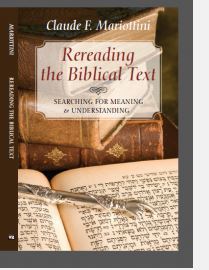
Rereading the Biblical Text
Visit my Amazon author’s page to purchase the book (click here).
Claude Mariottini
Emeritus Professor of Old Testament
Northern Baptist Seminary
A Note About This Post:
Before “Amos, Justice, and the NIV” was withdrawn for publication, “Amos, Justice, and the NIV” was read by 308 readers. You can read “Amos, Justice, and the NIV” and other articles on problems in Bible translation by reading my book Rereading the Biblical Text: Searching for Meaning and Understanding. Below is the content of the book:
CONTENTS
Acknowledgments – Page xi
Abbreviations – Page xii
Introduction – Page xv
SECTION 1 — THE PENTATEUCH
Chapter 1. The Creation of Animals in Genesis 2:19 – Page 3
Chapter 2. The Serpent Was Right (Genesis 3) – Page 7
Chapter 3. The Seed of the Woman (Genesis 3:15) – Page 11
Chapter 4. Were They Really Giants? (Genesis 6:4) – Page 17
Chapter 5. “As Far as Dan” (Gen 14:14) – Page 20
Chapter 6. Abraham and the Promises of God – Page (Genesis 12:7) – Page 23
Chapter 7. The Sacrifice of Isaac (Genesis 22:8) – Page 26
Chapter 8. The Rape of Bilhah (Genesis 35:22) – Page 29
Chapter 9. Miriam, a Leader in Israel (Exodus 15:20) – Page 32
Chapter 10. Azazel (Leviticus 16:8-10) – Page 35
Chapter 11. Understanding Numbers 24:24 – Page 38
SECTION 2 — THE HISTORICAL BOOKS
Chapter 12. The Levite and His Concubine (Judges 19:1–30) – Page 43
Chapter 13. The Sacrifice of Jephthah’s Daughter (Judges 10:6–12:7) – Page 47
Chapter 14. The Fate of Jephthah’s Daughter (Judges 10:6–12:7) – Page 4750
Chapter 15. The Virginity of Jephthah’s Daughter (Judges 10:6–12:7) – Page 54
Chapter 16. Who Went Back to the City? (Ruth 3:15) – Page 59
Chapter 17. Was Ruth Barren? (Ruth 4:13) – Page 59
Chapter 18. King Saul: Little in His Own Eyes (1 Samuel 15:17) – Page 63
Chapter 19. How Old Was Saul? (1 Samuel 13:1) – Page 64
Chapter 20. David and Melchizedek (Psalm 110:4) – Page 67
Chapter 21. David’s Sons Were Priests ((2 Samuel 8:18) – Page 70
Chapter 22. “Him that Pisseth against the Wall” (1 Samuel 25:22) – Page 72
Chapter 23. Whose Cloak Did Ahijah Tear? (1Kinga 11:4–7) – Page 78
Chapter 24. The Challenges of Parenthood (2 Kinga 21:25–26) – Page 82
SECTION 3 — THE WISDOM AND POETICAL BOOKS
Chapter 25. Psalm 8:5: In Search of a Better Translation – Page 87
Chapter 26. Understanding Psalm 17:14 – Page 90
Chapter 27. Jezebel’s Wedding Song (Psalm 45:1–17) – Page 93
Chapter 28. Psalm 100:3: In Search of a Better Translation – Page 99
Chapter 29. Sons or Children? (Psalm 127:3-5) – Page 103
Chapter 30. Proverbs 29:18 – Page 106
Chapter 31. “Black and Beautiful” or “Black but Beautiful”? (Song of Songs 1:5) – Page 108
SECTION 4 — THE PROPHETICAL BOOKS
Chapter 32. The Use of Gender Inclusive Language (Isaiah 9:1) – Page 115
Chapter 33. “You Have Increased Their Joy” (Isaiah 9:3) – Page 118
Chapter 34. Who Will the Messiah Strike? (Isaiah 11:4) – Page 120
Chapter 35. The Way of the Lord (Isaiah 40:3) – Page 122
Chapter 36. “All Their Goodliness” (Isa 40:6) – Page 126
Chapter 37. The Proclaimer of Good News (Isaiah 40:9) – Page 129
Chapter 38. The Problem of Divorce in the Old Testament (Isaiah 50:1) – Page 132
Chapter 39. Beulah Land (Isaiah 62:4) – Page 135
Chapter 40. The Balm of Gilead (Jeremiah 8:22) – Page 138
Chapter 41. The Mother of Seven (Jeremiah 15:9) – Page 142
Chapter 42. The Coming of the Messiah (Daniel 9:25–27) – Page 144
Chapter 43. The Seventy Weeks of Daniel (Daniel 9:25–27) – Page 148
Chapter 44. The Knowledge of God (Hosea 4:1) – Page 152
Chapter 45. The Word “Hesed” in the Book of Hosea (Hosea 4:1) – Page 154
Chapter 46. The Word “Justice” in Amos (Amos 5:24) – Page 157
Chapter 47. “What the Lord Requires” (Micah 6:8) – Page 160
Bibliography – Page 165
Index of Subjects – Page 169
Index of Authors – Page 171
Index of Scriptures and Other Ancient Documents – Page 173
Claude Mariottini
Emeritus Professor of Old Testament
Northern Baptist Seminary
NOTE: Did you like this post? Do you think other people would like to read this post? Be sure to share this post on Facebook and share a link on Twitter or Tumblr so that others may enjoy reading it too!
I would love to hear from you! Let me know what you thought of this post by leaving a comment below. Be sure to like my page on Facebook, follow me on Twitter, follow me on Tumblr, Facebook, and subscribe to my blog to receive each post by email.
If you are looking for other series of studies on the Old Testament, visit the Archive section and you will find many studies that deal with a variety of topics.











 Dr. Claude Mariottini - Professor of Old Testament
>Indeed NIV and TNIV are “inconsistent” in that they do not follow the translation principle of consistent translation of each Hebrew word by the same English word. That is a deliberate decision of the translators. At least they are more honest about it than the ESV translators who claim to be “essentially literal” but are very often (although not here) inconsistent. The only translation which seriously attempted to be consistent was the English Revised Version, and the results clearly show that this approach to translation just does not work.You seem to agree that in 2:7 and 5:12 Amos is referring to the concept of justice. The intention of a translation, of any good translation, is to render the meaning of the concepts in the original text. So NIV and TNIV are right to use “justice” in the translation.If anyone is really interested not so much in the meaning of the text as in the details of exactly how any one Hebrew word is used in different Bible books, then there is no real alternative for them to learning Hebrew and reading the original language text. Anyone who doesn’t know Hebrew is likely to be seriously misled by the results of a study based on Hebrew words in isolation from their meanings.
LikeLike
>Yes, we all need Greek and Hebrew. It is the false advertising that takes people in. Read this “transparent” translation. As if the original was always so crystal clear. I agree with the ideal of concordance, but it irritates me to know end to see it advertised by a Bible which translates εξουσιαζω and αυθεντεω as if they were the same and then sticks in “a symbol of” where it is not wanted. There should be someone who checks to see if a Bible sticks with the goals stated in the preface. To use Bible translation in an open power grab over women is despicable treatment of the very members of the church who should be ‘protected.’ Either we drop the debate over who is more literal, or a few translations have to take the log out of their own eye before they complain about the speck in their brothers and sisters eye. I respect your contribution to the debate, but I am growing more cynical every day about why people care about these issues.
LikeLike
>Dr. MariottiniThank you for pointing out what seems to be a small issue. I believe that we run into this with other words also, within the english language. Because some words in our lexicon may have one or more meanings. For example we might say justice was served, the justice of the court etc. None of which is really what Amos was getting at.
LikeLike