
NOTE:
This post has been withdrawn. The post has been published in my book, Rereading the Biblical Text: Searching for Meaning and Understanding. The approach taken in the book is to compare how different translations have approached difficult texts in the Old Testament. The goal of the book is to invite readers to reread the biblical text in light of the new understanding of the intent of the original writer of the text. You can order the book from Amazon.
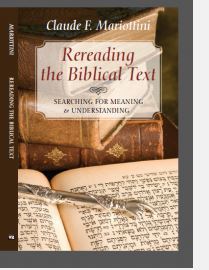
Rereading the Biblical Text
Visit my Amazon author’s page to purchase the book (click here).
Claude Mariottini
Emeritus Professor of Old Testament
Northern Baptist Seminary
A Note About This Post:
Before “Rereading Judges 11 31 – The Sacrifice of Jephthah’s Daughter” was withdrawn for publication, “Rereading Judges 11 31 – The Sacrifice of Jephthah’s Daughter” was read by 1707 readers. “Rereading Judges 11 31 – The Sacrifice of Jephthah’s Daughter” was also shared 1 time by readers who enjoyed reading the post. You can read “Rereading Judges 11 31 – The Sacrifice of Jephthah’s Daughter” and other articles on problems in Bible translation by reading my book Rereading the Biblical Text: Searching for Meaning and Understanding. Below is the content of the book:
CONTENTS
Acknowledgments – Page xi
Abbreviations – Page xii
Introduction – Page xv
SECTION 1 — THE PENTATEUCH
Chapter 1. The Creation of Animals in Genesis 2:19 – Page 3
Chapter 2. The Serpent Was Right (Genesis 3) – Page 7
Chapter 3. The Seed of the Woman (Genesis 3:15) – Page 11
Chapter 4. Were They Really Giants? (Genesis 6:4) – Page 17
Chapter 5. “As Far as Dan” (Gen 14:14) – Page 20
Chapter 6. Abraham and the Promises of God – Page (Genesis 12:7) – Page 23
Chapter 7. The Sacrifice of Isaac (Genesis 22:8) – Page 26
Chapter 8. The Rape of Bilhah (Genesis 35:22) – Page 29
Chapter 9. Miriam, a Leader in Israel (Exodus 15:20) – Page 32
Chapter 10. Azazel (Leviticus 16:8-10) – Page 35
Chapter 11. Understanding Numbers 24:24 – Page 38
SECTION 2 — THE HISTORICAL BOOKS
Chapter 12. The Levite and His Concubine (Judges 19:1–30) – Page 43
Chapter 13. The Sacrifice of Jephthah’s Daughter (Judges 10:6–12:7) – Page 47
Chapter 14. The Fate of Jephthah’s Daughter (Judges 10:6–12:7) – Page 4750
Chapter 15. The Virginity of Jephthah’s Daughter (Judges 10:6–12:7) – Page 54
Chapter 16. Who Went Back to the City? (Ruth 3:15) – Page 59
Chapter 17. Was Ruth Barren? (Ruth 4:13) – Page 59
Chapter 18. King Saul: Little in His Own Eyes (1 Samuel 15:17) – Page 63
Chapter 19. How Old Was Saul? (1 Samuel 13:1) – Page 64
Chapter 20. David and Melchizedek (Psalm 110:4) – Page 67
Chapter 21. David’s Sons Were Priests ((2 Samuel 8:18) – Page 70
Chapter 22. “Him that Pisseth against the Wall” (1 Samuel 25:22) – Page 72
Chapter 23. Whose Cloak Did Ahijah Tear? (1Kinga 11:4–7) – Page 78
Chapter 24. The Challenges of Parenthood (2 Kinga 21:25–26) – Page 82
SECTION 3 — THE WISDOM AND POETICAL BOOKS
Chapter 25. Psalm 8:5: In Search of a Better Translation – Page 87
Chapter 26. Understanding Psalm 17:14 – Page 90
Chapter 27. Jezebel’s Wedding Song (Psalm 45:1–17) – Page 93
Chapter 28. Psalm 100:3: In Search of a Better Translation – Page 99
Chapter 29. Sons or Children? (Psalm 127:3-5) – Page 103
Chapter 30. Proverbs 29:18 – Page 106
Chapter 31. “Black and Beautiful” or “Black but Beautiful”? (Song of Songs 1:5) – Page 108
SECTION 4 — THE PROPHETICAL BOOKS
Chapter 32. The Use of Gender Inclusive Language (Isaiah 9:1) – Page 115
Chapter 33. “You Have Increased Their Joy” (Isaiah 9:3) – Page 118
Chapter 34. Who Will the Messiah Strike? (Isaiah 11:4) – Page 120
Chapter 35. The Way of the Lord (Isaiah 40:3) – Page 122
Chapter 36. “All Their Goodliness” (Isa 40:6) – Page 126
Chapter 37. The Proclaimer of Good News (Isaiah 40:9) – Page 129
Chapter 38. The Problem of Divorce in the Old Testament (Isaiah 50:1) – Page 132
Chapter 39. Beulah Land (Isaiah 62:4) – Page 135
Chapter 40. The Balm of Gilead (Jeremiah 8:22) – Page 138
Chapter 41. The Mother of Seven (Jeremiah 15:9) – Page 142
Chapter 42. The Coming of the Messiah (Daniel 9:25–27) – Page 144
Chapter 43. The Seventy Weeks of Daniel (Daniel 9:25–27) – Page 148
Chapter 44. The Knowledge of God (Hosea 4:1) – Page 152
Chapter 45. The Word “Hesed” in the Book of Hosea (Hosea 4:1) – Page 154
Chapter 46. The Word “Justice” in Amos (Amos 5:24) – Page 157
Chapter 47. “What the Lord Requires” (Micah 6:8) – Page 160
Bibliography – Page 165
Index of Subjects – Page 169
Index of Authors – Page 171
Index of Scriptures and Other Ancient Documents – Page 173
Claude Mariottini
Emeritus Professor of Old Testament
Northern Baptist Seminary
NOTE: Did you like this post? Do you think other people would like to read this post? Be sure to share this post on Facebook and share a link on Twitter or Tumblr so that others may enjoy reading it too!
I would love to hear from you! Let me know what you thought of this post by leaving a comment below. Be sure to like my page on Facebook, follow me on Twitter, follow me on Tumblr, Facebook, and subscribe to my blog to receive each post by email.
If you are looking for other series of studies on the Old Testament, visit the Archive section and you will find many studies that deal with a variety of topics.











 Dr. Claude Mariottini - Professor of Old Testament
>Thank you for tackling this difficult passage for us. I recently finished editing an adult Sunday school lesson about Jephthah–quite a challenge!
LikeLike
>D.P.,Thank you for visiting my blog. I agree with you: Jephthah’s story is difficult because of the questions it raises. I hope my post will help clarify some of the important issues of the story.Claude Mariottini
LikeLike
>Wow. You left us hanging! I really enjoyed your post. I look forward to reading “the rest of the story.”
LikeLike
>D.V. I will be back to hear your conclusions!
LikeLike
>Dear Matt and Larry,The rest of the story will be posted on Monday. Thank you for visiting my blog.Claude Mariottini
LikeLike
>Anytime there is the slightest doubt about interpretation of Torah texts one should go to the SOURCE of the text, Judaism. Just as it would be rediculous to ask the U.N. or China to explain the U.S. Constitution, so it is to look to Christian leaders for explanations to difficult Jewish texts. Under no circumstances was Jephthah permitted to sacrifice his daughter, nor could he obligate her to a course of behavior.
LikeLike
>Hello Dr. Claude,I found something interesting and with valid points in the following link: http://www.apologeticspress.org/articles/2320It refers to Jephthah’s Daughter. It was written by Dave Miller, Ph.D.It says:”In Judges 11, Jephthah vowed to God that if he were victorious in battle, he would give to God whoever came through the doors of his house upon his return from battle. The term used in 11:31 is ‘olah, the normal Hebrew word for a burnt offering or sacrifice (used 286 times in the Old Testament). Did Jephthah intend to offer his daughter as a human sacrifice? Are the ethics of God and the Bible shown to be substandard by this incident?In the first place, if, in fact, Jephthah offered a human sacrifice, he did something that was strictly forbidden by Mosaic law and that is repugnant to God (Leviticus 18:21; 20:2-5; Deuteronomy 12:31; 18:10). It would be a bit bizarre for Jephthah to think that he could elicit God’s favor in battle by promising to offer Him a human sacrifice, that is, to do something that was in direct violation of the will of God. Such a proposal would be equivalent to a person requesting God’s blessing and assistance by offering to rape women or rob banks. God certainly would not approve of such an offer—though He may go ahead and assist the individual (11:32). God allows people to make wrong choices, even while He works out His own higher will in the midst of their illicit actions. He can even use such people to achieve a higher good (consider, as one example, Judas). When Israel clamored for a king—in direct opposition to God’s will—He nevertheless allowed them to proceed with their intentions, and even lent His assistance in the selection (1 Samuel 8:7,18-19; 10:19; 12:19; Psalm 106:14-15; Hosea 13:11; Acts 13:21).Second, if Jephthah offered his daughter as a human sacrifice, no indication is given in the text that God actually approved of the action. The Bible records many illicit actions carried out by numerous individuals throughout history, without an accompanying word of condemnation by the inspired writer. We must not assume that silence is evidence of divine approval. Even the commendation of Jephthah’s faith in the New Testament does not offer a blanket endorsement to everything Jephthah did during his lifetime. It merely commended the faith that he demonstrated when he risked going to war. Similarly, the Bible commends the faith of Samson, and Rahab the prostitute, without implying that their behavior was always in harmony with God’s will. Abraham manifested an incredible level of faith on several occasions, and is commended for such (Romans 4:20-21). Yet he clearly sinned on more than one occasion (Genesis 12:13; 16:4; 20:2ff.).Third, Jephthah’s action may best be understood by recognizing that he was using ‘olah in a figurative sense. We use the term “sacrifice” in a similar fashion when we say, “I’ll sacrifice a few dollars for that charity.” Jephthah was offering to sacrifice a member of his extended household to permanent, religious service associated with the Tabernacle. The Bible indicates that such non-priestly service was available, particularly to women who chose to so dedicate themselves (e.g., Exodus 38:8). [Sadly, Eli’s sons were guilty of taking sexual liberties with them (1 Samuel 2:22).] Even in the first century, Anna must have been one woman who had dedicated herself to the Lord’s service, since she “did not depart from the temple” (Luke 2:37).Several contextual indicators support this conclusion. First, the two-month period of mourning that Jephthah granted to his daughter was not for the purpose of grieving over her impending loss of life, but over the fact that she would never be able to marry. She bewailed her virginity (bethulim)—not her death (11:37). Second, the text goes out of its way to state that Jephthah had no other children: “[S]he was his only child. Besides her he had neither son nor daughter” (11:34). For his daughter to be consigned to perpetual celibacy meant the extinction of Jephthah’s family line—an extremely serious and tragic matter to an Israelite (cf. Numbers 27:1-11; 36:1ff.). Third, the sacrifice is treated as unfortunate—again, not because of any concern over her death, but because she would not become a mother. After stating that Jephthah “did with her according to his vow which he had vowed,” the inspired writer immediately adds, “and knew no man” (11:39). This statement would be a completely superfluous and callous remark if she had been put to death. Fourth, the declaration of Jephthah’s own sorrow (11:35) follows immediately after we are informed that he had no other children (11:34). Jephthah was not upset because his daughter would die a virgin. He was upset because she would live and remain a virgin.Hannah made a similar sacrifice when she turned her son over to the priestly direction of Eli for the rest of his life (1 Samuel 1:11). How many are willing to make such sacrifices? Actually, however, these tremendous acts of devotion were no greater than that which God requires of all Christians: to offer ourselves as spiritual burnt-offerings in service to God (Romans 12:1).”
LikeLike
>Anytime there is the slightest doubt about interpretation of Torah texts one should go to the SOURCE of the text, Judaism. Just as it would be rediculous to ask the U.N. or China to explain the U.S. Constitution, so it is to look to Christian leaders for explanations to difficult Jewish texts. ***The true source of the text is not Judaism, but the Holy Spirit. The text is not exclusively a Jewish one, but is also a Christian text.Under no circumstances was Jephthah permitted to sacrifice his daughter, nor could he obligate her to a course of behavior. ***The question isn't what Judaism would have permitted, but what Jephthah said and what Jephthah did. Since you recommend looking to Judaism for enlightenment here, perhaps you are not aware that the majority of rabbis have always taken for granted that Jephthah did sacrifice his daughter as a burnt offering — a minority have argued that he kept her in perpetual celibacy.
LikeLike
>Jordanes,The Hebrew Bible or the Old Testament is primarely a Hebrew Scripture and only then a Christian Scripture.The text is clear in saying that Jephthah actually sacrificed his daughter. You do not have to be a Jew to understand what the text says.Claude Mariottini
LikeLike
>Regarding what Jon Per quoted from http://www.apologeticspress.org/articles/2320,The quoted content argues that Jephthah was grief-stricken not by the prospect of losing his daughter, but by the fact that she would be a virgin and he would have no children to carry on his line, apparently a very grave thing for Israelites.It asserts she could not have been put to death:[After stating that Jephthah “did with her according to his vow which he had vowed,” the inspired writer immediately adds, “She knew no man.” (11:39). This statement would be a completely superfluous and callous remark if she had been put to death.] It could be, she knew no man ever after because she was dead. The fact that he talks about men here is because he was speaking about her virginity in the first place. Following “She knew no man.” (11:39), is "And it became a custom in Israel that the daughters of Israel went four days each year to lament the daughter of Jephthah the Gileadite. (11:40)" I find it odd for people to be lamenting the virginity of Jephthah's daughter, unless you are saying she is the only one who can continue a sacred bloodline of Israel. Lament is usally used for a death, isn't it?It also argues that even if sacrifice was offered, it did not mean that God had accepted it. Well, if that is the case, then why does God "deliver them [the people of Ammon] into his hands, right after he promises the sacrifice?Here he offers the sacrifice of some thing i do not know."And Jephthah made a vow to the LORD, and said, “If You will indeed deliver the people of Ammon into my hands, then it will be that whatever comes out of the doors of my house to meet me, when I return in peace from the people of Ammon, shall surely be the LORD’s, and I will offer it up as a burnt offering.” (11:30-31.)And what follows very explicitly is "So Jephthah advanced toward the people of Ammon to fight against them, and the LORD delivered them into his hands. (11:32)"Well, it could also mean the writer thought the victory was from the Lord, but in actual fact it was not, since God would not approve of the sacrifice in the first place. It was just a victory, but wrongly attributed to be victory at the strength of the Lord.I would like opinions over this. I am not trying to assert anything. If there's anything i really need to know do send it to my mail, indicated as my name above.
LikeLike
>Dear Lancer,Thank you for visiting my blog. I have already dealt with these issues in the three posts I wrote on Jephthah's daughter. You can read those posts here, here, and here.Claude Mariottini
LikeLike